

Hersey and Blanchard Model: A Comprehensive Guide to Situational Leadership
The Hersey and Blanchard Model, also known as Situational Leadership, represents a transformative approach to leadership that emerged in the 1970s. Developed by Dr. Paul Hersey and Ken Blanchard, this model fundamentally challenges the notion that a single leadership style works universally across all organizational contexts. Instead, it proposes that effective leadership is contingent upon specific situational factors and the maturity levels of followers. The model gained widespread adoption across industries because it recognizes that employees have different competence levels and commitment levels, requiring leaders to adjust their approach accordingly.
This leadership framework has become particularly valuable in modern organizations where diversity in skill levels, experience, and motivation is commonplace. Unlike behavioral leadership approaches such as Blake and Mouton’s Managerial Grid, the Hersey and Blanchard theory emphasizes that a leader’s ability to lead depends upon certain situational factors. By understanding, recognizing, and adapting to these factors, leaders can influence their surroundings and followers much more successfully than if these factors are ignored. The model’s flexibility and practicality have made it an enduring framework for leadership development and organizational management.
Understanding the Core Principles
At the foundation of the Hersey and Blanchard Model lies a critical insight: effective leadership requires leaders to assess and respond to the characteristics of their followers. The model focuses extensively on two key dimensions that determine appropriate leadership behaviors. First, leaders must evaluate the task readiness of their followers—their ability to perform required tasks through existing skills, knowledge, and capabilities. Second, leaders must assess psychological readiness—the willingness and motivation of followers to perform tasks without excessive guidance.
These two dimensions create a dynamic relationship between leaders and followers. A leader’s relationship with followers is likely to go through different stages as these abilities and willingness can change over time. This perspective revolutionized leadership thinking by suggesting that as employees develop and mature, the leadership approach must evolve correspondingly. An employee who starts with low competence and low commitment requires entirely different management than a seasoned professional with high competence and strong motivation.
The Four Leadership Styles
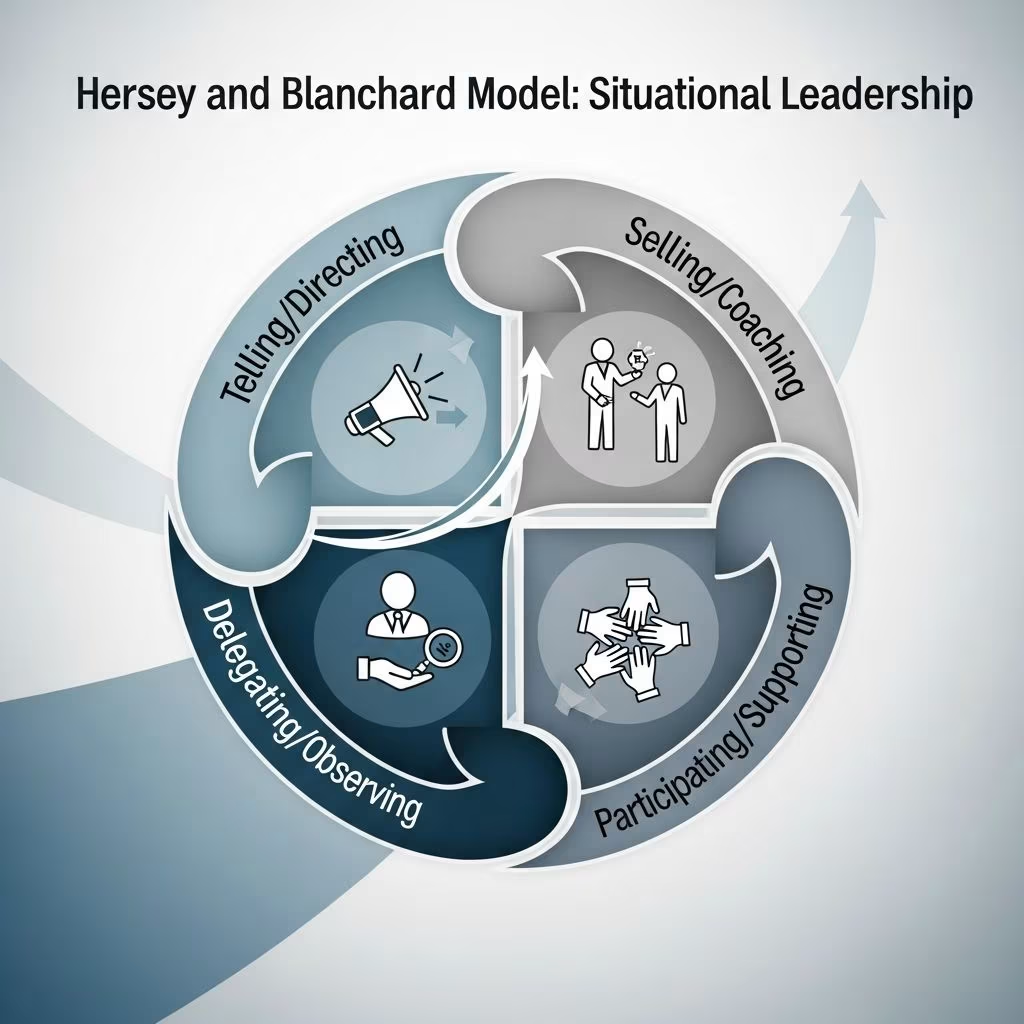
The Hersey and Blanchard Model defines four distinct leadership styles, each suited to different follower maturity levels. Leaders must understand these styles and know when to deploy each one effectively.
S1: Telling or Directing
The Telling or Directing leadership style places high emphasis on directive behavior and low emphasis on supportive behavior. In this style, the leader specifies what needs to be done and how to do it, with minimal focus on relationship building. The leader’s primary concern is task delivery rather than personal needs of subordinates.
Typical behaviors for S1 leaders include offering step-by-step instructions, providing clear explanations of consequences for non-performance, and maintaining close supervision. This style is particularly appropriate when tasks require clarity and the stages of the process must be easy to follow. Leaders employing this approach operate with the understanding that followers either do not know what to do or are unwilling and require a certain degree of directive guidance. While it may seem like micromanaging, in the proper context this style is not undesirable and serves important purposes.
S2: Selling or Coaching
The Selling or Coaching style represents a transition in leadership approach, combining high directive behavior with high supportive behavior. In this style, leaders motivate workers by selling them on the idea or setting the goal, with focus on both task and relationship behaviors. The leader continues to provide detailed instructions but also works to build confidence through praise and encouragement.
This approach suits followers who are willing to perform but lack the necessary ability or confidence. Leaders employing S2 behaviors offer praise for accomplishments to build workers’ confidence and help them develop their skills. The coach-like role emphasizes continued motivation while gradually increasing the follower’s competence. Leaders should be concerned with increasing the confidence and skills of followers so that they can ultimately take on more responsibility for their actions.
S3: Participating or Supporting
The Participating or Supporting leadership style shifts the balance significantly, emphasizing supportive behavior while reducing directive behavior. In this style, the leader works with followers on an equal footing and shares responsibility for making decisions. The focus places greater emphasis on relationship behavior than on task behavior.
At the S3 stage, followers have already developed the necessary skills to complete their tasks. Therefore, the leader should focus on providing feedback and support to motivate the employee and encourage greater development. Leaders provide feedback and praise as tasks are completed, helping followers maintain motivation and continue their professional growth. The leader becomes more of a facilitator and partner than a director, recognizing that followers have competence but may still need encouragement and collaborative support.
S4: Delegating
The Delegating style represents the culmination of the leadership progression, involving minimal direction and support. At the S4 level, the follower is already capable of performing their tasks independently. The leader should provide support when needed but also provide the follower with autonomy over their responsibilities.
In this style, the leader monitors progress but places the responsibility of accomplishing the task and making tactical decisions on the followers. Highly confident leaders may have no ongoing contact with the team, while others may expect progress reports. Leaders in the delegating mode recognize that their followers are confident, motivated, and strongly skilled—best described as ready, willing, and able. This approach maximizes employee autonomy and responsibility while maintaining accountability.
Follower Maturity Levels
The Hersey and Blanchard Model identifies four distinct maturity levels of followers, often referred to as readiness levels. Understanding these levels is essential for leaders to match their style appropriately.
M1 (R1): Unable and Unwilling
Followers at the M1 level lack both the ability and willingness to perform tasks independently. These individuals may be new to the organization or to specific tasks, with limited skills and potentially low motivation. M1 followers require close supervision, detailed instructions, and clear expectations. This level corresponds with the S1 Telling or Directing leadership style.
M2 (R2): Unable but Willing
M2 followers possess the motivation and willingness to perform but lack the necessary skills or experience. These individuals may be enthusiastic but need development and coaching. This level corresponds with the S2 Selling or Coaching style, where leaders build confidence while developing competence.
M3 (R3): Able but Unwilling
M3 followers are able to perform well on their tasks, having developed the necessary skill set, but are unwilling to do so. The reasons for this behavior are twofold: followers could be unmotivated to comply with the leader’s request or could still be nervous about performing the task without enough support and encouragement from the leader. These followers require supportive, participative leadership that addresses their concerns and rebuilds confidence. This level corresponds with the S3 Participating or Supporting style.
M4 (R4): Able and Willing
M4 followers are ready, able, and willing to perform. They are experienced at required tasks and comfortable with their own ability to do them well and independently. These followers are able and willing to not only do the task but to take responsibility for it. Both competence and commitment are considered high in this stage, making the S4 Delegating style most appropriate.
Matching Leadership Styles to Maturity Levels
The core principle of the Hersey and Blanchard Model is that leaders must align their behavioral approach to the maturity levels of followers. The model establishes clear pairings between leadership styles and follower maturity:
S1 (Telling) is most appropriate for M1 followers who require detailed direction and close supervision. S2 (Selling) is best suited for M2 followers who need continued instruction but also motivation and confidence building. S3 (Participating) works well with M3 followers who have competence but need supportive, collaborative leadership. S4 (Delegating) is ideal for M4 followers who possess both competence and commitment.
An important consideration is that this model tends to suit one-to-one, individual leadership rather than one-to-many leadership. Members of a team may differ significantly in their competence, confidence, and commitment, so one behavioral approach may not suit all of them. Leaders using this model must first figure out which category each team member belongs to, then flex their behavior to suit that individual, and finally recognize when that person has moved from one category to another and change leadership behavior accordingly.
The Progression Over Time
The Hersey and Blanchard Model demonstrates how leadership must evolve as employees develop. Consider a project team scenario: initially, the leader emphasizes directing, explaining tasks and establishing work schedules to get the group off the ground. As the team becomes familiar with project requirements, the leader transitions to a coaching role, offering praise and continuing to motivate the group. The leader gradually shifts to a supporting role, with increasingly skilled workers helping to make decisions about team progress. Eventually, the leader delegates most responsibility to the team, which has achieved high skill levels and can make many decisions about task completion.
This progression illustrates why leaders must remain flexible and attentive to employee development. Failing to adjust leadership style as employees mature can result in either micromanaging high-performers or abandoning struggling employees. The model emphasizes that flexibility and adaptability are hallmarks of effective leadership.
Key Advantages and Applications
The Hersey and Blanchard Model offers several significant advantages for organizational leaders. First, it provides a practical, repeatable process for matching leadership behaviors to performance needs. Unlike more theoretical frameworks, this model translates directly into actionable management practices.
Second, the model acknowledges that there is no one-size-fits-all approach to leadership. This recognition is particularly valuable in diverse teams where individual differences significantly impact performance. Leaders can tailor their approach to individual needs, increasing employee satisfaction and engagement.
Third, the model emphasizes employee development and growth. By progressing followers from lower to higher maturity levels, leaders create pathways for advancement and skill development. This approach supports both organizational objectives and employee career aspirations.
Frequently Asked Questions
Q: What is the primary focus of the Hersey and Blanchard Model?
A: The model focuses on adapting leadership styles based on the ability and willingness of individual employees. It recognizes that different employees require different leadership approaches depending on their maturity levels and performance needs.
Q: How many leadership styles does the Hersey and Blanchard Model identify?
A: The model identifies four leadership styles: Telling (S1), Selling (S2), Participating (S3), and Delegating (S4). Each style corresponds to different follower maturity levels and should be deployed appropriately.
Q: Can a leader use multiple leadership styles?
A: Yes, effective leaders using the Hersey and Blanchard Model typically employ all four styles throughout their careers and even within the same team. Different employees or situations require different approaches, and skilled leaders flex their style accordingly.
Q: What happens if a leader fails to adjust their style as employees develop?
A: If leaders maintain the same style regardless of employee development, they risk either stifling high performers through micromanagement or failing to support employees who need guidance. Misalignment between leadership style and employee maturity reduces effectiveness and engagement.
Q: Is the Hersey and Blanchard Model applicable to all types of organizations?
A: The model’s flexibility makes it applicable across various organizational contexts and industries. However, it works best in environments where leaders can maintain regular communication with individual team members and adjust their approach based on observed performance and development.
Q: How does the Hersey and Blanchard Model differ from other leadership theories?
A: Unlike trait-based or behavioral leadership theories that suggest universal leadership qualities, the Hersey and Blanchard Model emphasizes situational and contingency factors. It proposes that effective leadership is not about possessing certain traits but about adapting behaviors to match follower needs and circumstances.
References
- Hersey and Blanchard Situational Leadership Model EXPLAINED — Business to You. https://www.business-to-you.com/hersey-blanchard-situational-leadership-model/
- Hersey-Blanchard Model – Definition, How it Works — Corporate Finance Institute. https://corporatefinanceinstitute.com/resources/management/hersey-blanchard-model/
- Situational Leadership Theory — EBSCO Research Starters. https://www.ebsco.com/research-starters/social-sciences-and-humanities/situational-leadership-theory
- Situational Leadership® | What Is Situational Leadership® — Situational. https://situational.com/situational-leadership/
- Hersey and Blanchard’s Situational Leader — Aicura. https://www.aicura.com/eleadership/leadership-fundamentals/hersey-and-blanchards-situational-leader/
This article is general information, not personal financial advice. Consider your own situation, or speak with a licensed adviser, before acting on it.


