

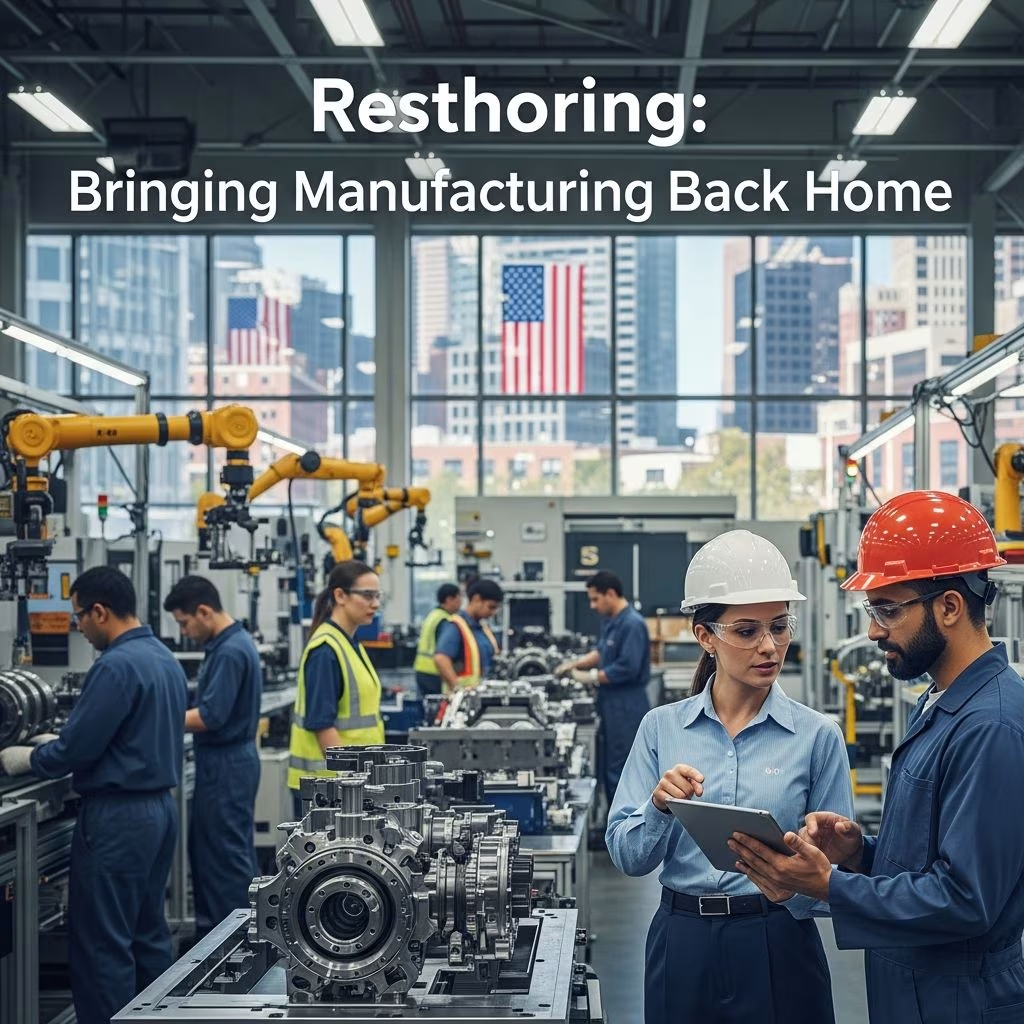
What Is Reshoring?
Reshoring, also known as backshoring, refers to the practice of moving manufacturing operations and production facilities back to a company’s home country after previously relocating them to foreign nations. This strategic reversal of offshoring represents a significant shift in global supply chain management and represents a growing trend among multinational corporations seeking to optimize their operations. Rather than continuing to manufacture goods in low-cost offshore locations, companies are increasingly reconsidering their production strategies and investing in domestic manufacturing capabilities.
The concept of reshoring has gained considerable attention in recent years as businesses face mounting pressures related to supply chain disruptions, rising labor costs in offshore markets, and changing geopolitical conditions. The COVID-19 pandemic particularly accelerated this trend, as companies recognized vulnerabilities in their extended global supply chains and the benefits of maintaining closer proximity to key markets.
Understanding the Reshoring Movement
Reshoring is fundamentally different from merely reducing offshoring activities. Research demonstrates that reshoring represents a deliberate and strategic decision to increase the domestic-to-foreign input ratio in production processes, capturing the essence of moving manufacturing operations back to the home country. This distinction is critical because a company might reduce offshoring due to changes in production scale or composition without actually reshoring operations.
The reshoring intensity varies significantly across different industries and countries. Some sectors, particularly those involving advanced manufacturing, electronics, and specialized components, have shown stronger reshoring trends than others. Understanding these patterns requires examining macro-level data that tracks the actual movement of production capacity rather than simply measuring reduced offshore investments.
Key Drivers of Reshoring
Multiple factors motivate companies to pursue reshoring strategies:
Supply Chain Resilience: Global supply chain disruptions have highlighted the vulnerabilities of extended manufacturing networks. Companies increasingly recognize that maintaining domestic production facilities provides greater control over inventory, quality, and delivery timelines. This factor became particularly acute during the pandemic when shipping delays and international logistics challenges threatened business continuity.
Labor Cost Dynamics: While offshoring was initially driven by lower labor costs in developing nations, this advantage has diminished considerably. Rising wages in traditional offshore manufacturing hubs like China and Southeast Asia, combined with currency fluctuations and increased competition for skilled labor, have narrowed the cost differential that once justified international relocation.
Automation and Technological Advancement: The rapid advancement of automation technologies has fundamentally changed the economic calculus of manufacturing location decisions. Modern robotic systems and artificial intelligence can perform tasks previously requiring large labor forces, reducing the labor cost advantage of offshore production. This technological shift particularly impacts emerging and developing economies that previously relied on labor cost advantages.
Geopolitical Considerations: Trade tensions, tariff impositions, and changing international relations have prompted companies to reconsider offshore production strategies. Governments implementing protectionist policies or imposing tariffs on imported goods create financial incentives for domestic production.
Sustainability and Environmental Concerns: Growing consumer demand for environmentally responsible manufacturing and reduced carbon footprints associated with long-distance shipping incentivizes companies to localize production near consumption markets.
Benefits of Reshoring
Companies pursuing reshoring strategies stand to gain numerous advantages:
Improved Quality Control: Bringing production closer to home enables more direct oversight and quality assurance. Manufacturers can implement rigorous quality standards and respond quickly to defects or design modifications without the delays inherent in international production.
Faster Time to Market: Reduced shipping times and simpler logistics enable companies to respond more rapidly to market demands and consumer preferences. This agility proves particularly valuable in industries with short product lifecycles or seasonal variations.
Reduced Transportation Costs: Eliminating or reducing long-distance shipping substantially decreases transportation expenses and associated environmental impacts. Nearshoring and reshoring reduce the logistics complexity that characterizes globally distributed supply chains.
Enhanced Supply Chain Security: Domestic production reduces dependence on international suppliers and mitigates risks associated with geopolitical instability, trade policy changes, or natural disasters in offshore locations.
Job Creation: Reshoring initiatives generate employment opportunities in manufacturing sectors, supporting local economies and contributing to economic growth in home countries. This advantage extends beyond direct manufacturing jobs to include supporting industries and services.
Intellectual Property Protection: Maintaining production domestically better protects proprietary technologies, designs, and manufacturing processes from unauthorized replication or theft.
Challenges and Limitations of Reshoring
Despite its advantages, reshoring presents significant obstacles that companies must carefully evaluate:
Higher Labor Costs: Domestic labor typically commands substantially higher wages than offshore alternatives. Even with automation reducing labor requirements, the wage differential can significantly impact production costs and profitability.
Workforce Availability: Many developed economies lack sufficient skilled manufacturing workers, creating challenges in scaling domestic production. Workforce development and training programs require substantial time and investment to build adequate human capital.
Capital Investment Requirements: Establishing or expanding domestic manufacturing facilities demands considerable capital expenditure. Companies must invest in facilities, equipment, technology infrastructure, and workforce training, with returns on investment often requiring several years to materialize.
Regulatory Compliance: Domestic manufacturing involves navigating complex regulatory environments, environmental standards, and labor regulations that may be more stringent than those in offshore locations. Compliance costs can be substantial and ongoing.
Limited Cost Competitiveness: Higher domestic labor and operational costs may render products uncompetitive in price-sensitive markets, potentially limiting market share and profitability for cost-conscious consumers.
Partial Production Constraints: Complete reshoring is rarely feasible for companies with complex global supply chains. Many firms pursue hybrid approaches, maintaining some offshore production while reshoring specific components or final assembly operations.
Reshoring vs. Nearshoring
Companies pursuing domestic production strategies often consider nearshoring as an alternative or complementary approach. Nearshoring involves relocating production to nearby countries rather than the home country itself, balancing some advantages of domestic production with lower costs than full reshoring.
Nearshoring offers middle-ground benefits: reduced shipping times and costs compared to distant offshore production, lower labor costs than domestic manufacturing, and simplified supply chain management compared to distant suppliers. Mexico has emerged as a popular nearshoring destination for U.S. companies, while Central European nations attract reshoring and nearshoring from Western Europe.
Economic Impact and Global Trends
Reshoring trends vary considerably across countries and industries. Research examining reshoring intensity at macro-levels reveals significant variation in reshoring patterns from China and other traditional offshore manufacturing hubs. Some developed economies have experienced more substantial reshoring activity than others, influenced by factors including government incentives, wage structures, automation adoption rates, and supply chain vulnerabilities specific to particular industries.
The relationship between automation and reshoring presents complex dynamics. While automation reduces labor cost advantages of offshore production, enabling reshoring feasibility, it also reduces employment requirements in reshored operations. This pattern particularly impacts unskilled and semi-skilled workers in both developed and developing economies.
Government policies increasingly influence reshoring decisions. Incentive programs, tax breaks, infrastructure investments, and protective tariffs shape corporate location decisions. Some governments actively promote reshoring through targeted policy initiatives aimed at rebuilding domestic manufacturing capacity.
Industry-Specific Reshoring Patterns
Reshoring activity concentrates in particular sectors characterized by high automation potential, technology intensity, or supply chain complexity. Advanced manufacturing, electronics, automotive components, pharmaceuticals, and specialized industrial equipment represent sectors experiencing notable reshoring trends.
Industries with just-in-time production requirements, short product lifecycles, or high customization demands benefit particularly from reshoring’s advantages. Conversely, labor-intensive industries with standardized products and minimal technological requirements maintain stronger offshore production orientations.
Future Outlook for Reshoring
Reshoring momentum appears likely to continue as companies respond to evolving economic conditions and geopolitical considerations. Continued advancement in automation technologies will further reduce labor cost advantages of offshore production, while persistent supply chain vulnerabilities reinforce the appeal of domestic production. Additionally, sustainability concerns and consumer preferences for locally-manufactured products will likely support continued reshoring momentum.
However, complete reversal of offshoring trends remains unlikely. Most companies will likely pursue hybrid strategies combining domestic production with selective offshore operations. The optimal production location strategy will continue varying by product, industry, and company-specific circumstances.
Frequently Asked Questions
Q: What is the difference between reshoring and backshoring?
A: Reshoring and backshoring are generally used interchangeably, both referring to the relocation of manufacturing operations back to a company’s home country after previous offshore relocation. The terms describe the same strategic shift in production location.
Q: Why do companies choose reshoring over maintaining offshore production?
A: Companies pursue reshoring due to supply chain vulnerabilities, rising offshore labor costs, automation reducing labor cost advantages, geopolitical considerations, quality control benefits, and proximity to key markets enabling faster response to consumer demands.
Q: Does reshoring reduce manufacturing employment despite creating new jobs?
A: Reshoring typically creates fewer jobs than original offshore operations due to automation. While employment opportunities emerge, they often require different skill sets than traditional manufacturing roles, creating both opportunities and challenges in workforce adaptation.
Q: How does automation affect reshoring decisions?
A: Advanced automation technologies reduce labor cost advantages of offshore production, making domestic manufacturing economically viable. However, automated facilities require fewer workers than traditional manufacturing, moderating employment gains from reshoring.
Q: Is reshoring a permanent trend or temporary response to current conditions?
A: Reshoring appears to represent a structural shift in manufacturing strategy rather than a temporary trend. Ongoing automation, supply chain emphasis on resilience, and geopolitical considerations suggest continued reshoring momentum, though complete reversal of offshoring is unlikely.
Q: How do government policies influence reshoring decisions?
A: Government incentives, tax provisions, tariff policies, and infrastructure investments significantly influence corporate location decisions. Supportive policies can accelerate reshoring by improving the economic viability of domestic production.
References
- Quantifying reshoring at the macro-level—Measurement and applications — Wiley Online Library. 2021-07-06. https://doi.org/10.1111/grow.12513
- Robots and reshoring: Evidence from Mexican labor markets — Journal of International Economics. https://doi.org/10.1016/j.jinteco.2020.103384
- Trading Tasks: A Simple Theory of Offshoring — American Economic Review. https://doi.org/10.1257/aer.98.5.1978
- Robots, reshoring, and the lot of low-skilled workers — European Economic Review. https://doi.org/10.1016/j.euroecorev.2021.103744
- Backshoring and nearshoring: An overview — Wiley Online Library. https://doi.org/10.1111/grow.12316
- Repatriation or Reshoring of Manufacturing to the U.S. and UK: Dynamics and Global Production Networks — Wiley Online Library. https://doi.org/10.1111/grow.12224
- Global Value Chains, the Rise of the Robots and Human Capital — Springer. https://doi.org/10.1007/s10273-018-2276-9
This article is general information, not personal financial advice. Consider your own situation, or speak with a licensed adviser, before acting on it.


