

What Is the Barbell Strategy?
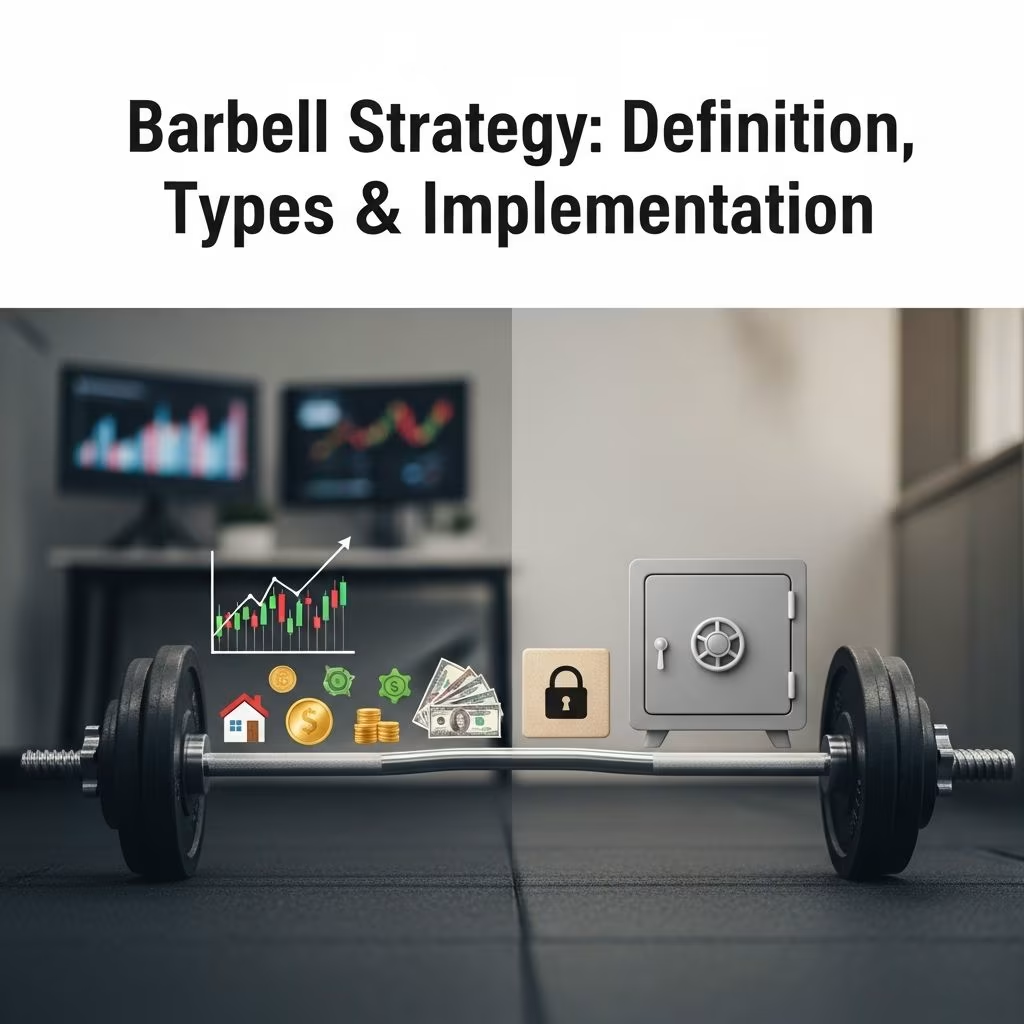
The barbell strategy is a portfolio management approach that divides investments between two opposite ends of the risk and maturity spectrum while avoiding exposure to middle-ground assets. Rather than spreading investments evenly across all asset classes, the barbell strategy concentrates capital in assets at both extremes: high-growth, high-risk investments on one end and stable, income-generating, low-risk investments on the other end. This creates a portfolio structure that resembles a barbell, with concentrated weights at both ends and minimal allocation to intermediate-risk assets.
The strategy is designed to capture superior returns from long-term growth trends while simultaneously generating stable income to mitigate short-term market volatility. By deliberately avoiding middle-ground investments, the barbell approach allows investors to maintain strong conviction in their highest-conviction opportunities while protecting their portfolio with defensive, income-producing assets.
How Does the Barbell Strategy Differ From a Balanced Portfolio?
While both the barbell strategy and balanced portfolios aim to manage risk, they approach portfolio construction fundamentally differently. A balanced portfolio typically allocates assets across a wide spectrum of stocks, bonds, real estate, and alternative investments to create stability through diversification across many different risk-reward profiles.
The key distinction is that balanced portfolios distribute capital more evenly across the entire spectrum of available investments. This approach tends to result in more moderate returns, as the portfolio captures neither the full upside of growth assets nor the maximum income protection of defensive assets. In contrast, the barbell strategy takes concentrated positions at both ends of the spectrum, allowing investors to pursue stronger convictions while maintaining downside protection through strategic income-generating holdings.
Additionally, balanced portfolios maintain relatively static allocations regardless of market conditions or conviction levels, whereas the barbell strategy allows for much greater flexibility in adjusting weightings based on market outlook and investor objectives.
Components of a Barbell Strategy
The barbell strategy consists of two primary components that work together to create a resilient portfolio structure:
The Growth Component
The growth side of the barbell focuses on high-conviction secular growth trends and companies that capitalize on irreversible, long-term economic shifts. These investments typically include stocks in sectors benefiting from digital transformation, technological innovation, and structural economic changes.
Quality growth companies within this component typically demonstrate several characteristics: strong profitability, resilient earnings quality, and the ability to sustain performance through market uncertainties. Investors using the barbell strategy often employ frameworks like the I.D.E.A. acronym to identify suitable growth holdings: Innovators (companies creating new markets), Disruptors (companies disrupting existing industries), Enablers (companies providing infrastructure for growth), and Adapters (established companies successfully adapting to new trends).
The growth component is intentionally weighted to be aggressive, capturing the full upside of market outperformance during favorable conditions while accepting the volatility that accompanies higher-growth investments.
The Income Component
The second half of the barbell strategy focuses on income-producing assets that provide downside protection and stability. This component typically includes dividend-paying equities, real estate investment trusts (REITs), and investment-grade corporate bonds. These assets generate consistent income streams that cushion portfolio performance during market downturns.
The income component offers several protective benefits: dividend payments provide tangible returns independent of stock price appreciation, bonds offer contractual income obligations regardless of market conditions, and REITs typically distribute significant portions of their earnings as dividends. By concentrating in high-quality income assets, investors can reduce portfolio volatility while maintaining positive returns even during periods of market stress.
Fixed Income Barbell Strategy
The barbell strategy originated in fixed income portfolio management and remains widely used in bond investing today. The fixed income barbell involves purchasing bonds exclusively at two ends of the maturity spectrum while avoiding intermediate-term bonds entirely.
Short-Term Bond Holdings
Short-term bonds typically have maturities ranging from three months to three years. These bonds offer several advantages within a barbell structure: They provide portfolio flexibility, allowing investors to reinvest maturing principal quickly if market conditions change or better opportunities emerge. They exhibit lower interest rate sensitivity, meaning their prices fluctuate less dramatically when rates move. Short-term bonds also allow investors to capitalize on rising interest rate environments by reinvesting principal at higher yields.
Long-Term Bond Holdings
Long-term bonds typically have maturities of seven to ten years or longer. Within the barbell structure, long-term bonds serve multiple purposes: They offer significantly higher yields to compensate investors for extended interest rate risk. They allow investors to lock in yields if interest rates decline, protecting income levels in falling rate environments. Long-term bonds provide portfolio stability through lower price volatility relative to equities, even as rates fluctuate.
The Avoided Middle Ground
The critical distinction in the fixed income barbell is the deliberate avoidance of intermediate-term bonds (typically four to six years). By concentrating exclusively at both ends of the maturity spectrum, investors achieve better portfolio positioning for specific market scenarios. The yields on intermediate bonds rarely justify the interest rate risk they carry, making them inefficient holdings within a barbell framework.
Advantages of the Barbell Strategy
The barbell strategy offers several compelling advantages that explain its popularity among sophisticated investors:
Access to Higher Yields
By concentrating in long-term bonds and high-growth equities, investors gain exposure to the highest-yielding investments available. Long-term bonds compensate investors for extended interest rate risk through higher coupon payments, while growth stocks offer superior total return potential. This dual exposure allows investors to capture returns that a more conservative portfolio might forgo.
Reduced Downside Risk
The strategic combination of growth and income assets creates natural risk-reduction dynamics. Short-term bonds and dividend-paying stocks tend to move independently from each other and from long-term bonds. When equity markets struggle, income-producing assets often maintain stability. When interest rates rise, short-term bonds recover quickly, providing reinvestment opportunities. This negative correlation between asset classes at opposite ends of the spectrum reduces overall portfolio downside risk.
Superior Risk-Adjusted Returns
By taking strong convictions in high-conviction opportunities while protecting downside with defensive assets, the barbell strategy can deliver superior risk-adjusted returns compared to more balanced approaches. The strategy captures growth upside while limiting downside losses through the income component.
Portfolio Flexibility
The barbell approach allows substantial flexibility in adjusting allocations based on market conditions and investor outlook. Weightings between growth and income components can be adjusted tactically without requiring fundamental portfolio restructuring. This flexibility enables responsive management as market conditions evolve.
Challenges and Considerations
While the barbell strategy offers significant advantages, investors should understand its limitations:
Yield Curve Sensitivity
The biggest challenge for fixed income barbell strategies occurs when the yield curve steepens significantly, widening the spread between short-term and long-term bond yields. In steepening environments, intermediate-bond strategies (called “bullet” strategies) often outperform barbell approaches. Conversely, the barbell tends to outperform during flattening yield curve environments.
Complexity and Expertise Requirements
Effectively implementing a barbell strategy requires substantial investment expertise and resources. Identifying truly high-conviction growth opportunities requires deep research capabilities. Managing the dynamic rebalancing between components demands active oversight and decision-making. Investors lacking the necessary expertise may struggle to capture the potential benefits.
Market Timing Risks
The barbell strategy’s effectiveness depends partially on correctly identifying secular growth trends and market cycle positioning. Misjudgments about which sectors will outperform or when market conditions will shift can result in underperformance relative to more balanced approaches.
Barbell Strategy vs. Other Bond Portfolio Approaches
The barbell strategy exists within a broader landscape of fixed income portfolio management techniques. Understanding how it compares to alternative approaches helps investors select appropriate strategies:
| Strategy | Structure | Best Performance | Key Benefit | Primary Risk |
|---|---|---|---|---|
| Barbell | Concentrated at short and long-term ends | Flattening yield curve | High yields + flexibility | Steepening yield curve |
| Bullet | Concentrated at intermediate term | Steepening yield curve | Predictable income | Limited flexibility |
| Ladder | Evenly distributed across maturities | Rising rate environments | Systematic rebalancing | Opportunity cost in declining rates |
Implementing a Barbell Strategy
Retail investors can implement barbell strategies through several accessible vehicles:
Individual Securities
Direct purchasing of individual stocks and bonds offers complete control over portfolio composition. Investors can select specific high-conviction growth stocks and income-producing dividend stocks, paired with individual bonds across their desired maturity spectrum. This approach requires significant research capability and ongoing monitoring but provides maximum flexibility.
Exchange-Traded Funds (ETFs)
ETFs provide diversified exposure to growth and income themes through single securities. Growth-focused ETFs, dividend ETFs, and bond ETFs at various maturity points allow investors to implement barbell strategies with lower costs and simplified management compared to individual security selection.
Unit Trusts and Mutual Funds
Professionally managed funds dedicated to barbell strategies offer expert implementation without requiring individual investment expertise. These vehicles handle security selection, rebalancing, and tactical adjustments based on professional managers’ market outlook.
Taleb’s Barbell Strategy for Risk Management
Nassim Taleb, renowned risk management theorist, developed a specific barbell framework focused on protecting against “black swan” events—extreme, unpredictable market occurrences. Taleb’s barbell divides portfolios into two halves: one consisting of very low-risk investments such as cash equivalents or short-term government bonds, and the other consisting of very high-risk, potentially high-return assets such as venture capital or deep out-of-the-money options.
This approach aims to achieve portfolio resilience by accepting that extreme events will occur while positioning to benefit from either highly probable modest outcomes or rare extreme positive outcomes, while minimizing exposure to likely negative outcomes. This framework emphasizes that the middle ground—moderate-risk investments—offers the worst risk-reward profile for most investors.
When to Use a Barbell Strategy
The barbell strategy proves particularly valuable in specific market environments and for investors with particular objectives:
Rising or High Interest Rate Environments
When interest rates are elevated or expected to rise, the barbell’s short-term component allows investors to benefit from rate increases while locking in higher yields in the long-term portion. This positioning captures the best of both rate scenarios.
Uncertain Economic Outlooks
When economic direction is unclear, the barbell’s dual focus on growth and income provides balanced positioning. If growth accelerates, the growth component captures upside. If economic conditions deteriorate, the income component provides stability.
Long-Term Wealth Accumulation
Investors pursuing long-term wealth accumulation benefit from the barbell’s growth focus while maintaining downside protection. This combination supports consistent wealth building through market cycles.
Frequently Asked Questions
What is the main difference between a barbell portfolio and a ladder portfolio?
While both involve purchasing bonds with different maturities, a ladder distributes holdings evenly across the maturity spectrum, whereas a barbell concentrates exclusively at short and long-term ends while avoiding intermediate bonds.
Can individual investors implement a barbell strategy?
Yes, retail investors can implement barbell strategies using individual stocks, ETFs, unit trusts, or combinations thereof. ETFs and mutual funds offer simplified implementation for investors lacking extensive research capabilities.
What happens to barbell strategies when the yield curve steepens?
Barbell strategies typically underperform when the yield curve steepens significantly, as intermediate-term bonds (which barbell strategies avoid) often outperform in such environments.
How should investors adjust barbell strategies as interest rates fall?
As interest rates decline, investors utilizing barbell approaches should gradually shift more maturing principal back toward longer-term bonds to maintain adequate income exposure in a lower-rate environment.
Is the barbell strategy appropriate for all investors?
The barbell strategy requires investment expertise and active management to implement effectively. It works best for investors with sufficient knowledge, time, or resources to manage the approach properly, or those using professionally managed vehicles.
What are black swan events, and how does Taleb’s barbell protect against them?
Black swan events are extreme, unpredictable market occurrences. Taleb’s barbell protects by concentrating in very low-risk assets and high-potential-return assets, avoiding middle-ground investments that offer poor risk-reward profiles during extreme events.
References
- The Barbell Strategy and How Do You Go About Adopting It? — DBS Bank Singapore. 2024. https://www.dbs.com.sg/personal/articles/nav/investing/the-barbell-strategy
- Barbell Bond Portfolio — Financial Edge. 2024-10-17. https://www.fe.training/free-resources/portfolio-management/barbell-bond-portfolio/
- Barbell Strategy — Corporate Finance Institute. 2024. https://corporatefinanceinstitute.com/resources/career-map/sell-side/capital-markets/barbell-strategy/
- Making Private Markets Work in a Barbell Strategy — Invesco Canada. 2024. https://www.invesco.com/ca/en/insights/making-private-markets-work-in-a-barbell-strategy.html
- Which Bond Strategy Is Right for You? — Charles Schwab. 2024. https://www.schwab.com/learn/story/which-bond-strategy-is-right-you
This article is general information, not personal financial advice. Consider your own situation, or speak with a licensed adviser, before acting on it.


