

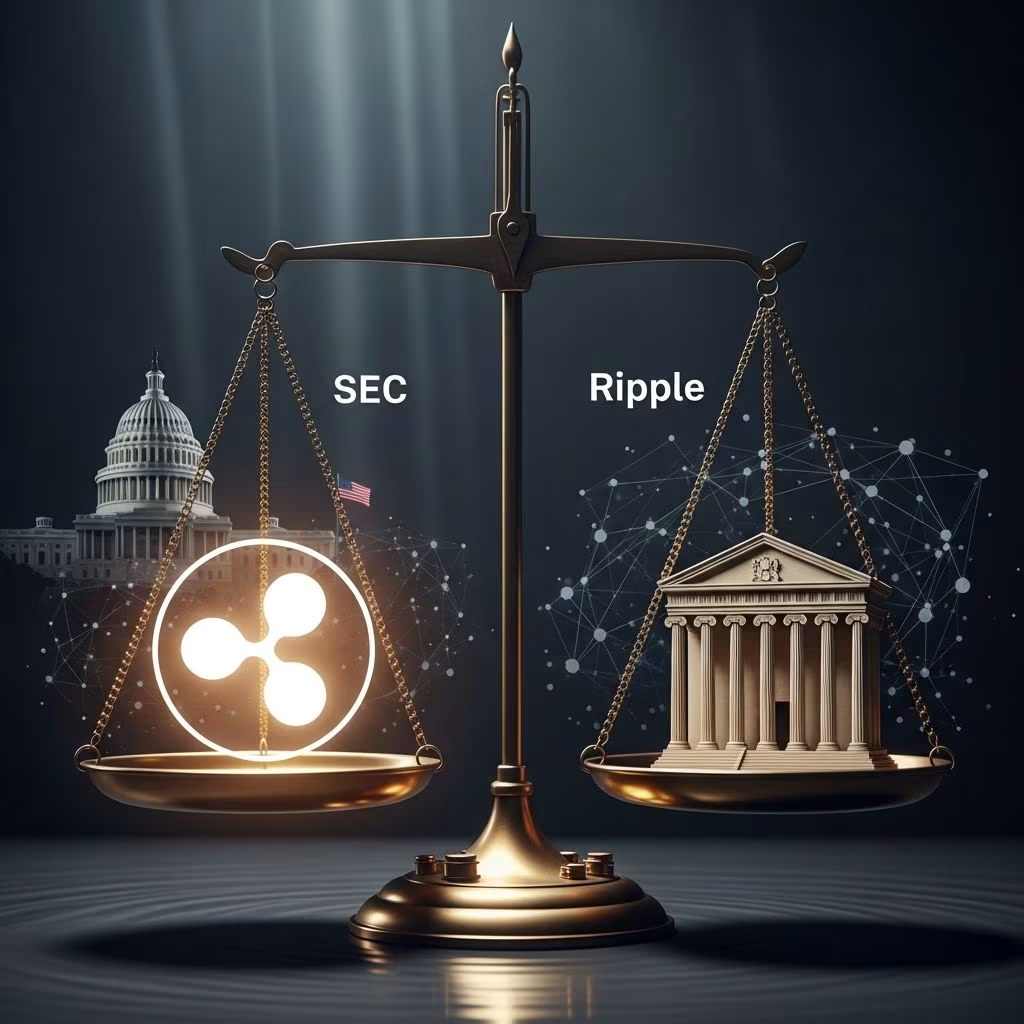
SEC vs. Ripple: Understanding the Landmark Cryptocurrency Legal Battle
The Securities and Exchange Commission’s lawsuit against Ripple Labs represents one of the most significant regulatory actions in the cryptocurrency industry. Filed in December 2020, the case challenges whether XRP, Ripple’s digital asset, should be classified as a security under federal law. This landmark litigation has profound implications for cryptocurrency regulation, investor protection, and the future of digital assets in the United States.
The Origins of the SEC’s Legal Action
On December 22, 2020, the SEC announced charges against Ripple Labs Inc., co-founder Christian Larsen, and CEO Bradley Garlinghouse, alleging that the company conducted a $1.3 billion unregistered securities offering. The regulatory agency claimed that Ripple raised capital by selling XRP tokens beginning in 2013 without proper registration or exemption from registration requirements under federal securities laws.
The complaint alleged that Ripple sold XRP to investors in the United States and worldwide through various channels, including direct institutional sales and distributions on digital asset exchanges. Additionally, the SEC charged that Larsen and Garlinghouse personally engaged in unregistered sales of XRP totaling approximately $600 million.
Key Allegations Against Ripple
The SEC’s complaint outlined several specific allegations regarding Ripple’s conduct:
Unregistered Securities Offerings
The primary allegation centered on Ripple’s failure to register its XRP offerings. The SEC argued that XRP qualified as an investment contract under the Howey Test, a legal standard established to determine whether an instrument constitutes a security. According to the SEC’s position, Ripple offered XRP to retail investors without providing the necessary disclosures required for registered securities offerings.
Institutional Sales and Market Manipulation
The SEC alleged that Ripple sold approximately $728.9 million worth of XRP to institutional counterparties, including hedge funds and On-Demand Liquidity (ODL) customers, through written contracts. These institutional sales were characterized as distributions into public markets designed to create liquidity and trading activity.
Distribution for Services
Ripple allegedly recognized $609 million in revenue from distributing XRP to individuals and entities in exchange for services, including market-making and development work. The SEC contended these transactions constituted unregistered securities offerings by disguising sales as compensation arrangements.
Executives’ Personal Sales
Beyond corporate sales, the SEC alleged that Larsen and Garlinghouse sold XRP from their personal holdings for approximately $600 million combined without filing registration statements or complying with securities registration requirements.
The Howey Test and Investment Contract Classification
Central to the SEC’s case was the application of the Howey Test, derived from SEC v. W.J. Howey Co. (1946). This test determines whether an instrument constitutes an investment contract by examining whether there is: (1) an investment of money, (2) in a common enterprise, (3) with an expectation of profits, (4) derived from the efforts of others.
The SEC argued that XRP transactions met all four prongs of the Howey Test, particularly emphasizing Ripple’s efforts to develop the XRP Ledger network and promote XRP’s adoption, which allegedly created reasonable expectations of profit for investors. Ripple, conversely, contended that XRP functioned as a currency and utility token rather than an investment contract, with holders deriving value from use rather than from Ripple’s efforts.
Ripple’s Defense Arguments
Ripple’s legal strategy centered on several key contentions:
XRP as a Utility Token
Ripple argued that XRP functioned primarily as a utility token facilitating transactions on the XRP Ledger, not as an investment vehicle. The company emphasized that XRP holders could use tokens for payments and transfers without relying on Ripple’s continued efforts or business success.
Notice Defense
Ripple asserted a notice defense, claiming the company lacked adequate notice that its conduct violated securities laws. The company argued that regulatory guidance on cryptocurrency was insufficient and ambiguous at the time of XRP sales, making compliance uncertain.
Secondary Market Sales
Ripple distinguished between its own sales and secondary market trading, arguing that once XRP entered circulation, subsequent transactions on exchanges occurred independent of Ripple’s involvement or control, thus falling outside securities regulation.
Court Proceedings and Legal Developments
The lawsuit progressed through federal court in the Southern District of New York, with Judge Analisa Torres presiding. Key procedural developments included:
Summary Judgment Motions
Both parties filed motions for summary judgment, asking the court to rule on portions of the case without proceeding to trial. These motions focused on whether XRP constituted a security and whether specific transactions violated securities laws.
Affirmative Defenses
In March 2022, the court denied the SEC’s motion to strike Ripple’s notice defense, allowing the company to proceed with arguments that it lacked clear notice of legal violations—a potentially significant development for Ripple’s case.
Contract Requirements
The court addressed whether investment contracts required written agreements between parties. Judge Torres rejected arguments that all investment contracts must include post-sale obligations and profit-sharing rights, adopting a broad interpretation of the Howey Test consistent with investor protection objectives.
The Institutional Sales Question
A critical issue in the litigation involved Ripple’s institutional sales—transactions with institutional buyers through written contracts. The SEC characterized these sales as distributions into public markets through conduits, arguing that even though institutional investors may be sophisticated, the ultimate purchasers on secondary markets included retail investors who lacked adequate disclosures.
Ripple countered that institutional sales to sophisticated buyers under written contracts differed fundamentally from retail offerings, potentially qualifying for exemptions from registration. The company also noted that many institutional buyers were ODL customers using XRP for actual payment settlement rather than investment purposes.
Secondary Market Trading Considerations
The litigation raised important questions about whether secondary market trading of XRP—transactions on digital asset exchanges where neither buyer nor seller was Ripple itself—constituted unregistered securities offerings. The court’s reasoning on this issue would have significant implications for how cryptocurrency trading platforms operate and whether all XRP transactions required registration.
Regulatory Implications and Broader Cryptocurrency Industry Impact
The SEC vs. Ripple case generated significant implications extending beyond the specific allegations:
Securities Classification of Cryptocurrencies
The lawsuit highlighted regulatory uncertainty regarding whether cryptocurrencies constitute securities. A finding that XRP qualifies as a security could establish precedent affecting other tokens and digital assets, potentially requiring many cryptocurrency projects to comply with securities registration and disclosure requirements.
Investor Protection Standards
The case underscored the SEC’s commitment to extending traditional securities protections to cryptocurrency investors. The agency emphasized that retail investors purchasing tokens deserve disclosures regarding business operations, financial conditions, and risks—protections long established for traditional securities.
Compliance Challenges
Cryptocurrency companies faced compliance uncertainty, with the case demonstrating regulatory willingness to pursue retroactive enforcement against conduct previously perceived as acceptable. The lack of clear ex-ante guidance created liability risks for companies that had conducted XRP sales without securities registration.
Frequently Asked Questions About SEC vs. Ripple
Q: What is the primary accusation against Ripple?
A: The SEC alleges Ripple conducted a $1.3 billion unregistered securities offering through XRP sales beginning in 2013, violating federal securities registration requirements without qualifying for exemptions.
Q: How did Ripple distribute XRP besides direct sales?
A: Ripple distributed XRP in exchange for services including market-making, development, and liquidity provision, recognizing approximately $609 million in revenue from these distributions.
Q: What is the Howey Test and why does it matter?
A: The Howey Test determines whether something constitutes a security by examining whether there is an investment of money in a common enterprise with profit expectations derived from others’ efforts. The SEC used this test to argue XRP qualifies as a security.
Q: What was Ripple’s primary defense argument?
A: Ripple argued XRP functions as a utility token facilitating transactions rather than an investment contract, and claimed insufficient regulatory notice that its conduct violated securities laws.
Q: How much did executives personally profit from XRP sales?
A: The SEC alleged that Larsen and Garlinghouse collectively sold approximately $600 million in XRP from their personal holdings without proper registration.
Q: What are the potential implications for other cryptocurrencies?
A: The case could establish precedent for classifying other tokens as securities, potentially requiring many cryptocurrency projects to comply with traditional securities regulations and disclosure requirements.
Significance for Cryptocurrency Investors
The SEC vs. Ripple litigation carries substantial implications for cryptocurrency investors. A determination that XRP constitutes a security could validate investor protection arguments, ensuring that XRP purchasers received or should have received disclosures about Ripple’s business and financial condition. Conversely, a ruling favoring Ripple might strengthen arguments that certain cryptocurrencies fall outside securities regulation, potentially reducing disclosure obligations and regulatory oversight.
Investors should recognize that the regulatory classification of digital assets remains unsettled, creating ongoing uncertainty about the legal status of their holdings and the protections afforded to them. The SEC’s aggressive enforcement posture in this case signals that regulatory agencies will pursue retroactive enforcement against conduct not clearly compliant with existing standards.
References
- SEC Charges Ripple and Two Executives with Conducting $1.3 Billion Unregistered Securities Offering — U.S. Securities and Exchange Commission. 2020-12-22. https://www.sec.gov/newsroom/press-releases/2020-338
- SEC v. Ripple Labs, Inc. — Summary Judgment Opinion — U.S. District Court, Southern District of New York. 2023-07-13. https://www.nysd.uscourts.gov/sites/default/files/2023-07/SEC%20vs%20Ripple%207-13-23.pdf
- Securities Act of 1933, Section 5 — Registration of Securities — U.S. House of Representatives Office of the Law Revision Counsel. https://www.law.cornell.edu/uscode/text/15/77e
This article is general information, not personal financial advice. Consider your own situation, or speak with a licensed adviser, before acting on it.


