

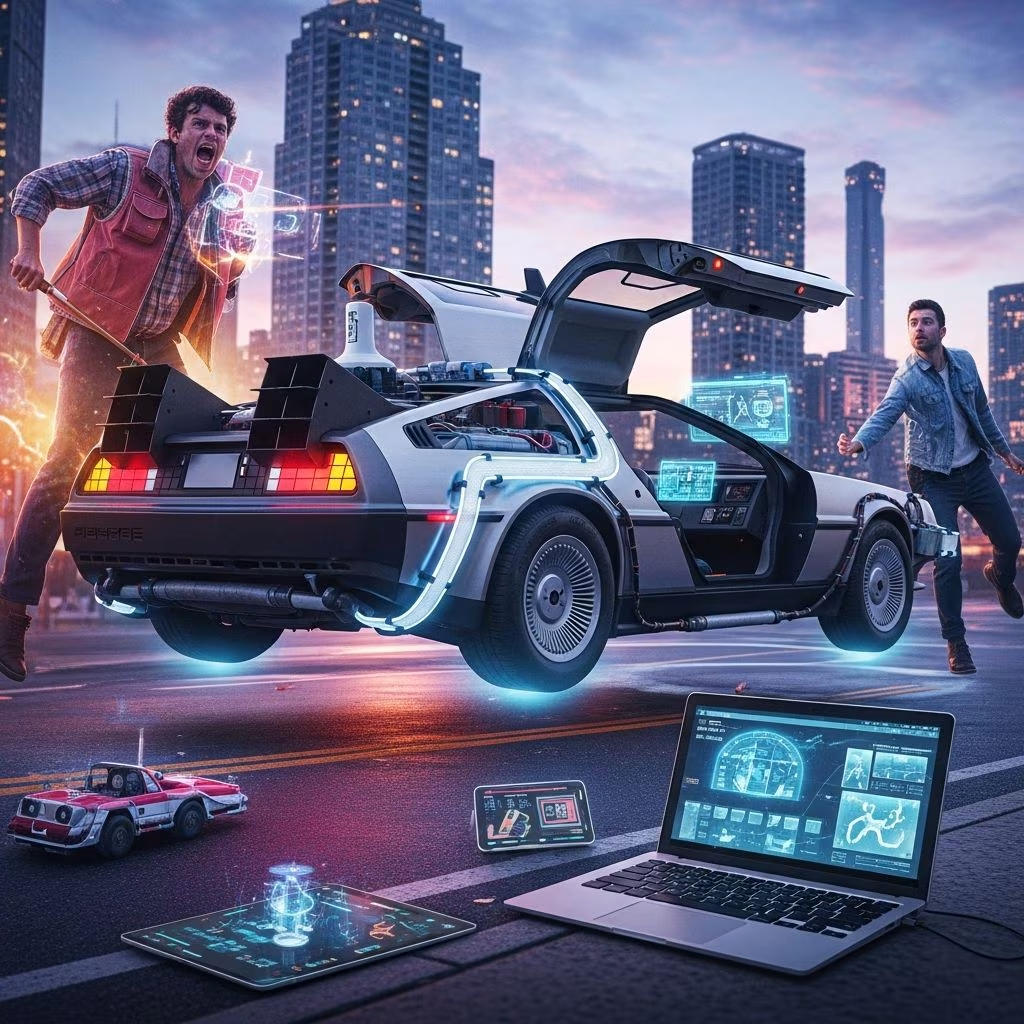
Back to the Future Day: 10 Predictions That Came True
October 21, 2015, marked a historic milestone for fans of the beloved 1989 film “Back to the Future Part II.” On this date, protagonist Marty McFly and his mentor Doc Brown arrived in the future using their iconic DeLorean time machine. While the film’s depiction of 2015 included some wildly inaccurate predictions—flying cars and hoverboards remain firmly in the realm of fantasy—numerous technological forecasts proved surprisingly prescient. This analysis examines the predictions that director Robert Zemekis and screenwriter Bob Gale got right, demonstrating that Hollywood’s vision of the future wasn’t entirely off base.
1. Personal Drones
One of the most visually striking predictions in “Back to the Future Part II” involves the widespread use of drones throughout 2015. In the film, drones are shown performing mundane tasks like walking dogs and capturing aerial footage for news organizations. While robotic dog walkers haven’t become mainstream, the prediction about drones in journalism proved remarkably accurate.
By 2015, personal drones had become widely available to consumers, with many priced around $1,000. News organizations rapidly adopted drone technology for capturing aerial photography and filming, enabling journalists to access perspectives previously impossible without expensive helicopter rentals. Beyond journalism, drones have revolutionized numerous industries, from agriculture and construction to delivery services and entertainment. The film’s vision of unmanned aerial vehicles as ubiquitous tools in everyday life has largely materialized, albeit with different applications than those originally depicted.
2. Tablets and Mobile Payment Technology
Perhaps one of the most impressive predictions involves mobile technology and wireless payment systems. In “Back to the Future Part II,” characters conduct transactions using wireless handheld devices that resemble modern tablets. One memorable scene features a character using a tablet-like device to electronically sign a document for a donation request.
This prediction proved remarkably accurate. The introduction of the iPad in 2010 and subsequent tablet devices validated the film’s vision of portable computing. However, the most significant validation came through mobile payment technology. The film predicted that wireless devices could facilitate payments in settings like taxi cabs, a prediction that manifested through applications such as Venmo, Apple Pay, Square, and Starbucks app. These platforms enable users to transfer money and make purchases using their smartphones, often incorporating biometric authentication methods like fingerprint recognition. The film’s screenwriters could scarcely have imagined how seamlessly mobile payments would integrate into daily transactions or how ubiquitous smartphone adoption would become.
3. Biometric Devices
Fingerprint recognition technology features prominently throughout “Back to the Future Part II,” particularly in a scene where Marty’s girlfriend Jennifer uses her thumbprint to unlock her house door in 2015. This prediction has become an integral part of contemporary security systems.
Today, biometric authentication methods have become standard across numerous devices and services. Smartphones like the iPhone incorporate fingerprint scanners for unlocking devices and authorizing payments. Banks and financial institutions utilize biometric measures for accessing account information and executing transactions. Home security systems now commonly employ fingerprint recognition for access control. However, the film inadvertently predicted another aspect of biometric technology: the vulnerability of such systems. While the movie humorously depicted fingerprint theft through extreme means, modern security experts recognize that biometric data can be compromised through more sophisticated methods. Despite these security challenges, fingerprint and other biometric technologies have become fundamental to how we authenticate identity and secure our digital and physical spaces.
4. Tablets and Handheld Computers
Beyond their use in payment systems, tablets and handheld computers represented a significant technological leap that the film accurately anticipated. The device shown in “Back to the Future Part II,” though bulkier than contemporary tablets, captured the essential concept of wireless, portable computing devices.
The film envisioned a future where personal technology would be compact, wireless, and integral to daily interactions. Today’s tablets and smartphones have surpassed the film’s vision in terms of processing power, display quality, and functionality. These devices serve purposes ranging from business communication to entertainment, education, and creative work. The accuracy of this prediction demonstrates the filmmakers’ understanding of where consumer technology was heading, even if they couldn’t foresee the specific devices or their capabilities.
5. Video Phones and Video Communications
In “Back to the Future Part II,” Marty’s future self receives a termination notice via video phone call. This scene prophetically depicted the rise of video communication technology that would become commonplace in the 21st century.
Video phones have indeed become standard communication tools, though not in the form the film depicted. Instead of dedicated video phone devices, video communication occurs through applications like Skype, FaceTime, Zoom, and Microsoft Teams. The film also inadvertently predicted social media and the sharing of personal information electronically. In the video phone scene, personal details including date of birth, occupation, and other identifying information appear on screen—a concept that parallels how modern social media platforms and digital communication systems handle personal data. While the film’s portrayal of video phones was reasonably accurate, it incorrectly predicted the widespread adoption of fax machines, a technology that would soon decline as email and digital communication became prevalent.
6. Artificial Intelligence
Perhaps most impressively, “Back to the Future Part II” included scenes depicting artificial intelligence in everyday settings. At Cafe 80s, customers place orders from AI-generated versions of Ronald Reagan and Michael Jackson, serving both comedic and cautionary purposes in the film.
This prediction has materialized in unexpected ways. Artificial intelligence has permeated everyday applications, from customer service chatbots to AI-powered personal assistants. ChatGPT and similar large language models have introduced AI capabilities to millions of users worldwide. While the specific implementation differs from the film’s vision, the core prediction—that AI would transition from science fiction to practical, everyday applications—proved prescient. The film’s portrayal of AI celebrities also anticipated concerns about deepfakes and the potential misuse of AI-generated likeness, issues that have become increasingly relevant in contemporary discourse.
7. Video Glasses and Wearable Technology
In one scene from “Back to the Future Part II,” Marty and Jennifer’s future children wear video glasses that distract them from family interaction. This prediction captured an important social trend: the disruption of family time by personal technology.
While the specific form—video glasses—hasn’t become dominant, the underlying prediction proved accurate. Today, smartphones serve the role the film assigned to video glasses, with users frequently distracted by screens during family meals and social gatherings. Additionally, wearable technology has evolved in ways that align with the film’s vision. Google Glass, though discontinued for mainstream consumer sale, demonstrated the viability of wearable computing devices. Similar products remain available and continue to evolve, offering capabilities like streaming video, image recording, and internet access. The film accurately anticipated how personal technology would become increasingly wearable and intrusive to social experiences.
8. News Drones and Aerial Photography
Building on the drone prediction, “Back to the Future Part II” specifically depicted operator-less news cameras flying autonomously to capture photographs and footage for news organizations. This vision has largely materialized in modern journalism.
News organizations worldwide now routinely deploy drones to capture aerial footage for news stories, providing perspectives and angles previously impossible or prohibitively expensive to obtain. Drones have transformed visual journalism, enabling reporters to document events from above, access dangerous or remote locations, and provide viewers with engaging aerial perspectives. This prediction demonstrates the filmmakers’ understanding of how technology would augment rather than replace traditional professions, with drones becoming tools that enhance journalistic capabilities.
9. Weather Prediction Technology
In a relatively subtle but notable prediction, Doc Brown states that rain will cease at a specific moment, and it does. While presented as a casual observation in the film, this prediction reflects advances in meteorological forecasting technology.
Modern weather forecasting has indeed become remarkably precise, especially for short-term predictions. Doppler radar, satellite imagery, and sophisticated computational models enable meteorologists to track precipitation patterns with considerable accuracy. Forecasters can now predict when rain will begin and end in specific locations, validating the film’s vision of highly accurate, localized weather prediction. This accuracy has practical applications for event planning, transportation, agriculture, and numerous other sectors dependent on weather conditions.
10. Post Office Decline
In “Back to the Future Part II,” Doc Brown mentions that post offices still exist but are notably inefficient. This prediction, though seemingly negative, captured a genuine trend in how postal services would evolve.
By 2015, the U.S. Postal Service was indeed struggling, losing billions of dollars annually as email and digital communication displaced traditional mail. The film accurately anticipated that postal services would persist but become increasingly irrelevant to everyday communication. The prediction reflects the screenwriters’ understanding that digital communication would fundamentally alter how people exchange information, even if physical mail infrastructure would remain.
Additional Predictions Worth Noting
Baseball Predictions: Perhaps the most famous “Back to the Future” prediction involves the Chicago Cubs winning the World Series. Co-writer Bob Gale intended this as a joke, predicting something so unlikely it seemed impossible. The Cubs won the World Series in 2016, just one year after the film’s predicted date. Gale also cleverly predicted a Major League Baseball team in Miami, which seemed unlikely in 1989 when the Marlins didn’t yet exist.
Decline of Physical Media: The film predicted that few paper books would be sold in 2015, with vintage bookshops offering rare physical copies. This prediction has proven largely accurate, as e-readers like Kindle, audiobooks, and digital publications have significantly reduced physical book sales while paper books haven’t disappeared entirely.
Frequently Asked Questions
Q: What was Back to the Future Day?
A: Back to the Future Day was October 21, 2015, the date when Marty McFly and Doc Brown traveled to the future in “Back to the Future Part II.” The date became a cultural celebration, with fans worldwide commemorating the film’s vision of the future.
Q: How accurate were the film’s technology predictions?
A: Surprisingly accurate. While some predictions like flying cars and hoverboards didn’t materialize, many technology forecasts proved prescient, including drones, tablets, mobile payments, biometric authentication, and video communication systems.
Q: Did the film predict smartphone technology?
A: While the film didn’t specifically predict smartphones as we know them, it accurately envisioned mobile, wireless, handheld devices that would enable communication and transactions. Modern smartphones have become far more capable than the devices depicted in the film.
Q: What major predictions did the film get wrong?
A: The film incorrectly predicted the prevalence of flying cars, functional hoverboards, widespread fax machine usage, and self-lacing shoes. It also overestimated the efficiency and adoption of certain technologies while underestimating others.
Q: How did the filmmakers make such accurate predictions?
A: Rather than possessing prophetic abilities, the filmmakers understood technological trends and consumer needs. They extrapolated from existing research, understanding that wireless communication, portable computing, and biometric security were logical future developments based on current research trajectories.
Conclusion
“Back to the Future Part II” demonstrates that while predicting the future remains inherently challenging, understanding technological trends and consumer needs can lead to surprisingly accurate forecasts. The film’s creators successfully identified several technologies that would become integral to 21st-century life, from drones and mobile payments to biometric security and artificial intelligence. While the film missed on flying cars and hoverboards, its more grounded technology predictions proved remarkably prescient. As we continue into the 2020s, the film serves as a reminder that today’s science fiction often becomes tomorrow’s mundane reality, and that filmmakers’ visions of the future, while rarely perfect, can capture genuine insights into how technology will reshape society. The predictions that came true validate the creative process of extrapolating from current trends, while those that didn’t remind us that the future remains fundamentally unpredictable.
References
- Back to the Future: How Accurate Were the Movie’s Predictions for 2015? — HubSpot and Lireo. 2015-10-21. https://www.lireo.com/how-accurate-was-back-to-the-future-in-predicting-our-future-infographic/
- Back to the Future II made surprisingly accurate predictions for Oct. 21, 2015 — Times Leader. 2015-10-21. https://www.timesleader.com/features/490096/back-to-the-future-ii-made-suprisingly-accurate-predictions-for-oct-21-2015
- 11 Modern Tech Gadgets ‘Back to the Future Part II’ Got Exactly Right — No Film School. https://nofilmschool.com/back-to-the-future-predictions
- U.S. Postal Service Financial Crisis — United States Postal Service. 2024. https://about.usps.com/
- National Weather Service Forecasting Technology — National Oceanic and Atmospheric Administration (NOAA). 2024. https://www.weather.gov/
- Biometric Authentication in Consumer Devices — National Institute of Standards and Technology (NIST). 2023. https://www.nist.gov/
This article is general information, not personal financial advice. Consider your own situation, or speak with a licensed adviser, before acting on it.


