

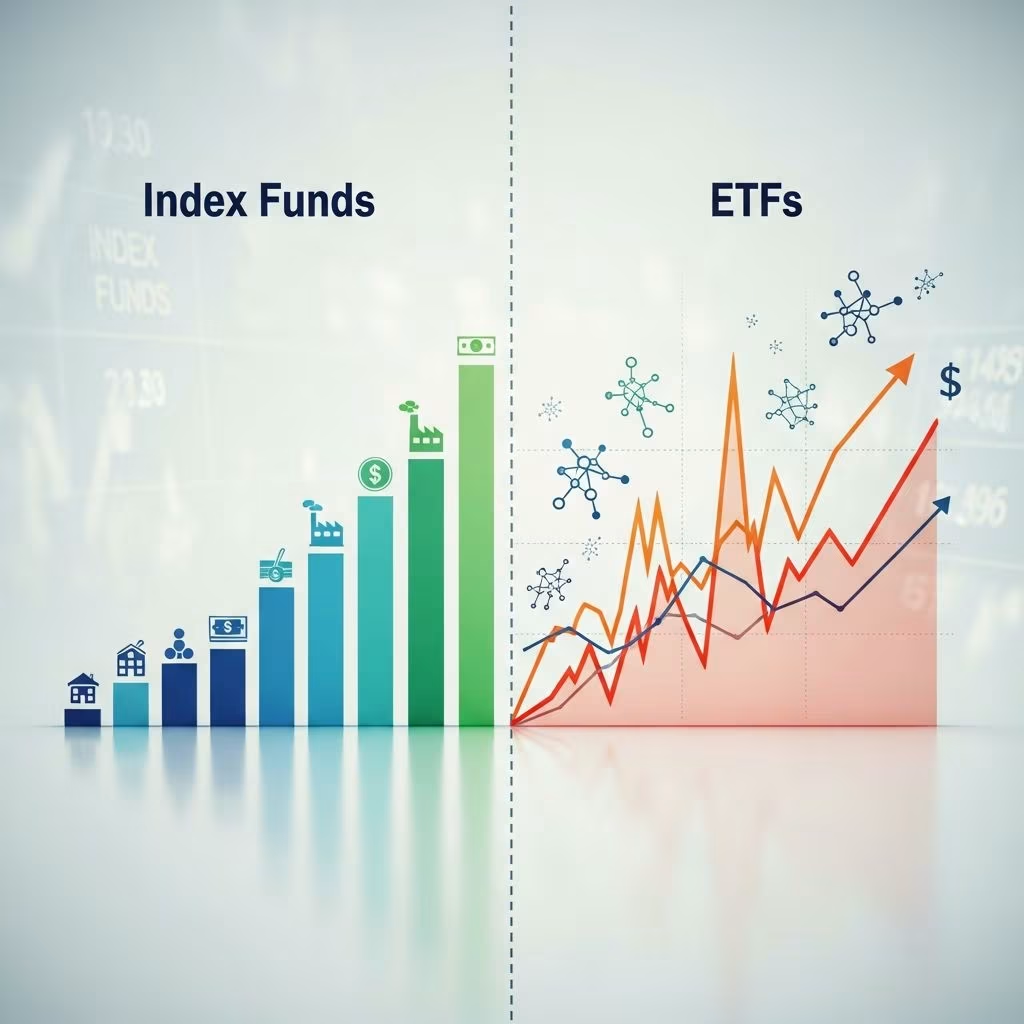
Index funds and exchange-traded funds (ETFs) are two of the most popular ways to invest for long-term goals like retirement, financial independence, and building wealth. They are both usually low-cost, diversified, and passive, but they are not exactly the same. Understanding how they differ can help you choose the right option for your situation and investing style.
In this guide, you will learn how index funds and ETFs work, what they have in common, how they differ, and how to decide which one makes the most sense for you.
What Is an Index Fund?
An index fund is a type of mutual fund designed to track the performance of a specific market index, such as the S&P 500, a total stock market index, or a bond index. Instead of a manager picking individual stocks, the fund simply tries to mirror the index it follows.
How index funds work
Index funds usually follow a straightforward process:
- The fund chooses a benchmark index (for example, an S&P 500 index).
- The manager buys the same or a representative sample of the stocks or bonds in that index in the same proportions.
- When the index changes, the fund periodically adjusts holdings to keep tracking it.
Because there is very little trading and no stock-picking, index funds are considered passively managed, which tends to keep costs low compared with actively managed mutual funds.
Key features of index funds
- Structure: A type of mutual fund.
- Trading: Bought and sold directly through the fund company or broker at the end-of-day price (net asset value, or NAV).
- Minimum investment: Often have a minimum dollar amount to get started, which can be a few hundred to a few thousand dollars, depending on the provider.
- Fees: Usually low expense ratios, but often slightly higher on average than comparable ETFs.
- Automatic investing: Very friendly to automatic monthly contributions and systematic investing plans.
What Is an ETF?
An exchange-traded fund (ETF) is a pooled investment fund that usually tracks an index but trades on a stock exchange just like an individual stock. Many ETFs are index-based and passively managed, although there are also actively managed ETFs.
How ETFs work
Most index ETFs are built similarly to index mutual funds but with a different trading mechanism:
- The ETF tracks a specific index (stocks, bonds, or other assets).
- Shares of the ETF trade on an exchange throughout the day at market prices, which may be slightly above or below the underlying NAV.
- Authorized participants (large institutions) create and redeem ETF shares in large blocks, helping keep the market price close to NAV and contributing to tax efficiency.
Key features of ETFs
- Structure: Exchange-traded fund listed on stock exchanges.
- Trading: Can be bought and sold throughout the day at market prices, just like individual stocks.
- Minimum investment: Typically the cost of one share, and some brokers offer fractional shares, reducing the effective minimum.
- Fees: Often have very low expense ratios and can be cheaper than similar index mutual funds.
- Tax efficiency: The creation/redemption process often makes ETFs more tax-efficient than mutual funds in many markets.
Similarities Between Index Funds and ETFs
Despite their structural differences, index funds and index ETFs share several important characteristics that make both attractive for long-term investing.
1. Both often track market indexes
Both index mutual funds and many ETFs are designed to track an underlying index rather than beat it. The goal is to match the performance of that index as closely as possible before fees.
2. Broad diversification
Investing in an index fund or ETF usually means owning a basket of securities in one purchase. For example:
- An S&P 500 fund gives you exposure to roughly 500 large U.S. companies.
- A total market fund includes thousands of stocks.
- A bond market fund spreads your money across a range of bonds.
This built-in diversification helps reduce company-specific risk compared with picking individual stocks.
3. Passive management and lower costs
Because index funds and most index ETFs simply follow an index instead of trying to outperform it, they typically have lower expenses than actively managed funds. Lower costs mean more of your returns stay in your account, which compounds over time.
4. Strong long-term performance vs. many active funds
Research regularly shows that over long periods, a relatively small percentage of actively managed funds outperform their benchmark index after fees, especially in large, efficient markets. This is a key reason many long-term investors favor simple index strategies using either index funds or ETFs.
Key Differences Between Index Funds and ETFs
Even though both fund types are often used for passive investing, there are important differences that affect how you buy them, how you use them, and which one may be better for you.
Comparison table: Index funds vs ETFs
| Feature | Index Fund | ETF |
|---|---|---|
| Typical structure | Mutual fund | Exchange-traded fund |
| How you trade | Buys/sells processed once per day at end-of-day NAV | Trades throughout the day on an exchange at market prices |
| Minimum investment | Often a fixed dollar minimum set by the fund | Usually the price of one share (or fraction) via a broker |
| Expense ratios | Generally low; sometimes slightly higher than ETFs | Often very low, especially for broad market ETFs |
| Tax efficiency | Can distribute capital gains more frequently | Often more tax-efficient due to in-kind creation/redemption |
| Automatic investing | Easy to set up automatic monthly contributions | Automatic investing depends on broker; not always as seamless |
| Intraday trading | Not available; trades execute after market close | Available; you can place market, limit, or stop orders |
1. Trading and pricing
Index funds trade only once per day, after the market closes. All buy and sell orders for that day are executed at the same NAV price calculated at the end of the trading day.
ETFs trade throughout regular market hours. Their prices fluctuate during the day based on supply and demand, similar to individual stocks. This allows for more flexibility for investors who want to trade at specific times or use order types like limit orders.
2. Minimum investment
Index mutual funds often have a minimum initial investment, which can be a barrier for beginners with small amounts of money. In contrast, you can usually start investing in an ETF with the cost of a single share, and many brokers now offer fractional shares, allowing you to start with even less.
3. Fees and costs
Both index funds and ETFs are known for low expense ratios compared with many actively managed funds. However, there are nuances:
- Expense ratio: Many broad-market ETFs have very low expense ratios, and similar index mutual funds are also low-cost, though sometimes slightly higher.
- Trading costs: With ETFs, you may pay bid–ask spreads and, if applicable, brokerage commissions. Many brokers now offer commission-free ETF trading, but the spread is still an implicit cost. Index funds usually do not have bid–ask spreads, and some may have no-load and no-transaction-fee structures.
4. Tax efficiency
In taxable accounts, ETFs often have an edge in tax efficiency. When investors in an index mutual fund redeem their shares, the fund may need to sell securities, which can trigger capital gains that are distributed to shareholders.
By contrast, ETF shares typically change hands between buyers and sellers on an exchange. The fund usually does not need to sell underlying holdings to meet redemptions. Large institutions create and redeem ETF shares in kind (exchanging baskets of securities), which helps ETFs minimize realizing capital gains.
As a result, broad index ETFs often distribute fewer taxable capital gains than comparable index mutual funds, though this can vary by provider and fund.
5. Flexibility and use cases
Index funds are often preferred by investors who:
- Want a simple, automatic, set-and-forget investing process.
- Like contributing fixed amounts on a schedule (for example, every payday).
- Are less concerned about intraday price movements and short-term trading.
ETFs are often chosen by investors who:
- Value intraday trading and real-time pricing.
- Want access to a wide range of niche or thematic strategies (such as sectors, factors, or commodities) that may be available primarily in ETF form.
- Are focused on tax efficiency and lower average expense ratios in taxable accounts.
Pros and Cons of Index Funds
Advantages of index funds
- Simplicity: Easy to understand, buy, and hold for the long term.
- Automatic investing: Very friendly to recurring contributions and systematic investment plans.
- Low costs: Typically lower expense ratios than actively managed mutual funds.
- No intraday trading decisions: Reduces the temptation to trade frequently based on short-term price moves.
Drawbacks of index funds
- End-of-day pricing only: You cannot control intraday execution price; all orders fill at the closing NAV.
- Higher minimums: The required initial investment can be higher than the cost of a single ETF share.
- Potentially less tax-efficient: In taxable accounts, index mutual funds may distribute capital gains more often than comparable ETFs.
Pros and Cons of ETFs
Advantages of ETFs
- Intraday trading: You can trade throughout the day using a variety of order types, which can be helpful for more active investors.
- Lower minimum investment: You can often start with the price of a single share or even less with fractional shares.
- Low expense ratios: Many broad-market ETFs are among the cheapest investment options available.
- Tax efficiency: The way ETFs are built and traded often leads to fewer taxable capital gain distributions in many markets.
Drawbacks of ETFs
- Bid–ask spreads: The difference between the price at which you can buy and sell can add to your costs, especially in less liquid ETFs.
- Trading complexity: The ability to trade all day can tempt investors into frequent trading, which may hurt long-term returns.
- Automatic contributions: Not all brokers allow seamless automatic ETF investing in fixed dollar amounts, especially without fractional shares.
Risk Considerations for Both
Index funds and ETFs both carry market risk—the risk that the overall market or the specific segment you invest in declines in value. Because they are diversified, they usually carry less company-specific risk than individual stocks, but they are still subject to volatility and potential losses.
The level of risk depends on what the fund holds:
- Stock index funds/ETFs: Higher potential returns and higher volatility.
- Bond index funds/ETFs: Generally lower volatility but still exposed to interest-rate and credit risk.
- Sector or thematic funds: Narrower focus can mean higher risk and volatility.
Neither index funds nor ETFs are guaranteed, and you can lose money in both.
How to Choose Between Index Funds and ETFs
There is no universal “best” option. Instead, think about your goals, account type, and investing preferences when choosing between index funds and ETFs.
1. Consider your account type
- Tax-advantaged accounts (like retirement accounts in many countries): Tax efficiency may be less critical because gains and income may already receive special tax treatment. In these accounts, choosing between an index mutual fund and an ETF often comes down to convenience, fees, and available options.
- Taxable accounts: ETFs often have an edge because of their typical tax efficiency, but some index mutual funds are also very tax-efficient. Compare historical capital gain distributions and fees.
2. Think about how you prefer to invest
- If you want a hands-off, automated approach, and your provider offers low-cost index mutual funds, those may be attractive.
- If you prefer flexibility, lower minimums, or more specialized exposures, ETFs may be a better fit.
3. Compare specific funds, not just types
The decision is not just “index fund vs ETF” in the abstract; it is about comparing specific options side by side:
- Check the expense ratios of each fund.
- Look at tracking error—how closely the fund has followed its index over time.
- Review historical capital gain distributions for taxable accounts.
- Confirm whether there are transaction fees or commissions from your broker.
Practical Examples
Here are two simplified scenarios to illustrate how an investor might choose.
Example 1: Beginner investing small amounts each month
Suppose you are just starting, can invest a small fixed amount monthly, and want a simple long-term strategy. If your broker offers a low-cost total market index mutual fund with no minimum or a very low minimum and easy automatic contributions, that might be the easiest path. You can set up recurring investments and avoid worrying about intraday ETF prices.
Example 2: Taxable account focused on tax efficiency
If you have a larger portfolio in a taxable brokerage account and care about minimizing capital gains distributions, you might lean toward broad-market ETFs with very low expense ratios and strong records of tax efficiency.
Frequently Asked Questions (FAQs)
Q: Are all ETFs index funds?
A: No. Many ETFs are index-based and passively track a benchmark, but some are actively managed and do not follow a specific index.
Q: Are index funds or ETFs better for beginners?
A: Both can work well. Index mutual funds are often easier for automatic investing, while ETFs can be more accessible for small starting amounts and tax efficiency. The best choice depends on your broker, account type, and how you prefer to invest.
Q: Which is more tax-efficient, an index fund or an ETF?
A: In many markets, broad index ETFs tend to be more tax-efficient than comparable index mutual funds because of how ETF shares are created and redeemed, which reduces the need for the fund to sell holdings and realize capital gains.
Q: Do I need a special account to buy ETFs?
A: You usually need a standard brokerage account that allows stock and ETF trading. ETFs are bought and sold on exchanges the same way you trade individual stocks.
Q: Can I lose money in index funds and ETFs?
A: Yes. Both index funds and ETFs are subject to market risk. Their value will rise and fall with the markets they track, and there is no guarantee of profit or protection from loss.
References
- ETF versus Index Funds — Mirae Asset Mutual Fund. 2023-06-01. https://www.miraeassetmf.co.in/knowledge-center/index-funds-vs-etf
- Index funds vs ETFs: Everything you need to know — IG International. 2022-09-05. https://www.ig.com/en/trading-strategies/index-funds-vs-etfs–everything-you-need-to-know-250617
- Index Fund vs. ETF: Differences and Similarities — NerdWallet. 2024-08-15. https://www.nerdwallet.com/investing/learn/etf-vs-index-fund-compare
- ETFs vs. Mutual Funds: Which to Choose — Vanguard. 2023-04-10. https://investor.vanguard.com/investor-resources-education/etfs/etf-vs-mutual-fund
- ETFs vs. Mutual Funds – What’s the Difference? — Charles Schwab. 2024-03-20. https://www.schwab.com/etfs/mutual-funds-vs-etfs
This article is general information, not personal financial advice. Consider your own situation, or speak with a licensed adviser, before acting on it.


