

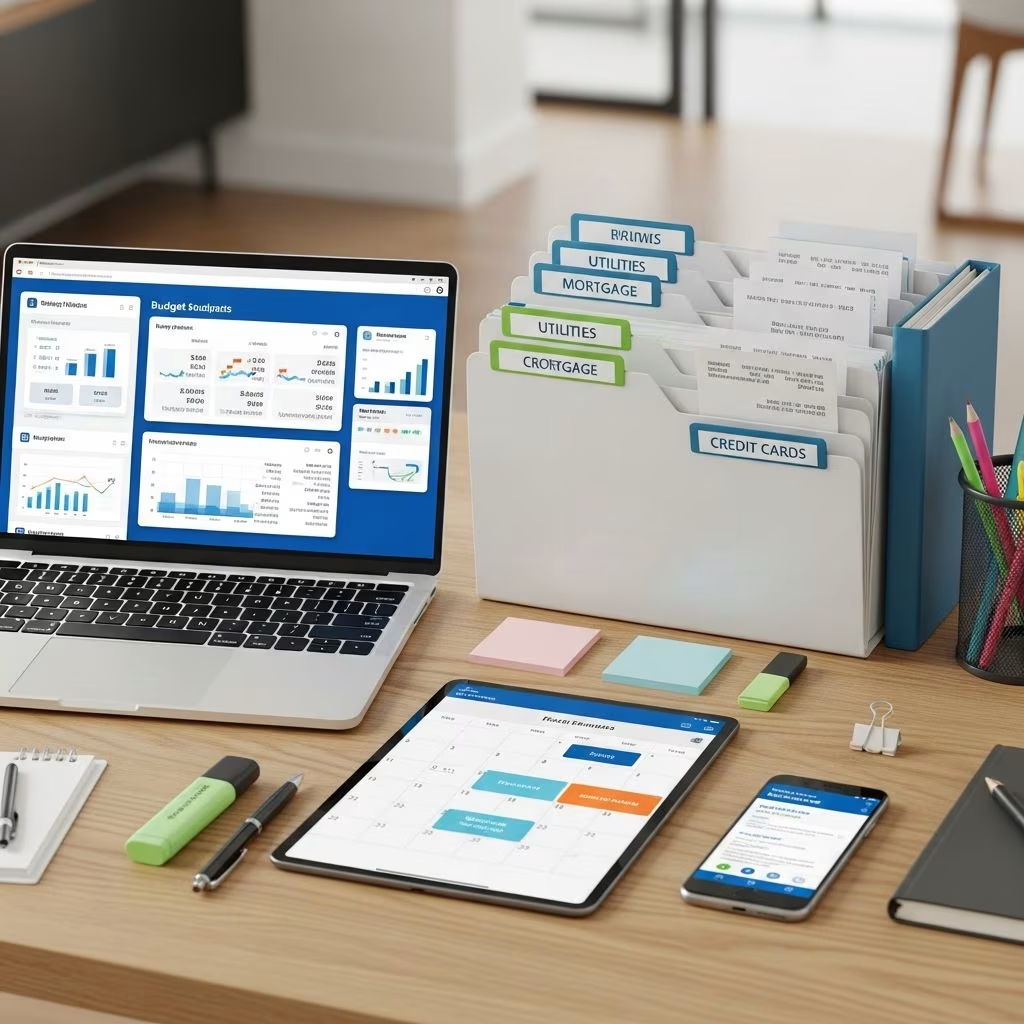
Staying on top of your bills is a core part of managing your money well. When you have a simple system to track what you owe and when it is due, you can avoid late fees, protect your credit, and feel more in control of your finances.
This guide walks you through how to list your bills, schedule them on your calendar, use autopay wisely, choose tools to track payments, and set up routines so nothing slips through the cracks.
Why tracking bills and payments matters
Missing or paying bills late can quickly become expensive and stressful. Many credit cards charge late fees of around $25–$40 for each late payment, and some increase your interest rate after repeated late payments.1 In addition, payment history is one of the most important factors in your credit scores, so consistently paying on time helps you qualify for better rates on future loans.2
Having a clear, repeatable system to track your bills helps you:
- Avoid late fees and penalty interest.
- Protect your credit by paying on time.
- Reduce stress because you are not trying to remember dates in your head.
- Improve your budget since you always know what is coming up.
Create a list of bills to pay
Keeping track of bills and payments starts with knowing exactly what you owe and when. Instead of trying to remember everything, create a master list of all your recurring bills.
How to build your master bill list
Set aside 20–30 minutes to write down every bill you pay during a typical month or year. Include:
- Bill name (for example, rent, electricity, internet).
- Usual amount (or range if it varies).
- Due date (exact date or billing cycle, such as “around the 5th”).
- Frequency (monthly, quarterly, yearly, or irregular).
- How you pay (bank transfer, credit card, automatic debit, etc.).
A simple way to capture everything is to pull your last two or three bank or credit card statements and highlight all recurring payments.
| Bill | Typical Amount | Due Date | Frequency | Payment Method |
|---|---|---|---|---|
| Rent / Mortgage | $1,200 | 1st of month | Monthly | Bank transfer |
| Electricity | $90–$140 | 10th of month | Monthly | Debit card |
| Cell phone | $80 | 15th of month | Monthly | Autopay (credit card) |
| Car insurance | $600 | June 1 | Every 6 months | Bank account |
| Streaming subscription | $15 | 22nd of month | Monthly | Credit card |
Examples of bills to include
Here are common categories to review as you list your bills:
- Housing: rent, mortgage, property taxes (if not included in your mortgage), homeowners or renters insurance.
- Utilities: electricity, gas, water, trash, sewer, internet, phone.
- Debt payments: credit cards, student loans, auto loans, personal loans.
- Insurance: health, auto, life, disability, pet.
- Subscriptions & memberships: streaming services, software, gym, clubs.
- Childcare & education: daycare, tuition, after-school programs.
- Other recurring expenses: storage units, security systems, monthly donation pledges.
Do not forget annual or irregular bills
Some of the easiest bills to miss are the ones that arrive only once or a few times a year. To prevent surprises, add them to your list now and break them into monthly amounts in your budget.
Examples of annual or irregular bills include:
- Vehicle registration and inspection fees.
- Annual insurance premiums (if not paid monthly).
- Professional licenses or union dues.
- Annual subscriptions or software renewals.
- Planned medical or dental procedures.
Add your bills to your calendar
Once you have a complete list, the next step is to place each bill on a calendar so you can see what is due and when. Using a calendar is a simple way to build awareness and avoid last-minute scrambles.
Using a paper planner or wall calendar
If you prefer analog tools, a paper planner or wall calendar can work extremely well because you are likely to look at it daily.
- Write each bill on the date it is due along with the amount.
- Use colored pens or highlighters for different categories (for example, blue for housing, red for debt, green for insurance).
- Mark annual or quarterly bills on the month they are due, and add a reminder one or two months earlier.
- Keep the calendar in a visible place, such as near your desk or on your fridge.
Using a digital calendar with reminders
Digital calendars (such as Google Calendar or the calendar on your phone) make it easy to set recurring events and automatic reminders.
- Create a recurring event for each bill on its due date (monthly, quarterly, or annually).
- Add 1–2 reminders for each bill, such as 7 days and 2 days before the due date.
- Include key details in the event description, such as the usual amount and how you pay it.
- If your paychecks come on specific dates, line up your bills with your pay periods where possible.
Many people find that using calendar reminders significantly improves on-time payments because it reduces the need to rely on memory alone.3
Put your bills on autopay
Automatic payments, or autopay, can be one of the most reliable ways to make sure your bills are paid on time. When set up correctly, autopay helps you avoid late fees and maintain a strong payment history, which is a key component of your credit profile.2
Benefits of autopay
- On-time payments: Once autopay is active and funds are available, payments are made automatically by the due date.
- Less mental load: You do not have to remember every single due date.
- Potential perks: Some lenders offer small rate reductions for setting up automatic payments, especially on student loans.4
Things to watch out for
Autopay is powerful, but it still requires attention.
- Check for fees: Some service providers may charge processing fees for certain payment methods. Build these into your budget if they apply.
- Monitor your account balance: Ensure enough money is in your checking account before the automatic withdrawal to avoid overdraft fees.
- Track variable bills: For bills that change month to month (like utilities), review the amount before the payment processes.
- Update details when you switch banks or cards: Otherwise, automatic payments may fail.
You may also choose a hybrid approach: put essential bills (such as rent, mortgage, or minimum debt payments) on autopay and manually pay others you want to review closely each month.
5 tools to keep track of bills and payments
There is no single “right” tool to track your bills. The best option is the one you will actually use consistently. Below are five common approaches, each with strengths you can mix and match.
1. Spreadsheets
Spreadsheets are flexible and powerful for organizing your bill information and tracking payments over time.
- Create columns for bill name, due date, amount, autopay status, and checkboxes for each month.
- Use filters or sorting to see what is due next.
- Color-code missed or upcoming bills.
- Store your spreadsheet in the cloud (for example, Google Sheets) so you can update it from your phone.
Spreadsheets are especially helpful if you like customizing your own system and want to see patterns in your bills throughout the year.
2. Budgeting and money management apps
Budgeting and money management apps connect to your bank and credit card accounts to track transactions and, in many cases, your bills automatically. Many of these apps can send alerts before bills are due or when a large payment is initiated.
- Link your accounts securely so the app can automatically import transactions.3
- Label which transactions are recurring bills.
- Turn on notifications for upcoming bills and low balances.
- Use built-in budget features to make sure you have enough set aside for each bill category.
Several reputable apps offer free versions with core bill-tracking features; paid tiers often add advanced reports or automation.
3. Transaction registers or ledgers
A transaction register is the small logbook often included with checkbooks, but you can also use any small notebook or a printed ledger template. Even though checks are less common today, this method still works well for people who prefer writing things down.
- List each bill with the date, payee, and amount when you pay it.
- Subtract each payment from your running account balance.
- Mark the bill as paid for the month once the payment clears.
This option is simple, portable, and does not require apps or internet access.
4. Expense tracker sheets
Expense tracker sheets are printable forms or simple tables you can use to log your bills and other spending. They work similarly to a transaction register but are often organized by month or category.
- Use one sheet per month with rows for each bill and columns to check off when paid.
- Keep the sheets in a binder or folder near where you open your mail.
- At the end of each month, review the sheet to spot any missed or unusually high bills.
If you like physical paper but want more structure than a blank notebook, expense tracker sheets can be ideal.
5. Use a hybrid approach
You do not have to choose only one method. Many people use a combination of tools to match different parts of their financial life.
- Use autopay for essentials, a spreadsheet to see everything at a glance, and a calendar for reminders.
- Track day-to-day spending in a budgeting app, but do a weekly check-in with paper expense sheets.
- Carry a small notebook or phone notes to jot down bills you decide to pay early or irregular expenses you want to remember.
The goal is not perfection; it is building a routine that keeps you aware and in control.
Key times to keep track of bills and payments
Beyond which tools you use, when you track your bills also matters. Consistency is more important than complexity. Choose a schedule that fits your life and stick with it.
When the expenses happen
One option is to track bills and other expenses as they happen. This can be done:
- Automatically, if your budgeting app updates in real time from your bank.
- Manually, by entering each payment in your spreadsheet, ledger, or app as soon as you make it.
Tracking in real time helps you stay highly aware of your spending and reduces the risk of forgetting a bill you paid.
At the end of the day
If tracking all day feels overwhelming, try a quick daily check-in instead. At the end of each day (or on most days):
- Gather receipts, emails, and notifications related to bills and payments.
- Log into your bank or app and note which bills were paid that day.
- Update your tracker or spreadsheet with those payments.
- Glance at your upcoming calendar events to see what is due in the next few days.
A short daily money check-in can take 5–10 minutes and is associated with better financial awareness and lower money-related stress.3
Once per week during your budgeting time
At a minimum, plan to review your bills and expenses once a week. Many financial educators recommend weekly money dates because they strike a good balance between staying informed and not feeling overwhelmed.3
- Pick a specific day and time (for example, Sunday evening) for your money review.
- Check which bills were due in the past week and confirm they were paid.
- Look ahead at the next 1–2 weeks of bills and make sure your upcoming income can cover them.
- Adjust your discretionary spending if you see a heavier bill week approaching.
Try not to go longer than a week without checking in. The longer you wait, the easier it is for bills and small charges to pile up unnoticed.
Simple tips to stay consistent
Building a bill-tracking system that works for the long term is mostly about habits. These small tips can help you stick with your plan:
- Automate what you can, but still review your accounts regularly.
- Keep your system simple enough that you can maintain it even on busy weeks.
- Use visual cues, such as leaving your planner open or pinning a checklist near your workspace.
- Link your bill check-in to an existing routine (for example, after Sunday breakfast or with your morning coffee on weekdays).
- Review at least once a year to cancel unused subscriptions and renegotiate bills where possible.5
Frequently Asked Questions (FAQs)
Q: What is the easiest way to keep track of all my bills?
A: The easiest way is usually a combination of tools: a calendar with reminders for due dates, autopay for essential bills, and either a budgeting app or spreadsheet to see everything in one place. Choose the simplest system you can maintain consistently.
Q: How can I avoid missing annual or irregular bills?
A: Add all annual and irregular bills to your master list and set calendar reminders 1–2 months before they are due. In your budget, divide the annual cost by 12 and set that amount aside each month in a savings category so the money is ready when the bill arrives.
Q: Should I put every bill on autopay?
A: Autopay is helpful for fixed, essential bills and minimum debt payments, but you may prefer to manually pay variable bills so you can review the amount first. Whatever you choose, always monitor your account balances to avoid overdrafts and make sure payment methods stay up to date.
Q: Is it safe to use apps that connect to my bank?
A: Reputable budgeting apps use bank-level encryption and do not allow anyone to move money from your account directly through the app. However, you should still follow security best practices: use strong, unique passwords, turn on two-factor authentication where available, and only connect apps from companies you trust.
Q: How often should I check my accounts and bill tracker?
A: Many people do well with a brief daily glance or at least a weekly review. The key is to check in often enough that you can spot potential problems early, such as a missed bill, a subscription you no longer use, or an incorrect charge.
References
- Credit Card Late Fees and Other Penalties — Consumer Financial Protection Bureau. 2023-01-01. https://www.consumerfinance.gov/ask-cfpb/what-happens-if-i-miss-a-credit-card-payment-en-51/
- What is a credit score? — Consumer Financial Protection Bureau. 2022-09-01. https://www.consumerfinance.gov/ask-cfpb/what-is-a-credit-score-en-315/
- Consumer Response Annual Report — Consumer Financial Protection Bureau. 2023-03-31. https://www.consumerfinance.gov/data-research/research-reports/consumer-response-annual-report/
- Student Loan Repayment Options — Federal Student Aid, U.S. Department of Education. 2024-01-01. https://studentaid.gov/manage-loans/repayment/plans
- Cutting Costs: Strategies for Reducing Household Expenses — Federal Trade Commission. 2022-05-01. https://www.consumer.ftc.gov/articles/money-management
This article is general information, not personal financial advice. Consider your own situation, or speak with a licensed adviser, before acting on it.


