

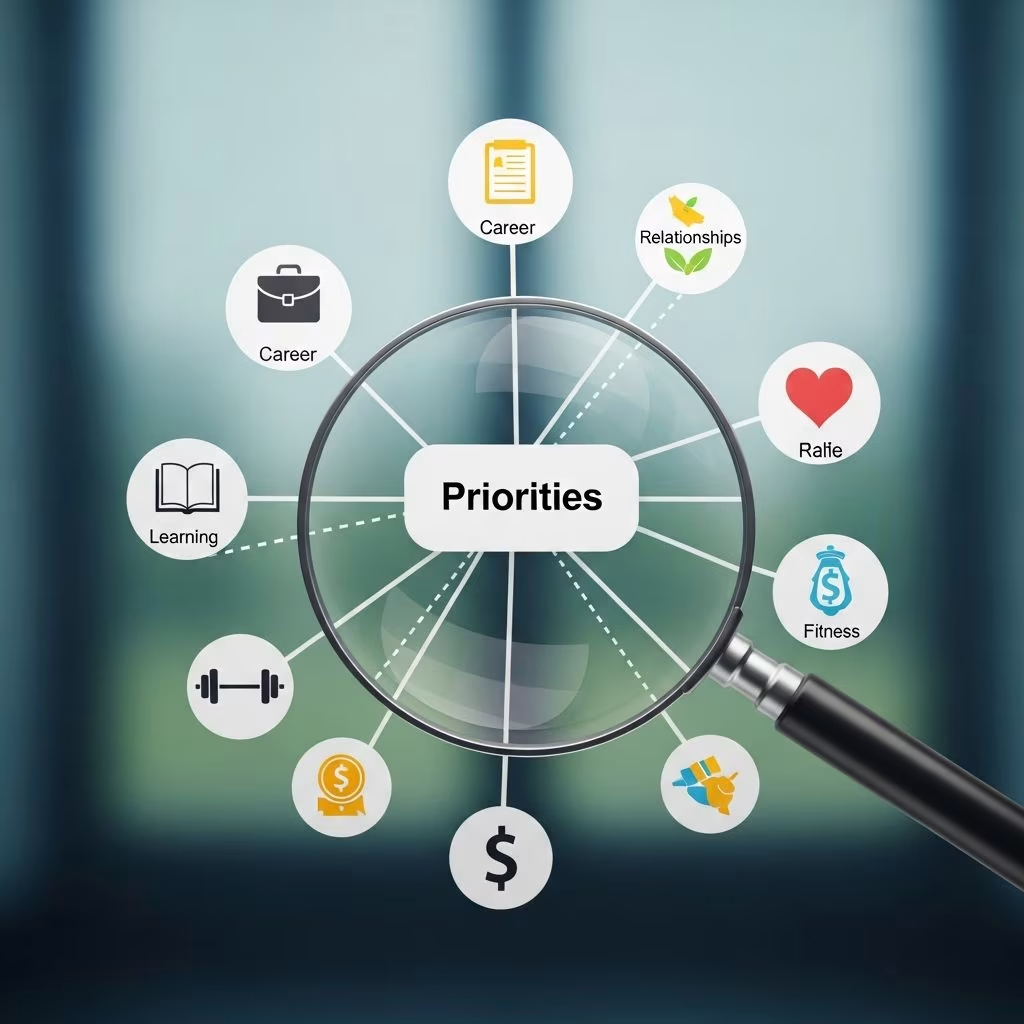
Feeling stretched thin, overwhelmed by goals, and unsure what should come first is often a sign that your priorities are not clearly defined. When you decide what truly matters most, your time, energy, and money start working together instead of pulling you in a dozen conflicting directions.
This guide walks you through what priorities are, why they matter, how they differ from goals, and a practical process to define and live by your most important priorities in life.
Why your priorities in life really matter
Life offers unlimited options but limited time, money, and energy. Without clearly defined priorities, you can stay busy yet feel like you are not making meaningful progress. Priorities act like a filter that determines what deserves your focus and what can be postponed, delegated, or declined.
Research on goal-setting and self-regulation shows that people who align daily actions with personally meaningful values report higher well-being and lower stress than those who chase externally imposed goals. When your priorities are clear, you can:
- Make faster decisions without second-guessing yourself.
- Say “no” with confidence to opportunities that don’t fit your life direction.
- Protect time for health, relationships, and financial stability.
- Prevent burnout by focusing on what moves the needle instead of reacting to everything.
In personal finance specifically, having clear life priorities helps you decide what to save for, how aggressively to pay off debt, and which lifestyle expenses are worth keeping versus cutting.
Priorities versus goals: what is the difference?
People often mix up priorities and goals, but they are not the same. Understanding the difference makes it easier to design a life that feels both productive and meaningful.
| Aspect | Priorities | Goals |
|---|---|---|
| Time frame | Ongoing, long-term focus | Have clear start and end points |
| Nature | Broad themes that reflect what matters most | Specific outcomes or milestones |
| Examples | Health, financial stability, family, personal growth | Save $10,000, run a 10K, pay off a credit card |
| Connection to values | Directly grounded in your core values | Should support priorities but do not always do so by default |
| Flexibility | Stable but can evolve with life stages | Regularly updated, completed, or replaced |
Your priorities define the direction of your life. Your goals define the milestones along that direction. For example:
- If your priority is physical health, your goals could include exercising three times a week, scheduling preventive checkups, or improving your sleep.
- If your priority is financial security, your goals might be building a 3–6 month emergency fund, paying off high-interest debt, and starting to invest for retirement.
Step-by-step: how to define your priorities in life
Defining your priorities is a reflective process, not something to rush through in 10 minutes. Set aside quiet, uninterrupted time with a notebook or document and walk through these steps.
1. Reflect on what truly matters to you
Start by asking yourself a few grounding questions:
- What kind of person do I want to be remembered as?
- Which moments in my life have felt most meaningful or fulfilling?
- What do I regret saying yes to? What do I wish I had protected more time or money for?
- If I had fewer obligations, what would I naturally spend more time doing?
Write down anything that comes up without judging or editing it. You will organize and refine later.
2. Brain-dump everything that feels important
Next, list all the areas, activities, and responsibilities that feel important in your life right now. Include personal, family, work, and financial items. For example:
- Physical health and energy
- Emotional and mental well-being
- Family, partner, and close friendships
- Career growth or business
- Financial stability, debt freedom, and building wealth
- Faith or spirituality
- Learning and self-development
- Rest, hobbies, and creative expression
- Giving back, community, or volunteering
Do not worry yet about ranking or choosing. The goal of this step is to see everything you are trying to hold in your life.
3. Group your list into life categories
Now, sort your brain-dump into a handful of broad life categories. Many people find it helpful to use categories such as:
- Health & wellness (physical, mental, emotional)
- Money & finances (income, savings, debt, investing)
- Career & business (job, business, professional development)
- Relationships & family (partner, children, friends, extended family)
- Personal growth & lifestyle (learning, hobbies, travel, spiritual life)
Within each category, list what matters most to you. For instance, under Health & wellness, you might write “maintain strength and mobility,” “reduce stress,” and “sleep better.” Under Money & finances, you might list “get out of high-interest debt,” “build an emergency fund,” or “start investing for retirement.”
4. Rank your priorities in order of importance
Next, challenge yourself to rank these categories and items from most important to least important for this season of your life. There is no universally correct order. For one person, health may clearly come first. For another, stabilizing finances may be the most urgent priority.
Ask yourself:
- If I could focus on only three areas for the next year, which would make the biggest positive difference to my life?
- Which areas, if neglected, would carry the greatest long-term cost (health issues, financial instability, broken relationships)?
Be honest about trade-offs. You can care about many things, but not everything can be number one at the same time.
5. Choose your non-negotiables
Non-negotiables are the activities and standards that you commit to protecting even during busy or stressful times. They embody your top priorities in concrete form. Examples include:
- Walking for 30 minutes at least five days a week (health).
- Contributing a set amount to savings or debt repayment every month (finances).
- Eating dinner with your family without screens several nights a week (relationships).
- Reserving one evening each week for rest or a hobby (personal well-being).
Write these non-negotiables down clearly. They are the baseline you return to when life gets chaotic.
6. Align your priorities with your goals
Once your priorities and non-negotiables are clear, review your existing goals. For each goal, ask:
- Which priority does this goal support?
- Is this goal still worth pursuing, or is it based on external pressure or comparison?
- Do any important priorities currently have no goals attached to them?
Ideally, every meaningful goal should directly support a top priority. If you notice goals that do not connect to anything important—or that even conflict with your priorities—consider revising, postponing, or dropping them.
7. Make time and space for your priorities
Knowing your priorities is not enough; they must be visible in your schedule and your money. Research on behavior change emphasizes the importance of implementation plans—deciding in advance when, where, and how you will act.
To put your priorities into practice:
- Block time on your calendar for priority activities first, then fit in other tasks around them.
- Use a weekly review to check that the way you spent your time matches your stated priorities.
- Set up automatic transfers for savings, investing, or debt payments that reflect your financial priorities.
- Reduce or remove commitments that consistently pull you away from your top priorities.
8. Create boundaries to protect what matters
Clear priorities often require new boundaries. Boundaries are the limits you set on how others can use your time, energy, and resources. They help you stay on track when other people’s expectations or emergencies arise.
Healthy boundaries might include:
- Limiting work emails or messages outside of set hours to protect family or rest time.
- Saying “no” to social events that clash with essential recovery time or financial goals.
- Communicating spending limits or savings goals with your partner so you can support each other.
Boundaries can feel uncomfortable at first, but they are essential if you want your life to reflect your priorities instead of everyone else’s.
Key life areas to consider prioritizing
Your unique situation will determine your exact priorities, but many people find that certain areas consistently deserve attention because of their long-term impact on quality of life.
Prioritizing your health and well-being
Good health supports everything else you want to do. When you are physically and mentally well, you have more capacity for work, relationships, and financial decisions. Public health research consistently links regular physical activity and healthy sleep with lower risk of chronic disease and improved mood.
Practical ways to prioritize health include:
- Scheduling annual checkups and recommended screenings.
- Building movement into your daily routine, even if it is in short bursts.
- Setting consistent sleep and wake times most nights of the week.
- Seeking support or counseling if you notice persistent stress, anxiety, or low mood.
Prioritizing your finances
Money is not the only priority in life, but it is a powerful tool that influences nearly every other area. Financial stress is associated with poorer mental health and can strain relationships and work performance. Giving your finances a high priority—especially if you are dealing with debt or an unstable income—can dramatically increase your sense of security.
Key financial priorities to consider:
- Tracking income and expenses so you know where your money goes.
- Building an emergency fund to cover at least 3–6 months of basic living costs.
- Paying off high-interest debt as a priority before lower-cost borrowing.
- Taking advantage of retirement accounts and employer matches where available.
Career and business priorities
Your work or business can be a major source of income, purpose, and identity. However, without clear priorities, it can also become all-consuming. Reflect on questions such as:
- What role do I want my career or business to play in my life overall?
- Do I value stability more right now, or am I ready to prioritize growth and change?
- What skills or experiences do I need to pursue my longer-term vision?
Aligning your career goals with your life priorities helps prevent sacrificing health or relationships for work that does not truly fit you.
Relationships and emotional wellness
Supportive relationships and emotional health are strong predictors of life satisfaction. Long-running studies on adult development have found that the quality of close relationships is a key factor in happiness and even physical health over the long term.
To prioritize relationships and emotional wellness, you might:
- Reserve regular time for connection with your partner, children, or close friends.
- Practice open communication about money, time, and expectations.
- Develop routines that help you process stress, such as journaling or therapy.
Reviewing and adjusting your priorities over time
Priorities are not a one-time decision. Major life events—such as a new job, a child, illness, or relocation—can change what deserves the most attention. Review your list of priorities at least a few times a year and ask:
- Does this still reflect who I am and what I value most right now?
- Are there new responsibilities or opportunities I need to factor in?
- Have I taken on goals that no longer align with my top priorities?
Updating your priorities is not a sign of failure; it is evidence that you are living with awareness and intention.
Frequently Asked Questions (FAQs)
Q: How many priorities should I have?
A: You can care about many things, but it is usually most effective to have three to five top life priorities at any given time. This makes it easier to allocate time and money without feeling pulled in too many directions.
Q: How do I handle guilt when I say no to people?
A: Guilt is common when you start enforcing boundaries. Remind yourself that saying no to what does not align with your priorities allows you to say a deeper yes to what matters most. Communicate kindly and clearly, and remember that protecting your health, finances, and relationships is a responsible choice, not a selfish one.
Q: Can my priorities change over time?
A: Yes. Priorities often shift with life stages—such as starting a family, changing careers, or caring for aging parents. Review your priorities regularly and give yourself permission to adjust them as your circumstances and values evolve.
Q: How do I align my budget with my life priorities?
A: Start by listing your top priorities and then examining your last one to three months of spending. Look for areas where your money does not reflect your stated values—for example, high spending on convenience but little set aside for savings or health. Gradually redirect money from lower-priority expenses toward your top priorities, using automatic transfers where possible.
Q: What if my family or partner has different priorities?
A: Begin with an honest conversation about what each of you values and why. Look for overlap—such as shared goals around stability, health, or time together—and build around those. Where differences remain, negotiate compromises and set clear agreements, especially around joint time and money, so everyone understands the plan.
References
- Building Financial Security Over a Lifetime — Consumer Financial Protection Bureau. 2022-06-01. https://www.consumerfinance.gov/consumer-tools/save-and-invest/
- Harvard Study of Adult Development — Harvard Medical School. 2017-01-01. https://www.health.harvard.edu/healthbeat/harvard-study-what-makes-a-good-life
- A Blueprint to Prioritize Your Personal Finances — Quick and Dirty Tips / Money Girl. 2020-09-21. https://www.quickanddirtytips.com/personal-finance/budgeting-saving/a-blueprint-to-prioritize-your-personal-finances/
- Physical Activity Guidelines for Americans, 2nd edition — U.S. Department of Health and Human Services. 2018-11-01. https://health.gov/sites/default/files/2019-09/Physical_Activity_Guidelines_2nd_edition.pdf
- Implementation Intentions and Goal Achievement: A Meta-Analysis — Gollwitzer & Sheeran, Advances in Experimental Social Psychology. 2006-01-01. https://doi.org/10.1016/S0065-2601(06)38002-1
- Financial Strain and Mental Health — American Psychological Association. 2022-03-01. https://www.apa.org/news/press/releases/stress/2022/concerns-present-future-well-being
This article is general information, not personal financial advice. Consider your own situation, or speak with a licensed adviser, before acting on it.


