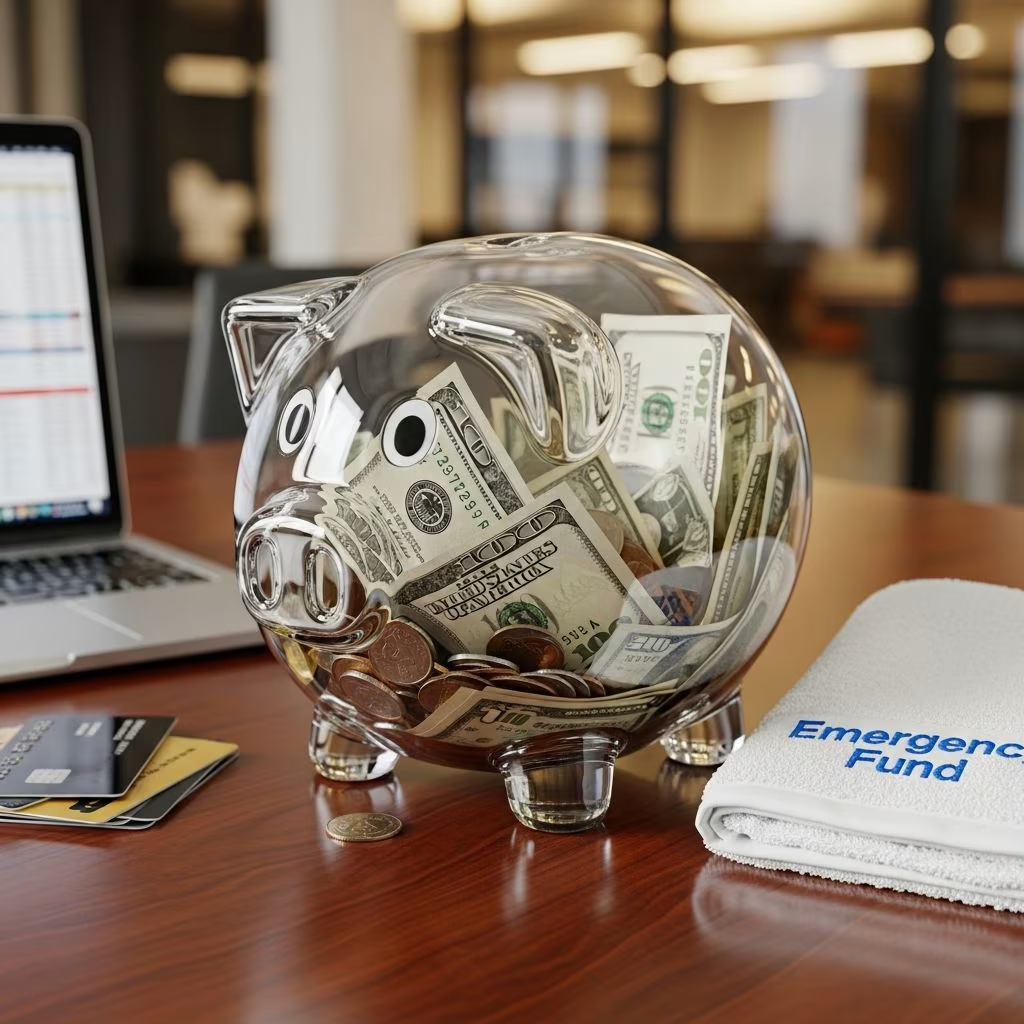
An emergency fund is the financial buffer that protects you when life does not go according to plan. Whether it is a sudden car repair, a surprise medical bill, or a temporary job loss, having cash ready helps you avoid high-interest debt and financial stress. Experts commonly recommend saving at least three to six months of essential living expenses in an emergency fund, with more if your income is unstable or you have dependents.
Choosing where to keep that money is just as important as deciding how much to save. The right account strikes a careful balance between safety, liquidity (easy access), and a competitive interest rate so inflation does not quietly erode your savings.
This guide explains what makes an ideal emergency-fund account, compares the best places to keep your reserves, highlights common mistakes, and answers frequently asked questions about emergency savings.
What Makes an Ideal Emergency Fund?
Your emergency fund is not an investment seeking high risk and high return. It is a defensive tool designed to be there when you need it most. Because of that, the account you choose should focus on the following features:
- Safety of your principal
- Immediate or near-immediate access
- Low fees and low minimums
- Reasonable, preferably above-average interest
- Simplicity so you can access funds quickly under stress
Safety: FDIC and NCUA Insurance
Safety is non-negotiable for emergency savings. In most cases, that means keeping your fund at a bank or credit union with government-backed deposit insurance:
- FDIC insurance covers deposits at most U.S. banks up to $250,000 per depositor, per ownership category, per insured bank.
- NCUA share insurance provides similar coverage for deposits at federally insured credit unions, also typically up to $250,000 per depositor, per ownership category.
Qualifying accounts include checking, savings, money market deposit accounts, and certificates of deposit (CDs). Investment products such as stocks, bonds, mutual funds, or money market mutual funds are not protected by FDIC or NCUA insurance, even if you buy them through an insured institution.
Liquidity: Easy Access When You Need It
Emergencies do not wait for your money to settle. Your emergency fund should be available:
- Within minutes or hours via transfer, ATM, or debit card for most situations
- Within at most a few business days for less urgent needs
Accounts that lock your money away for long terms, or that impose stiff penalties or delays for withdrawals, are poor candidates. For example, long-term CDs or retirement accounts may involve penalties, paperwork, or tax consequences when accessed in an emergency.
Earning Interest Without Sacrificing Safety
The primary job of your emergency fund is stability, not aggressive growth. Still, with inflation regularly eroding purchasing power, earning a competitive annual percentage yield (APY) helps your fund keep pace with rising prices. High-yield savings accounts and money market accounts often pay significantly more than traditional savings accounts, especially at online banks that have lower overhead costs.
5 Best Places to Keep Your Emergency Fund
Several account types work well for emergency savings. Each offers a slightly different blend of interest, access, and convenience. Using more than one can also help you diversify how you access cash in a crisis.
| Account Type | Best For | Main Advantages | Main Drawbacks |
|---|---|---|---|
| High-yield savings account | Primary emergency fund | High APY, FDIC/NCUA insurance, fast transfers | Typically online-only, may limit withdrawals |
| Money market deposit account | Emergency fund with check/debit access | Competitive APY, check-writing or debit card, insured | Higher minimums at some institutions |
| Local bank or credit union savings | Backup or starter emergency fund | Physical branch access, easy ATM use, insured | Often low APY versus online options |
| Money market mutual fund | Seasoned investors comfortable with minimal risk | Historically stable, often competitive yields | No FDIC/NCUA insurance; 1–2 day access |
| Short-term CD ladder (partial fund) | Portion of fund you likely will not use soon | Can boost yield on stable portion of fund | Early withdrawal penalties; less flexible |
1) High-Yield Savings Accounts
A high-yield savings account (HYSA) is often the top choice for an emergency fund. These accounts, especially from online banks, typically pay significantly higher APYs than traditional savings accounts, while still offering daily liquidity and deposit insurance.
Key features to look for in a high-yield savings account:
- FDIC or NCUA insurance up to applicable limits
- No monthly maintenance fees or easy ways to waive them
- Low or no minimum balance requirement
- Fast transfers to and from your primary checking account
- A consistently competitive APY relative to other online banks
Many institutions allow you to link your HYSA to an existing checking account, making it easy to move money with a few clicks. Although transfers between banks may take one to three business days, some banks offer instant or same-day transfers for internal accounts.
2) Money Market Deposit Accounts
A money market deposit account at a bank or credit union combines features of savings and checking. Like high-yield savings accounts, these may offer competitive interest rates, while also providing:
- Check-writing ability on the account
- Debit card access for purchases or ATM withdrawals
- FDIC or NCUA insurance when offered by insured institutions
Because money market accounts allow direct spending, they can be especially useful when you need to pay emergency expenses immediately, without waiting for a transfer. However, some banks set higher minimum balances for their best money market yields, and you may still face limits on certain types of withdrawals per month.
3) Local Bank or Credit Union Savings Accounts
A standard savings account at your local bank or credit union is another option, and for some people, an ideal backup emergency fund location. These accounts typically:
- Are insured by the FDIC or NCUA
- Offer simple, familiar access via branch visits and ATMs
- Allow quick transfers between your local checking and savings
The main drawback is the lower interest rate compared to leading online high-yield savings accounts. Many large brick-and-mortar banks pay very low APYs on basic savings accounts, which may not keep pace with inflation. For that reason, these accounts work best as:
- A starter home for your emergency fund while you build savings habits
- A backup location alongside a higher-yield online account
4) Money Market Mutual Funds
Money market mutual funds are investment products offered by brokerage firms and mutual fund companies. They invest in very short-term, high-quality instruments such as Treasury bills, commercial paper, and certificates of deposit.
Advantages include:
- Historically stable share prices (typically $1 per share)
- Often competitive yields compared with deposit accounts
- Integration with brokerage accounts, making transfers to investments easy
However, they are not FDIC- or NCUA-insured and thus carry slight investment risk. While rare, money market mutual funds can lose value in extreme market conditions. Access may also take a day or two, as you generally have to sell shares and transfer the cash to a bank account.
Because of these factors, money market mutual funds may be appropriate for investors who are comfortable with minimal investment risk and who maintain other instantly accessible cash as a first line of defense.
5) Using Short-Term CDs Strategically
Short-term certificates of deposit (CDs) are usually not ideal for your entire emergency fund because early withdrawals can trigger penalties. However, some people successfully use a CD ladder for a portion of their emergency savings, keeping the rest in fully liquid accounts.
For example, you might:
- Keep three months of expenses in a high-yield savings account
- Place an additional three months in a series of 3-, 6-, and 9-month CDs that roll over
This approach can slightly boost the return on money you are less likely to need immediately, but you must be comfortable with the possibility of early withdrawal penalties if several emergencies happen in quick succession.
What Are the Best High-Yield Savings Accounts?
The best high-yield savings accounts tend to be offered by online banks and credit unions that compete on rate and low fees. When comparing high-yield savings options for your emergency fund, consider:
- APY relative to other institutions, not just the headline rate
- Fee structure (monthly fees, excess withdrawal fees, transfer fees)
- Transfer speed to and from your main checking account
- Quality of online and mobile banking tools
- Customer service options, including phone support and secure messaging
Many comparison tools and rate tables, maintained by major financial publishers, can help you identify institutions currently paying leading rates, but the best account for you is the one that balances yield with convenience and reliability.
Where Not to Put Your Emergency Fund
Just as important as knowing the best banks and accounts is understanding where your emergency fund does not belong. Certain places introduce too much risk, too little liquidity, or unnecessary complexity.
Investments With Market Risk
Accounts or products that fluctuate in value can undermine the core purpose of an emergency fund. These include:
- Individual stocks and stock mutual funds or ETFs
- Long-term bond funds that can lose value when interest rates rise
- Cryptocurrencies and other speculative assets
While these investments may be appropriate for long-term goals such as retirement, their volatility makes them poor choices for money you might need on short notice.
Illiquid or Penalty-Prone Accounts
Other accounts may seem safe but are too restrictive for emergency purposes:
- Long-term CDs with substantial early withdrawal penalties
- Retirement accounts (like traditional IRAs and 401(k)s) where early withdrawals can trigger taxes and penalties, except in limited circumstances
- Savings bonds, which often require holding periods and may penalize early redemption
These vehicles can play a role in your broader financial plan, but they should not be the primary home for money you might need at any time.
Too Much Cash at Home
Keeping a small amount of physical cash at home for true emergencies (such as power outages) can be helpful, but storing a large portion of your emergency fund in cash exposes you to:
- Theft or loss
- Zero interest and guaranteed erosion of value due to inflation
A modest cash cushion is fine, but the bulk of your emergency savings is safer in insured, interest-bearing accounts.
How Much Should You Keep in an Emergency Fund?
Although this guide focuses on where to keep an emergency fund, deciding how much to save helps you choose the right account mix. Many financial educators suggest:
- 3 months of essential expenses if you have stable employment, no dependents, and strong job prospects
- 6 months or more if you are self-employed, have irregular income, or support dependents
- 9–12 months for those close to retirement or with medical conditions or specialized careers
Start with a smaller target, such as $500 to $1,000 as a starter emergency fund, then gradually increase until you reach your personal comfort level.
Practical Tips for Managing Your Emergency Fund
- Automate contributions by setting up monthly transfers from checking to your emergency account.
- Separate your emergency fund from everyday spending accounts to reduce temptation to dip into it.
- Review your interest rate every few months and consider switching if your account becomes uncompetitive.
- Replenish after use by increasing contributions until the balance returns to your target level.
- Adjust the size of your fund when major life changes occur, such as marriage, children, or career shifts.
Frequently Asked Questions (FAQs)
Q: What is the best type of account for an emergency fund?
A: For most people, a high-yield savings account at an FDIC- or NCUA-insured institution is the best primary home for an emergency fund. It offers a strong combination of safety, daily liquidity, and competitive interest without exposure to market risk.
Q: How much should I keep in my emergency fund?
A: Common guidance is to save three to six months of essential living expenses, with more if your income is irregular, you have dependents, or your job would be hard to replace. Start with a smaller target and build up over time.
Q: Is it safe to use a money market mutual fund for emergencies?
A: Money market mutual funds are generally considered low risk, but they are not insured by the FDIC or NCUA. They may be reasonable for a portion of your emergency savings if you also maintain insured, instantly accessible cash elsewhere and are comfortable with minimal investment risk.
Q: How often should I check the interest rate on my emergency account?
A: Reviewing your emergency fund’s interest rate every few months helps ensure it remains competitive, especially in periods when interest rates are changing. If your bank’s rate falls significantly below leading offers, consider moving your savings to a higher-yield account.
Q: Should I invest some of my emergency fund to earn more?
A: The primary goal of an emergency fund is capital preservation and access, not maximizing return. While you might use short-term CDs or money market mutual funds for a small portion of your reserve, the majority should stay in insured, highly liquid accounts so you can access it without worrying about market swings or penalties.
References
- How to Build an Emergency Fund — Wintrust. 2023-12-01. https://www.wintrust.com/articles/2023/12/how-to-build-an-emergency-fund.html
- The Best Places To Keep Your Emergency Fund — Bankrate. 2025-12-10. https://www.bankrate.com/banking/savings/where-to-keep-emergency-fund/
- FDIC: Deposit Insurance FAQs — Federal Deposit Insurance Corporation. 2024-05-01. https://www.fdic.gov/resources/deposit-insurance/
- Share Insurance Estimator — National Credit Union Administration. 2024-03-15. https://www.mycreditunion.gov/insurance/estimator
- How to Start Building an Emergency Fund & Why You Need One — Bank of America Better Money Habits. 2024-02-20. https://bettermoneyhabits.bankofamerica.com/en/saving-budgeting/emergency-fund-tips
This article is general information, not personal financial advice. Consider your own situation, or speak with a licensed adviser, before acting on it.