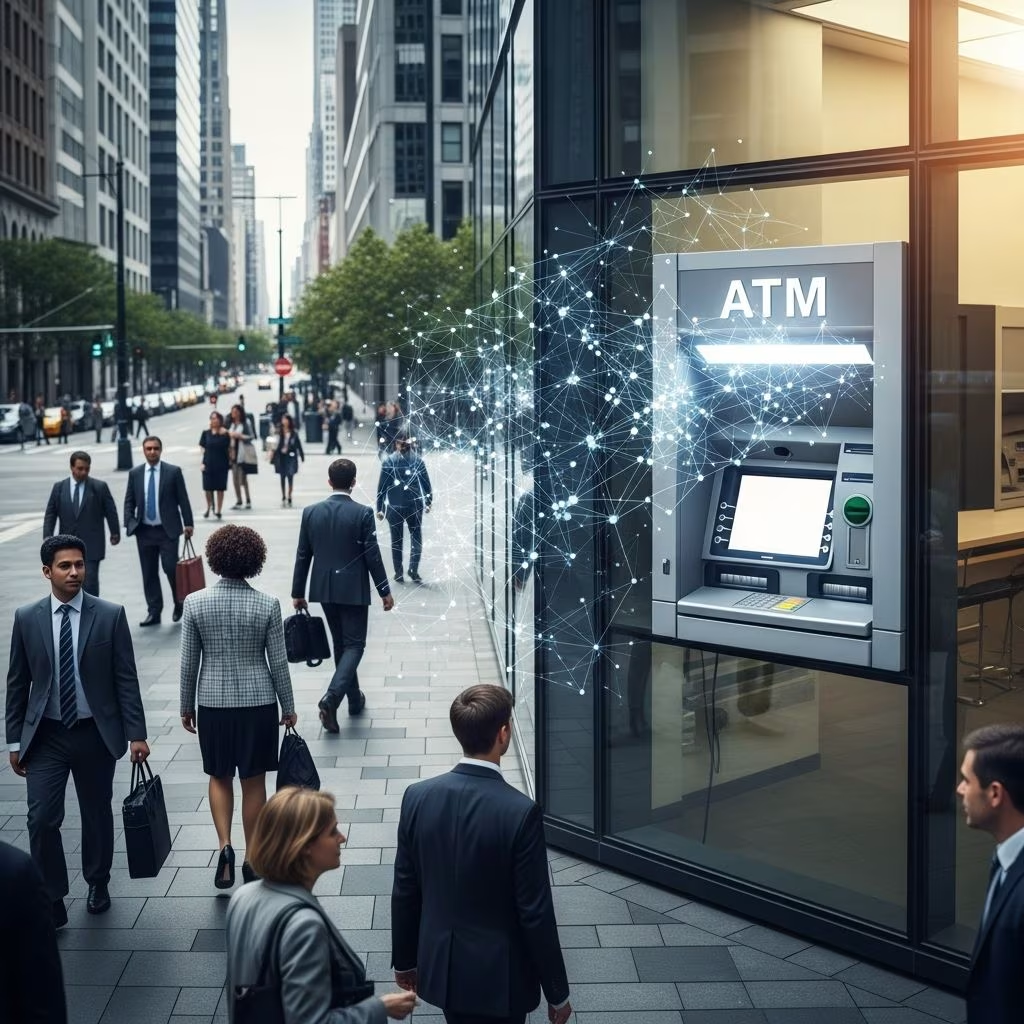
ATM access remains one of the most important features of any bank account. Heavy ATM users can save a significant amount of money each year by choosing banks that offer large ATM networks, ATM fee reimbursement, or both. At the same time, you need to compare fees, interest rates, and account terms so that convenient ATM access does not come with hidden costs elsewhere.
This guide explains how ATM networks work, highlights banks known for extensive ATM access, and shows how to choose accounts that minimize or avoid ATM fees.
Why ATM Access Still Matters
Even in a world of mobile payments and digital wallets, cash is still widely used for person-to-person payments, small purchases, and emergencies. The Federal Reserve’s most recent Diary of Consumer Payment Choice reports that cash continues to be a common payment method for low-value, in-person transactions, especially under $25.
However, withdrawing cash can be expensive if you regularly use ATMs outside your bank’s network. According to a Bankrate survey, the combined average cost of using an out-of-network ATM (your bank’s fee plus the ATM owner’s surcharge) has reached record highs in recent years, exceeding $5 in some U.S. metro areas.
That is why it pays to focus on both the size of a bank’s ATM network and how it handles out-of-network ATM fees.
Best Banks for ATMs: What to Look For
When evaluating the best banks for ATMs, look at several key dimensions beyond just the number of machines.
- Network size and coverage: How many ATMs can you use for free nationwide? Are there locations in the states or cities you visit most often?
- Out-of-network fee policy: Does the bank charge its own non-network ATM fee? Does it reimburse any surcharges charged by ATM operators, and if so, how much per month?
- Account fees: Is there a monthly maintenance fee, and can it be waived? Are overdraft fees high relative to averages?
- Interest rates (APY): For interest-bearing checking and savings, how do the rates compare with other banks?
- Branch access: Do you need physical branches, or are you comfortable with an online-only bank that focuses on ATM and digital access?
Many of the banks that stand out for ATM access are either large national institutions with thousands of their own ATMs, or online banks and brokerages that reimburse third-party ATM fees.
Major National Banks with Large ATM Networks
Traditional national banks often maintain thousands of branded ATMs. These machines are typically free for their own customers, and can provide broad coverage across multiple states.
| Bank | Approximate Deposits* | U.S. Branches* | States with Branches* | ATMs* | Key Drawbacks |
|---|---|---|---|---|---|
| JPMorgan Chase | $2.3 trillion* | 4,700* | 35* | 16,000* | No truly free standard checking, higher-than-average overdraft fees, and comparatively low savings APYs. |
| Bank of America | $1.9 trillion* | 3,900* | 37* | 18,000* | Limited free checking options, overdraft fees can be above industry averages, and savings rates are low. |
| Wells Fargo | $1.3 trillion* | 8,050* | 42* | 13,000* | Few free checking options, overdraft charges often higher than peers, and weak savings yields. |
| Citibank | $1.4 trillion* | 2,600+* | 13* | 3,200+* | Free checking mostly for students, relatively high overdraft fees, and below-average savings rates. |
*Figures are approximate and for illustrative comparison only; actual counts and balances change over time based on bank reports and regulatory filings.
These banks stand out for the sheer number of ATMs and branches, which can be advantageous if you travel frequently within the U.S. However, large national banks often offset the cost of their infrastructure with higher account fees and lower deposit interest rates relative to online competitors.
Online Banks and Brokerages with ATM Fee Reimbursement
Online-focused banks typically have few or no branches, but they compensate by partnering with large ATM networks or by reimbursing third-party ATM fees. This model offers flexibility, especially for customers who are comfortable doing most of their banking digitally.
- Charles Schwab Bank: Its widely known investor checking account reimburses all ATM fees worldwide, making it a favorite for international travelers, though interest rates are modest compared with high-yield savings.
- Ally Bank: Provides access to tens of thousands of fee-free ATMs and reimburses a set dollar amount per statement cycle for out-of-network domestic ATM fees.
- Capital One: Offers 70,000+ fee-free ATMs through its own machines and partner networks like MoneyPass and Allpoint.
- First Internet Bank and other online banks: Some accounts reimburse a fixed amount of ATM surcharges each month, effectively lowering the cost of using non-network ATMs.
These banks often pair robust ATM policies with low or no monthly maintenance fees and more competitive interest rates, but you must be comfortable with limited or no branch access.
Understanding Major ATM Networks
In many cases, the size of your ATM network depends less on your bank’s own machines and more on which third-party ATM networks it uses. Online banks, credit unions, and some regional banks plug into these networks so their customers can withdraw cash without surcharges.
Allpoint
Allpoint is marketed as the world’s largest surcharge-free ATM network, with more than 55,000 locations worldwide, including the United States, Canada, Mexico, Australia, and the United Kingdom. Allpoint ATMs are commonly located in national retail chains and convenience stores. If your bank or credit union participates in Allpoint, you can typically withdraw cash at these machines without paying the ATM owner a surcharge.
MoneyPass
MoneyPass, operated by Fiserv, offers a network of more than 32,000 surcharge-free ATMs across the United States. Many regional and online banks, as well as some credit unions, use the MoneyPass network, which can significantly expand your free ATM access beyond your bank’s own branch footprint.
NYCE, Pulse, and STAR
Several other major ATM and debit networks add further coverage:
- NYCE: Operated by FIS, this network includes thousands of ATMs in the U.S. and supports both ATM and point-of-sale debit transactions.
- Pulse: A Discover Financial Services network, Pulse connects hundreds of thousands of ATMs and millions of point-of-sale terminals in the U.S. and more than 100 countries.
- STAR: Operated by Fiserv (previously First Data), STAR provides nationwide ATM and debit access across all 50 states.
Most ATMs prominently display network logos (e.g., Allpoint, MoneyPass, Pulse), helping you quickly determine whether your card will work surcharge-free. Some machines belong to multiple networks, which increases the chance your bank participates in at least one of them.
How to Minimize ATM Fees
Reducing or eliminating ATM fees requires a combination of bank selection and good habits. A few key strategies can make a large difference over time.
- Choose banks with broad free ATM access: Look for banks that either operate thousands of ATMs themselves or partner with large networks such as Allpoint and MoneyPass.
- Prioritize reimbursement policies: Some institutions reimburse all or part of third-party ATM surcharges each month, which can be especially valuable if you travel or live in an area with few in-network ATMs.
- Plan withdrawals ahead: Instead of making several small withdrawals and incurring multiple surcharges, withdraw a larger amount once (within your daily limit) and reduce the number of fee-bearing transactions.
- Use cash back at stores when possible: Many retailers offer cash back during debit card purchases, which can provide cash without ATM fees, subject to the store’s limits.
- Monitor your bank’s disclosures: Banks must clearly disclose ATM fees, reimbursement caps, and network affiliations in their account terms; review these regularly for changes.
Know Your Limits When Using ATMs with Savings Accounts
Accessing cash from a savings account via ATM can be convenient, but it comes with important restrictions and potential trade-offs.
- Withdrawal limits: Each bank sets its own daily ATM withdrawal limit, which may differ between checking and savings accounts. These limits are designed to reduce risk from theft or fraud.
- Transaction counts: Historically, U.S. regulations limited certain types of savings withdrawals to six per month; while the Federal Reserve removed this strict federal cap in 2020, many banks still impose their own limits or fees on excessive savings withdrawals.
- Risk of fees: If your bank still enforces savings withdrawal limits, repeated ATM transfers or withdrawals from savings could trigger excess-withdrawal fees.
- Impact on savings goals: Frequent cash access from savings can undermine long-term goals. Consider using a linked checking account for everyday ATM activity and reserving savings for less frequent needs.
Before relying on a savings account for ATM use, review your bank’s specific rules, including per-day dollar limits, per-month transaction caps, and any excess-activity fees.
Comparing ATM-Focused Checking Accounts
Because ATM use is generally tied to your primary checking account, evaluating checking features alongside ATM policies is essential.
| Feature | Large National Banks | Online / Hybrid Banks |
|---|---|---|
| ATM Access | Thousands of branded ATMs; some limited non-network fee waivers. | Fewer proprietary ATMs but broad surcharge-free access through networks and reimbursements. |
| Monthly Fees | Often $10–$15, sometimes waivable with direct deposit or balance minimums. | Frequently no monthly maintenance fee. |
| Overdraft Fees | Can be relatively high, though many have introduced safety nets or reduced fees. | Often lower fees and more flexible overdraft policies, sometimes with small buffers. |
| Interest Rates | Checking and savings APYs generally low relative to online peers. | More competitive APYs on checking/savings, especially in bundled accounts. |
| Branch Access | Extensive; good for in-person service and cash deposits. | Limited or none; deposits handled via mobile, ACH, or mail. |
Deciding between these options depends on how you value in-person service versus fee savings and reimbursement flexibility.
How to Choose the Best Bank for Your ATM Needs
The best bank for ATMs is highly personal. Ask yourself the following questions before you open or switch accounts:
- How often do I use ATMs? If you withdraw cash several times per week, even modest fees can add up quickly.
- Where do I live and travel? Look for banks or networks with strong coverage in your city, state, and typical travel destinations.
- Do I mostly bank online? If yes, online banks that emphasize ATM reimbursements may be particularly attractive.
- Am I willing to maintain minimum balances? Some banks waive fees or offer better benefits if you keep a certain amount in the account.
- What other features matter? Consider mobile apps, bill pay, overdraft protection, and linked savings options.
It can be helpful to use comparison tools or bank award reports that evaluate institutions on fees, interest rates, and digital features in addition to ATM policies.
Frequently Asked Questions (FAQs)
Q: What bank has the most free ATMs?
Several large banks and networks provide extensive fee-free ATM access. Capital One customers, for example, can access more than 70,000 ATMs through the bank’s own machines and partner networks such as MoneyPass and Allpoint. Some credit unions and online banks also tap into broad surcharge-free networks like Allpoint, effectively giving their customers tens of thousands of free ATM locations.
Q: Which bank ATM lets me withdraw the most cash?
The per-day withdrawal limit depends on your bank, account type, and sometimes the specific ATM. Banks set these limits for security and risk management reasons, and they can vary widely. If you regularly need larger withdrawals, contact your bank to ask about your current limit and whether it can be temporarily or permanently increased.
Q: What bank or network has the largest ATM footprint?
In terms of surcharge-free networks, Allpoint is one of the largest, with more than 55,000 ATMs across multiple countries. Among individual banks, national institutions like Bank of America and Chase operate many thousands of branded ATMs, while some online-focused banks give you access to similarly large footprints by partnering with networks such as Allpoint, MoneyPass, Pulse, and STAR.
Q: How much can I save by avoiding out-of-network ATM fees?
If the combined average fee for an out-of-network ATM withdrawal is more than $4–$5, as surveys from Bankrate and others indicate in many cities, a customer who makes four such withdrawals a month could easily spend over $200 a year in ATM fees. Choosing a bank or network that minimizes these costs can translate directly into savings.
Q: Are online banks safe for heavy ATM users?
Most reputable online banks are insured by the Federal Deposit Insurance Corporation (FDIC) to the same limits as traditional banks, and they often use major ATM networks plus reimbursement policies to ensure convenient cash access. As long as you confirm FDIC insurance, understand the bank’s ATM and reimbursement rules, and follow basic security practices, online banks can be a safe and cost-effective option for frequent ATM users.
References
- 2023 Findings from the Diary of Consumer Payment Choice — Board of Governors of the Federal Reserve System. 2023-10-19. https://www.federalreserve.gov/paymentsystems/2023-diary-of-consumer-payment-choice.htm
- Payment Services (including cash machines) — UK Payment Markets / LINK & international ATM network data summary. UK Finance. 2023-07-01. https://www.ukfinance.org.uk/data-and-research/data/payment-markets
- Bankrate 2024 Checking Account and ATM Fee Study — Bankrate. 2024-10-02. https://www.bankrate.com/banking/checking/checking-account-survey/
- Allpoint Network Overview — Allpoint / NCR Atleos. 2024-01-15. https://www.allpointnetwork.com/atm-locations
- FDIC Consumer News: Understanding Overdraft and Account Fees — Federal Deposit Insurance Corporation. 2024-06-06. https://www.fdic.gov/resources/consumers/consumer-news/2024-06.html
- 2026 Banking Awards: Top-Ranked Accounts for Savings and Checking — MoneyRates. 2025-12-20. https://www.moneyrates.com/bank-awards.htm
- Best National Banks of 2026: Top Institutions Reviewed — MoneyRates. 2025-12-15. https://www.moneyrates.com/banks/best-national-banks.htm
This article is general information, not personal financial advice. Consider your own situation, or speak with a licensed adviser, before acting on it.