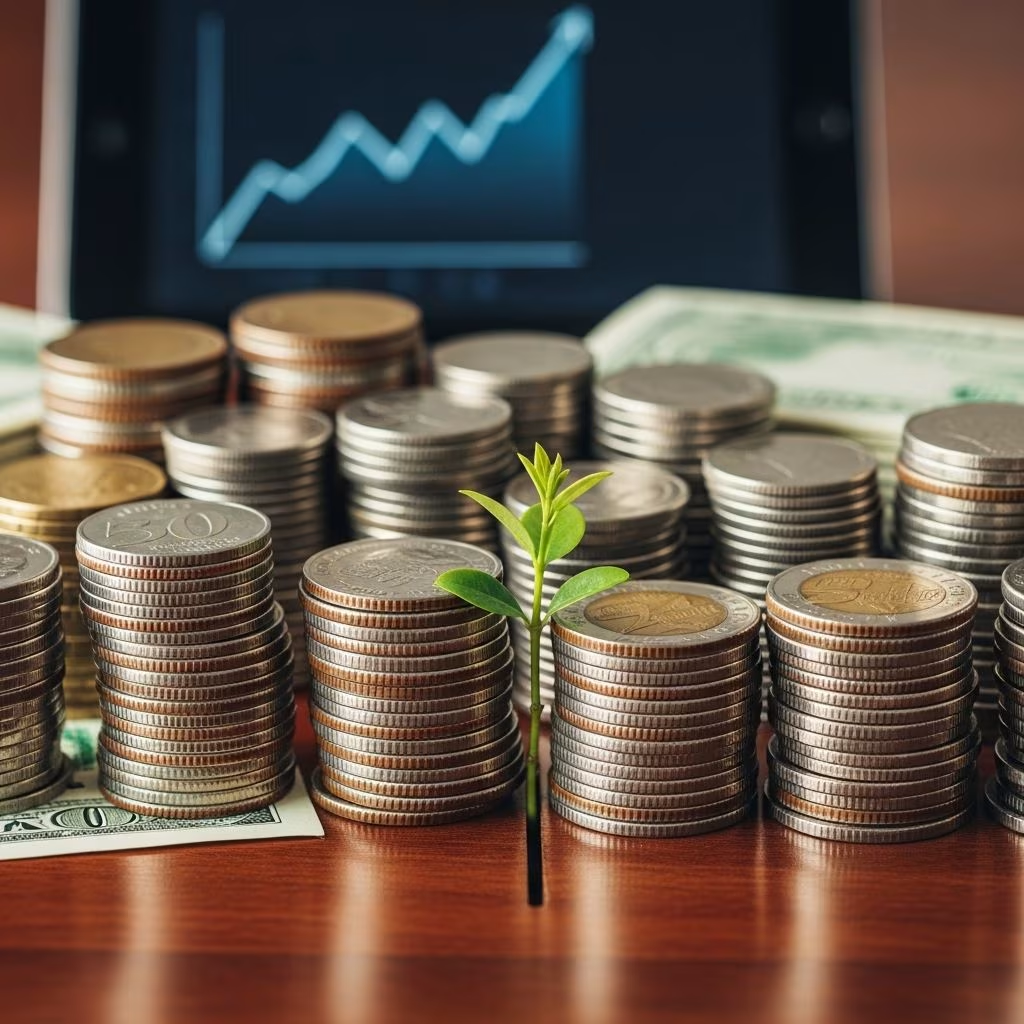
Many savers still earn very little interest on their money, even though high-yield savings options can pay several times the national average rate. To grow your savings faster and protect your money from inflation, it is essential to choose the right accounts and use a few simple strategies to maximize the interest you earn.
Why Earning a Higher Rate on Savings Matters
The interest rate on your savings directly affects how quickly your money grows. A small difference in rate becomes a large difference in dollars when you compound returns over several years and on larger balances.
According to recent banking data, the national average savings rate in the U.S. has hovered well under 1% APY, while some of the best high-yield savings accounts pay around 5% APY or more. That spread means you could earn several times more interest simply by moving to a better account.
- National average savings rate: often under 1% APY.
- Top high-yield savings accounts: roughly 4–5% APY in recent surveys.
- Impact: A higher rate can increase your annual interest by hundreds or thousands of dollars, depending on your balance.
For example, consider a $5,000 balance:
- At 0.01% APY, you earn about $0.50 in interest per year.
- At 5.00% APY, you earn about $250 in interest per year.
That’s a 500-fold increase in annual interest simply from choosing a better account, not from saving more money.
Set Clear Savings Goals Before You Choose Accounts
Before opening or switching accounts, define exactly what you are saving for and when you will need the money. Research indicates that people who set specific savings goals accumulate substantially more than those who do not. Clear goals help you match each dollar with the right type of account and time horizon.
- Short-term goals (0–2 years): emergency fund, car repair, vacation, moving costs.
- Medium-term goals (2–5 years): home down payment, wedding, graduate school.
- Long-term goals (5+ years): large home renovation, business start-up funds, early retirement savings (beyond tax-advantaged accounts).
Once your goals are clear, you can choose the accounts that balance three things for each goal:
- Safety of principal
- Access to your money when needed
- Interest rate or return
Understand the Main Types of Savings Accounts
Different account types are better suited for different goals. Each has its own trade-off between liquidity, rate, and predictability.
| Account Type | Typical APY Range* | Best For |
|---|---|---|
| Basic Savings Account | About 0.05%–0.5% APY at many banks | Minimal balances, basic emergency funds at same bank as checking |
| High-Yield Savings | Up to ~5.3% APY at competitive banks | Emergency funds, flexible goals, everyday savings with better rates |
| Online Savings Account | Often similar to high-yield accounts | People comfortable banking online who want top rates and low fees |
| Money Market Account | Higher than basic savings, sometimes comparable to high-yield | Larger balances needing limited check-writing or debit access |
| Certificates of Deposit (CDs) | Rates often higher for longer terms | Money you can lock up for a fixed period without needing access |
*Ranges are approximate and depend on current market conditions and specific banks.
Use High-Yield Savings Accounts for Everyday Goals
High-yield savings accounts are one of the easiest ways to earn more interest while keeping quick access to your cash. They work like regular savings accounts but pay much higher rates, especially at online banks.
Advantages of high-yield savings accounts
- Significantly higher APY than traditional branch-based savings.
- FDIC or NCUA insurance at most U.S. banks and credit unions, up to legal limits.
- Flexible access through transfers, mobile apps, and sometimes ATMs.
- Low or no monthly fees at many online institutions.
High-yield savings accounts are ideal for:
- Emergency funds
- Short-term goals where you might need quick access
- Parking large balances temporarily while deciding on longer-term investments
Why Online Banks Often Pay the Best Rates
Online banks frequently offer the most competitive savings and money market rates because they have lower operating costs than traditional branch-based banks. They pass part of those savings back to customers through higher APYs.
- Online savings account rates have been measured at nearly ten times the average branch-based rate in some surveys.
- Online banks often also reduce or eliminate monthly maintenance fees.
- They typically provide modern digital tools, such as mobile check deposit and real-time alerts, making it easier to manage your savings.
If you primarily use digital banking and rarely visit branches, moving your savings to a reputable online bank can substantially increase the interest you earn without sacrificing convenience.
Use CDs and CD Ladders for Higher and More Predictable Yields
Certificates of deposit (CDs) can offer higher yields than savings accounts in exchange for committing your money for a fixed term, such as 6 months, 1 year, or 5 years. You typically pay a penalty if you withdraw before the maturity date, so CDs work best for money you will not need immediately.
When CDs make sense
- You have a specific date when you will need the money (for example, a tuition payment next year).
- You want a fixed, guaranteed rate for the entire term.
- You are willing to trade some liquidity for a higher yield.
What is a CD ladder?
A CD ladder is a strategy that spreads your money across multiple CDs with different maturity dates. This balances higher long-term CD rates with regular access to portions of your money.
Example of a simple 4-year CD ladder with $8,000:
- $2,000 in a 1-year CD
- $2,000 in a 2-year CD
- $2,000 in a 3-year CD
- $2,000 in a 4-year CD
When the 1-year CD matures, you can either:
- Use the cash if you need it, or
- Reinvest it in a new 4-year CD to keep the ladder going at higher long-term rates
This strategy gives you:
- Regular access to part of your savings at each maturity date.
- Higher average yield than keeping everything in a short-term CD or low-rate account.
Boost Returns with Consistent, Automated Deposits
Compounding becomes much more powerful when you add money regularly. Frequent contributions mean more dollars earning interest, and each interest payment then earns more interest over time.
Why consistent deposits help
- They increase your average balance, so more of your money is earning interest.
- They make saving automatic, reducing the temptation to spend first and save last.
- They help you benefit from a form of dollar-cost averaging on cash yields and future investment decisions.
How to automate your savings
- Set up an automatic transfer from checking to savings each payday.
- Direct a portion of your paycheck straight into a high-yield savings account if your employer allows split deposits.
- Increase your automatic savings amount when you receive raises, bonuses, or tax refunds.
For visual learners, using a bank-provided or independent compound interest calculator can help you see how regular contributions accelerate growth over time.
Know When Switching Accounts Is Worth It
Moving your savings to a higher-rate account can be very rewarding, but switching too often can be inconvenient. Focus on situations where the benefit clearly outweighs the hassle.
Consider switching if:
- The new account’s rate is at least 1 percentage point higher than your current one, especially on larger balances.
- You have a substantial balance (for example, $10,000 or more) so that the extra interest is meaningful.
- Your current account charges maintenance or low-balance fees that eat into your returns.
Examples of rate differences that matter
- On $10,000, a 1% higher rate earns about $100 more per year.
- On $2,000, that same 1% difference is only $20 per year, which may not justify the effort to switch.
When rates move lower in the broader economy, you do not have to accept a poor rate. Even in low-rate environments, the best savings accounts can offer several times the interest of the average account, so comparing and switching periodically can still improve your earnings.
Practical Steps to Earn More Interest on Your Savings
To summarize the main strategies and help you put them into action, use the checklist below.
- Define specific savings goals and timeframes for each bucket of money.
- Match each goal to the right account type:
- High-yield or online savings for emergencies and flexible goals.
- Money market accounts for larger balances with limited check access.
- CDs and CD ladders for money you can lock up for a period to get higher rates.
- Automate deposits from checking to savings so you contribute consistently.
- Monitor your APY and compare it to current top rates at least a few times per year using reputable comparison tools.
- Switch accounts when the rate gap is large enough and your balance is high enough that the added interest is clearly worthwhile.
Safety and Insurance Considerations
Always verify that the bank or credit union holding your savings is properly insured. In the United States, eligible deposits are insured up to legal limits by the Federal Deposit Insurance Corporation (FDIC) or the National Credit Union Administration (NCUA).
- Confirm the institution is an FDIC member bank or NCUA insured credit union.
- Stay within insurance limits per depositor, per institution, and per ownership category.
- Keep records of your accounts and balances, especially if you use multiple banks.
Choosing insured institutions ensures that while you work to increase your interest earnings, your principal remains protected up to the applicable limits if the institution fails.
Frequently Asked Questions (FAQs)
Q: What is a good interest rate on a savings account?
A: A good rate is typically one that is significantly higher than the national average and close to the best rates available from reputable banks. Recent surveys show top high-yield savings accounts paying several times more than average branch-based accounts, so aim for rates in that competitive range.
Q: Is a high-yield savings account safe?
A: High-yield savings accounts at FDIC-insured banks or NCUA-insured credit unions are generally just as safe as traditional savings accounts, as long as your balances stay within insurance limits. The main difference is the higher APY and, often, the online-only access.
Q: Should I put my entire emergency fund in a high-yield online account?
A: Many people keep most of their emergency fund in a high-yield online account to earn more interest, while keeping a small portion in a local bank for instant access. The right mix depends on your comfort level and how quickly you might need the money.
Q: When does it make sense to use CDs instead of savings accounts?
A: CDs work best for money you do not need for a specific period and want to lock in a fixed rate. If you may need the funds unexpectedly, a high-yield savings account or money market account is usually more appropriate due to their greater liquidity.
Q: How often should I compare savings account rates?
A: Checking rates two to four times per year is usually enough for most savers. If you notice your rate dropping or you learn that other banks are offering substantially better APYs, it may be time to compare options and consider switching.
References
- Savings Accounts: Essentials & Tips — MoneyRates. 2025-10-15 (updated, date approximate based on page metadata). https://www.moneyrates.com/savings/
- How to Earn More Interest on Your Savings in 2025 — MoneyRates. 2025-11-20 (approximate; article content reference). https://www.moneyrates.com/savings/ways-to-earn-more-interest-on-savings.htm
- The Best High-Yield Savings Accounts for January 2026 — MoneyRates. 2026-01-01. https://www.moneyrates.com/savings/high-yield-savings-accounts.htm
- Interest Rate Comparison Tool — MoneyRates. 2024-09-30 (tool and methodology). https://www.moneyrates.com/research-center/compare-interest-rates.htm
- 6 Factors Affecting Savings & Money Market Rates — MoneyRates. 2018-10-05. https://www.moneyrates.com/money-market-account/key-factors-that-will-affect-money-market-rates.htm
This article is general information, not personal financial advice. Consider your own situation, or speak with a licensed adviser, before acting on it.