

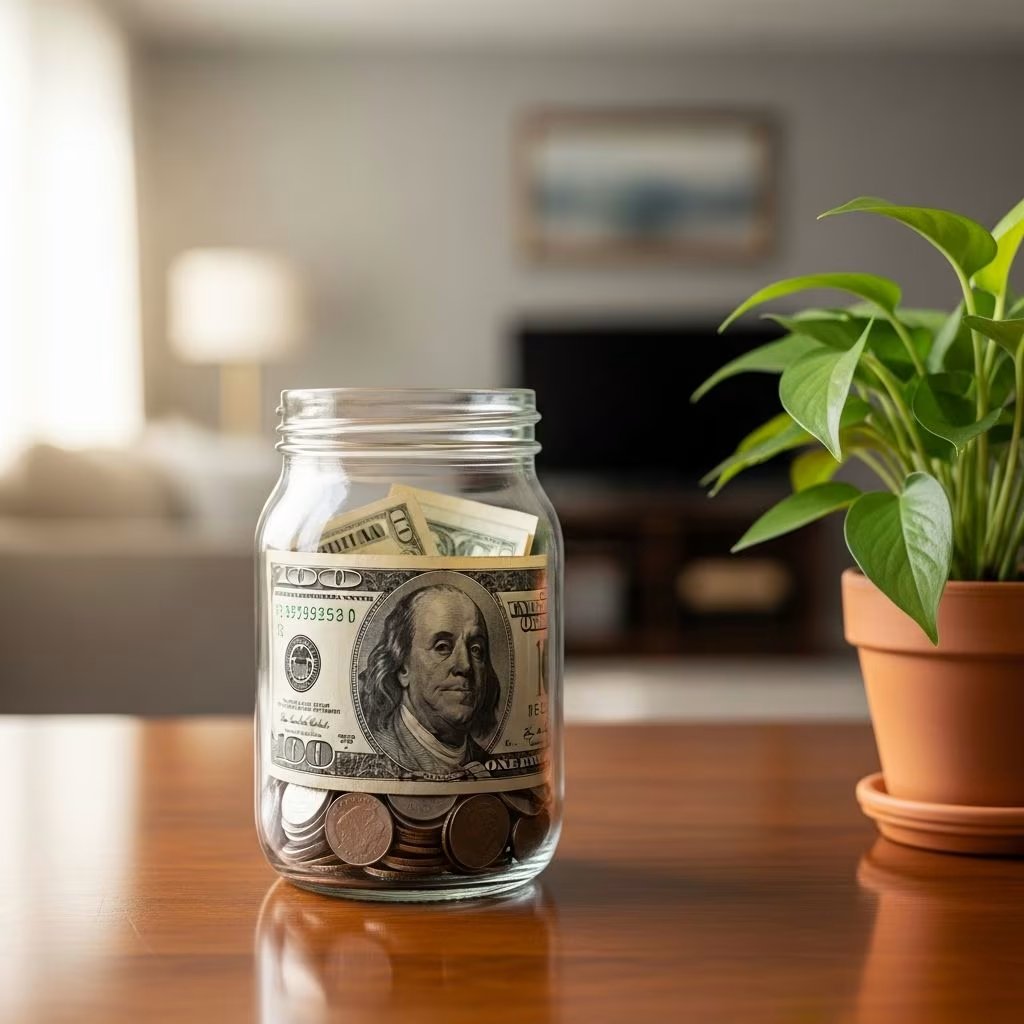
An emergency fund is one of the most important building blocks of financial stability. It protects you from unexpected expenses and income shocks so you can avoid high-interest debt and keep long-term goals on track. Knowing how much to save, where to keep it, and how to build it step by step can turn a vague money goal into a clear, actionable plan.
This guide explains how to calculate your ideal emergency fund, how to customize it to your situation, the best places to store it, and realistic strategies to grow it over time.
What Is an Emergency Fund?
An emergency fund is a cash reserve set aside specifically for unplanned expenses or financial emergencies such as a job loss, medical bills, car repairs, or urgent home maintenance. It is not meant for vacations, planned purchases, or everyday spending.
Key characteristics of a solid emergency fund include:
- Accessibility: You can get to the money quickly when an emergency occurs.
- Safety: Your principal is protected and not exposed to large market swings.
- Separation: The money is kept in a separate account so you are less tempted to spend it on non-emergencies.
Without this buffer, many people turn to credit cards, personal loans, or skipping essential bills when the unexpected happens, which can create long-lasting financial strain.
Why Emergency Funds Matter
Recent surveys show that a significant share of households do not have enough cash to handle a modest financial shock. Bankrate’s 2025 emergency savings report found that nearly one in four Americans has no emergency savings at all, and only 46% have enough to cover three months of expenses. This gap makes people much more vulnerable to events like job loss, medical emergencies, or major repairs.
An emergency fund helps you:
- Avoid high-interest debt when emergencies strike, such as relying on credit cards for urgent costs.
- Stay current on bills even if your income drops temporarily.
- Protect long-term goals so you do not need to cash out retirement or investment accounts at a bad time.
- Reduce stress: Knowing you have a cushion can significantly improve financial confidence.
How Much Emergency Fund Is Enough?
There is no single number that fits everyone, but most financial experts recommend a target range rather than a fixed dollar amount.
Common guidance from banks and financial institutions suggests saving three to six months of essential living expenses for emergencies.[10] However, the right amount for you depends on your job stability, income sources, family situation, and existing safety nets.
| Situation | Suggested Emergency Fund Target |
|---|---|
| Stable job, single income, few dependents | 3–4 months of expenses |
| Dual-income household, stable careers | 3–6 months of expenses |
| Self-employed or irregular income | 6–12 months of expenses |
| Single earner with dependents | 6–9 months of expenses |
| High-risk industry or limited job prospects | 9–12 months of expenses |
If saving several months of expenses feels overwhelming, start with a smaller, more immediate goal such as $500 to $1,000. Even a modest cushion can help cover smaller emergencies and keep you from turning to costly credit.
Factors That Affect Your Emergency Fund Size
Consider the following when deciding where you fall within or beyond the three-to-six-month guideline:
- Job stability: If your job is secure in a strong industry, you may be comfortable with a smaller fund. If you work on commission, in cyclical industries, or face layoff risk, a larger cushion is wise.
- Number of income sources: Dual-income households may weather a job loss more easily than single-earner households.
- Dependents: Supporting children, aging parents, or others increases the cost and complexity of emergencies.
- Health and insurance coverage: High deductibles or limited insurance can mean higher out-of-pocket costs in a medical event.[10]
- Existing savings and credit access: Strong savings or low-rate credit lines do not replace an emergency fund, but they can influence how conservative you want to be.
How to Calculate Your Emergency Fund Target
Rather than guessing, calculate a clear target based on your actual monthly expenses. Many financial organizations recommend breaking expenses into fixed and variable categories to get an accurate picture.
Step 1: List Your Essential Monthly Expenses
Focus on costs you must cover to keep your household functioning during a crisis. These typically include:
- Rent or mortgage payments
- Utilities (electricity, water, gas, internet, phone)
- Groceries and basic household supplies
- Insurance premiums (health, auto, renters or homeowners)
- Transportation (car payment, fuel, transit passes)
- Minimum debt payments (credit cards, student loans, personal loans)
- Childcare or essential education expenses
- Medical costs you regularly pay out of pocket
Exclude non-essentials such as vacations, entertainment, and luxury shopping. The goal is to understand what it costs to keep your life running at a basic but comfortable level.
Step 2: Calculate Your Monthly Total
Add up the essential expenses to arrive at your core monthly spending number. If some costs vary from month to month, use a three- to six-month average or a reasonable estimate based on recent history.
Step 3: Choose Your Multiplier
Decide how many months of expenses to cover based on your risk factors:
- Relatively stable job, no dependents: multiply by 3–4.
- Family household or somewhat uncertain job outlook: multiply by 6.
- Self-employed, gig work, or high-risk field: multiply by 9–12.
For example, if your essential expenses are $3,000 per month and you aim for six months, your target emergency fund is $18,000.
Step 4: Set Milestones
Break your ultimate target into smaller milestones so it feels achievable. For instance:
- Milestone 1: First $500–$1,000.
- Milestone 2: One month of expenses.
- Milestone 3: Three months of expenses.
- Milestone 4: Full target (six months or more).
Celebrate progress at each milestone to stay motivated, even if your ultimate number is years away.
Where to Keep Your Emergency Fund
An effective emergency fund needs to be safe, liquid, and ideally interest-bearing. It should not be locked away in investments that could lose value right when you need the money.
Financial institutions and regulators highlight the importance of choosing accounts that preserve capital while offering quick access to cash.
High-Yield Savings Accounts
High-yield savings accounts are often one of the best options for emergency funds. Many of these accounts:
- Are offered by banks or credit unions insured by the FDIC or NCUA up to applicable limits.
- Provide competitive interest rates well above traditional branch savings accounts, especially at online banks.
- Allow easy transfers to checking or direct withdrawals, preserving liquidity.
Because emergency funds may sit untouched for months, earning a higher yield helps offset inflation and grow your buffer over time.
Money Market Deposit Accounts
Money market deposit accounts at banks or credit unions can also be good emergency fund vehicles. They typically:
- Are FDIC- or NCUA-insured up to applicable limits.
- Offer check-writing or debit card access in many cases.
- Pay competitive rates, sometimes higher than regular savings.
These accounts combine safety with convenient access, which can be useful during a time-sensitive emergency such as a major car repair.
Certificates of Deposit (CDs)
CDs generally pay higher interest in exchange for locking in your money for a set term. They are usually not ideal for your entire emergency fund because early withdrawals can incur penalties. However, some people use a portion of their emergency savings in a “CD ladder” while keeping the rest in a more liquid account, balancing yield with accessibility.
Money Market Mutual Funds
Money market mutual funds, offered through brokerage firms, invest in short-term instruments such as Treasury bills and commercial paper. They aim to maintain a stable value and provide liquidity, but they are not insured or guaranteed by the FDIC or any government agency. It is still possible, although uncommon, to lose money in these funds, so they may be better suited for investors comfortable with a small degree of risk rather than for core emergency savings.
Checking Accounts
Keeping part of your emergency fund in a checking account can provide immediate access via debit card or checks. However, checking accounts typically pay little or no interest, so they are best used for a small front-line buffer, with the bulk of your emergency savings held in a higher-yield, but still liquid, account.
Strategies to Build Your Emergency Fund
Building an emergency fund is less about finding the perfect moment and more about consistent, manageable progress. Even small regular contributions can grow into a meaningful cushion over time.
1. Start Small and Be Consistent
If money is tight, the Consumer Financial Protection Bureau emphasizes that even modest savings can make a difference. Start with what you can afford:
- Set an initial goal of $500, then work toward $1,000.
- Automate a transfer of $10–$50 per paycheck into your emergency fund.
- Increase contributions whenever your income rises or expenses fall.
2. Automate Your Savings
Automation reduces the temptation to skip contributions. You can:
- Set up automatic transfers from your checking to your emergency savings the day after each payday.
- Use payroll split deposits (if offered) to send a fixed amount directly into savings.
- Round up debit card purchases to the nearest dollar and direct the difference to savings, if your bank offers this feature.
3. Redirect Windfalls
Use unexpected money to accelerate your progress:
- Tax refunds
- Work bonuses or commissions
- Cash gifts
- Proceeds from selling unused items
Consider allocating a percentage of every windfall (for example, 50–75%) to your emergency fund until you reach your target.
4. Adjust Your Budget
Budgeting is a powerful tool for freeing up money to save. Financial education resources commonly recommend tracking spending and making small adjustments over time. Potential areas to trim include:
- Subscription services you rarely use
- Dining out and delivered meals
- Impulse online shopping
- Non-essential travel or entertainment
Even $50–$100 per month redirected to your emergency fund can significantly shorten the time it takes to reach your goal.
5. Review and Rebalance Over Time
Your ideal emergency fund will change as your life changes. Review your situation at least once a year and after major milestones such as marriage, having a child, buying a home, or changing jobs. Adjust your target and contributions accordingly.
When You Should Use Your Emergency Fund
An emergency fund is for genuine, unexpected financial needs, not for planned events or wants. It is helpful to define in advance what counts as an emergency for you.
Appropriate Uses
- Job loss or a significant reduction in working hours
- Unexpected medical or dental bills
- Major car repairs needed to stay employed
- Urgent home repairs (for example, fixing a broken furnace in winter)
- Emergency travel related to illness or family crisis
Situations That Usually Do Not Qualify
- Vacations and leisure travel
- Planned home renovations or upgrades
- Non-essential shopping or entertainment
- Routine bills when income is adequate
If you do tap your emergency fund, prioritize rebuilding it as soon as possible after the crisis passes.
Common Mistakes to Avoid
Even with good intentions, it is easy to weaken your emergency fund strategy without realizing it. Avoid these pitfalls:
- Investing the entire fund in volatile assets such as stocks or long-term bonds, which can fall in value at the exact moment you need the money.
- Keeping it too inaccessible, for example in long-term CDs with large penalties, so you hesitate to use it when you truly need to.
- Mixing it with everyday spending in your main checking account, making it hard to track and easier to spend casually.
- Never adjusting the target as your life changes, leaving you under- or over-funded for your current situation.
Frequently Asked Questions (FAQs)
Q: Is three to six months of expenses always enough?
A: Three to six months is a widely used rule of thumb recommended by many financial experts and surveys, but it is a starting point, not a one-size-fits-all number.[10] If your income is irregular, your job is less secure, or you have dependents, aiming for nine to twelve months can provide more protection.
Q: Should I pay off debt or build an emergency fund first?
A: Many people find a balanced approach works best. Building a small starter emergency fund (for example, $500–$1,000) can keep you from relying on more high-interest debt for small emergencies, while you also make steady progress on paying down existing debt. After reaching that starter amount, you can decide how to split extra cash between more aggressive debt repayment and growing your emergency fund.
Q: Where is the best place to keep my emergency fund?
A: A separate high-yield savings account or insured money market deposit account is often ideal. These accounts combine principal protection, easy access, and interest earnings, which helps your emergency fund keep up better with inflation.
Q: How often should I review my emergency fund?
A: Review your emergency fund at least once a year and after major life changes such as a job change, marriage or divorce, a new child, or buying a home. Check whether your current balance still covers your chosen number of months of essential expenses and adjust your contributions as needed.
Q: What if I can only save a small amount each month?
A: Saving small amounts is still worthwhile. The Consumer Financial Protection Bureau notes that even modest savings can provide meaningful financial security over time. Focus on consistency: automate what you can afford, increase contributions when your income grows, and use windfalls to accelerate progress.
References
- An essential guide to building an emergency fund — Consumer Financial Protection Bureau. 2024-03-12. https://www.consumerfinance.gov/an-essential-guide-to-building-an-emergency-fund/
- Bankrate’s 2025 Annual Emergency Savings Report — Bankrate. 2025-05-29. https://www.bankrate.com/banking/savings/emergency-savings-report/
- How Much Should You Be Saving for an Emergency? — Wells Fargo. 2024-06-10. https://www.wellsfargo.com/financial-education/basic-finances/manage-money/cashflow-savings/emergencies/
- Comprehensive Guide to Building an Emergency Fund — Vanguard. 2023-11-15. https://investor.vanguard.com/investor-resources-education/emergency-fund
- Ways to Earn More Interest on Your Money in 2026 — MoneyRates. 2025-12-20. https://www.moneyrates.com/savings/ways-to-earn-more-interest-on-savings.htm
- Your Emergency Fund: How Much Is Enough? — Bailey Wealth Advisors. 2024-02-08. https://www.baileywealthadvisors.com/resource-center/money/your-emergency-fund-how-much-is-enough
This article is general information, not personal financial advice. Consider your own situation, or speak with a licensed adviser, before acting on it.


