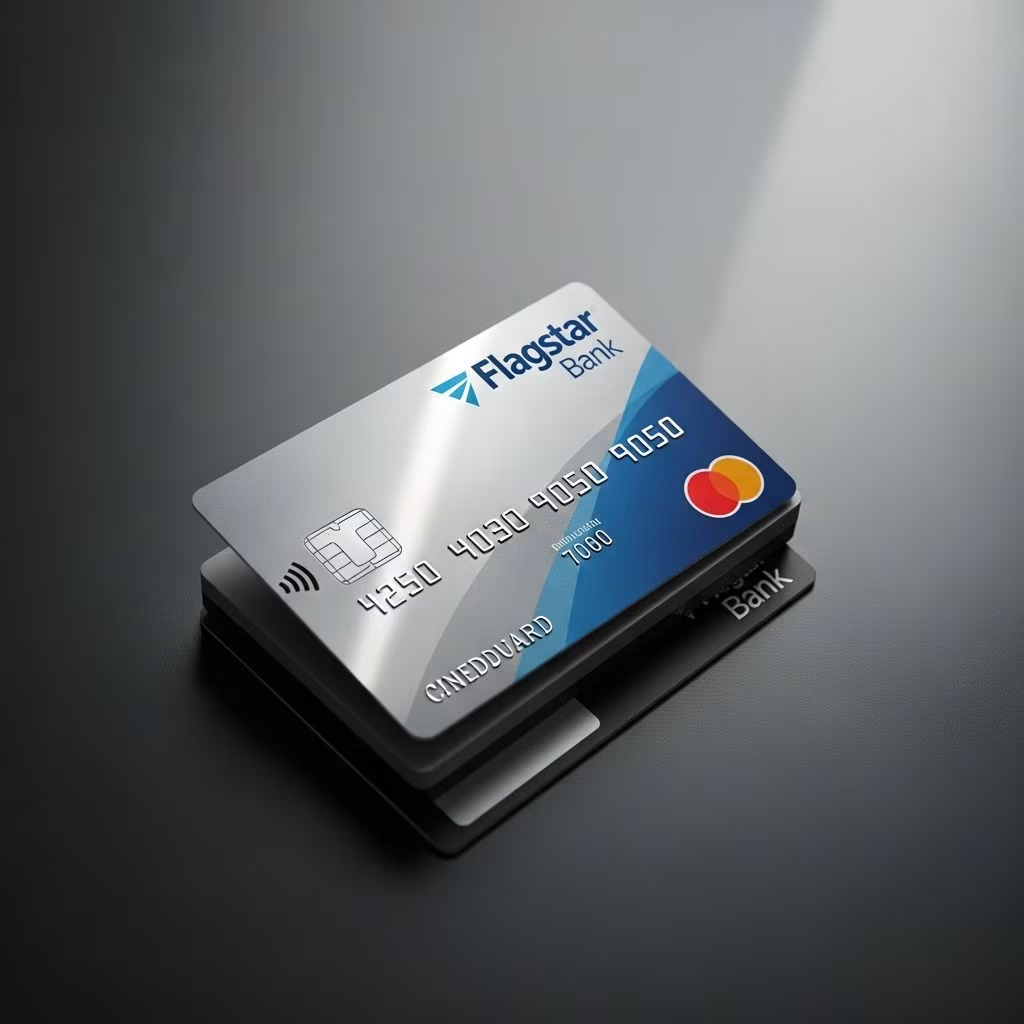
Flagstar Bank is a large regional bank offering a broad mix of checking, savings, certificates of deposit (CDs), mortgages, home equity products, and small-business services. This review walks through its key banking products, interest rates, fees, digital experience, and who is most likely to benefit from banking with Flagstar.
About Flagstar Bank
Flagstar Bank, N.A. is one of the largest regional banks in the United States and is a wholly owned subsidiary of Flagstar Financial, Inc., a bank holding company headquartered in Hicksville, New York. At June 30, 2025, Flagstar reported roughly $92 billion in assets and operated about 360 locations across nine states, with major concentrations in the New York–New Jersey metro area, Michigan, the upper Midwest, Florida, and the West Coast.
The institution traces its current brand back to the former Flagstar Bank founded as a federal savings bank in Michigan in 1987, originally under the name First Security Savings Bank. The current company also incorporates the historical Queens County Savings Bank founded in 1859 in New York, reflecting its long-standing presence in consumer banking and mortgage lending.
Flagstar has developed a national reputation for its mortgage business and continues to focus heavily on home lending and related services, while also offering full-service consumer and business banking.
Flagstar Bank Pros and Cons
| Pros | Cons |
|---|---|
|
|
Flagstar Bank Checking Accounts
Flagstar offers several checking account types tailored to different needs, such as everyday banking, premium relationship banking, and accounts designed to minimize fees. While specific names and exact terms may change over time, most accounts share some common features.
Common Features of Flagstar Checking
- Debit card access for ATM withdrawals and everyday purchases.
- Online and mobile banking with digital tools such as balance monitoring and internal transfers.
- Bill pay to schedule and manage recurring payments.
- Direct deposit for payroll and government benefits.
- FDIC insurance on eligible deposits up to the standard insurance amount per depositor, per insured bank, for each account ownership category.
Potential Fees and How to Avoid Them
Many regional banks, including Flagstar, charge monthly maintenance fees on certain checking accounts when balance or activity requirements are not met. These fees can often be reduced or eliminated through one or more of the following:
- Maintaining a specified minimum daily or average balance.
- Setting up and meeting a minimum direct deposit threshold each month.
- Opting for basic or entry-level checking products that may have no or lower monthly fees.
Overdraft fees may also apply if you spend more than your available balance, though policies vary by account and are subject to regulatory guidance from agencies such as the Consumer Financial Protection Bureau (CFPB).
Flagstar Savings Accounts
Flagstar offers savings options that pair with its checking products and can help customers build emergency funds or save for short-term goals. Like many brick-and-mortar banks, base savings account rates may be modest, but relationship benefits or promotional rates may sometimes be offered.
Typical Savings Features
- Interest-bearing balances, with rates that can vary by account tier and market conditions.
- Automatic transfers from checking to savings to support systematic saving.
- Online and mobile access to monitor balances and move money between Flagstar accounts.
- FDIC insurance on eligible savings balances up to applicable limits.
Given the competitive landscape, customers who prioritize yield may want to compare Flagstar’s rates with those offered by online-only banks, which sometimes feature higher annual percentage yields (APYs) due to their lower overhead.
Flagstar Certificates of Deposit (CDs)
Flagstar CDs are designed for customers who can commit funds for a set period in exchange for a fixed rate. CD terms often range from short-term (for example, three to six months) to several years.
Key CD Considerations
- Fixed interest rate: The APY is typically locked for the term of the CD, which can be beneficial in stable or falling rate environments.
- Early withdrawal penalty: Withdrawing funds before maturity generally triggers a penalty, which can reduce or eliminate interest earnings.
- FDIC insurance: Eligible CDs are insured up to the FDIC’s standard coverage limits.
- Laddering strategies: Some customers use CD ladders—staggered maturities—to balance liquidity needs with the desire to capture higher long-term rates.
Money Market and Premium Accounts
In addition to basic savings, Flagstar may offer money market or premium savings accounts that combine higher potential yields with limited check-writing or debit access. These accounts typically require higher minimum balances but can be attractive for customers who maintain larger cash reserves.
- Higher balance requirements: Premium accounts often require several thousand dollars or more to avoid fees or access top-tier rates.
- Tiered rates: Interest may increase as your balance climbs into higher tiers.
- Limited transactions: While prior federal limits on savings and money market withdrawals (Regulation D) have been relaxed, banks may still impose their own transaction limits or fees on excessive withdrawals.
Mortgages and Home Equity Products
Flagstar has long been known as a significant mortgage lender, originating loans both for its own portfolio and for sale in the secondary market. The bank offers a variety of home lending options, which may include:
- Conventional fixed-rate and adjustable-rate mortgages.
- FHA, VA, and other government-backed mortgage products, subject to eligibility.
- Jumbo mortgages for higher-priced properties, where permitted.
- Home equity lines of credit (HELOCs) and home equity loans for borrowing against home equity.
Because mortgage pricing is highly sensitive to credit profile, down payment, property type, and market rates, prospective borrowers should compare Flagstar’s offers with other lenders and review current rate disclosures, points, and fees carefully.
Other Loans and Services
Beyond home lending, Flagstar may provide additional products such as:
- Auto or consumer loans, depending on location and underwriting criteria.
- Small-business checking, savings, and lending solutions for local entrepreneurs.
- Treasury management and commercial banking services for larger clients.
Product availability can vary by state and may change over time, so customers should verify specific offerings directly with the bank.
Digital and Mobile Banking
Flagstar supports online and mobile banking, enabling customers to manage everyday finances remotely. While features can evolve, typical capabilities include:
- Viewing balances and recent transactions across checking, savings, and loans.
- Transferring funds between Flagstar accounts and to external institutions.
- Mobile check deposit using smartphone cameras, within limits and eligibility.
- Online bill pay for utilities, credit cards, and other recurring payments.
- Secure messaging and alerts for balance thresholds, payments due, or suspicious activity.
As with any digital banking service, customers are encouraged to use strong passwords, enable multi-factor authentication where available, and keep devices updated to reduce cybersecurity risks. The Federal Trade Commission (FTC) recommends monitoring accounts regularly to detect unauthorized transactions early.
Branch and ATM Access
Flagstar operates roughly 360 branch locations across nine states, with particular strength in New York, New Jersey, Michigan, and other upper Midwest and coastal markets. Branches provide access to in-person services such as account opening, cash deposits, loan consultations, and safe-deposit boxes where offered.
ATM access varies by region and network partnerships. Customers should review Flagstar’s ATM network details to understand potential surcharges or fee reimbursements, especially if they travel frequently or live outside the bank’s core markets.
Safety, Regulation, and Customer Protection
Flagstar Bank, N.A. is a federally insured depository institution. Most consumer deposit accounts—such as checking, savings, and CDs—are insured by the Federal Deposit Insurance Corporation (FDIC) up to at least $250,000 per depositor, per insured bank, per ownership category.
The bank operates under oversight from federal and state regulators. In the years following the 2008 financial crisis, Flagstar entered into several regulatory settlements related to its mortgage operations, including agreements with the Consumer Financial Protection Bureau and other parties. These actions illustrate how banking and mortgage activities remain subject to enforcement when regulators identify violations or consumer harm, which in turn has led many institutions to strengthen compliance and risk management programs.
Community Involvement
Flagstar’s corporate materials describe commitments to supporting local communities through lending, philanthropy, and financial education. For example, the bank has announced multi-year economic development initiatives in areas such as Pontiac, Michigan, combining targeted mortgage programs, small-business funding, and support for local cultural and educational projects.
Such community investment activities are often reviewed during Community Reinvestment Act (CRA) examinations, which evaluate how well banks meet the credit needs of the communities they serve, including low- and moderate-income neighborhoods.
Is Flagstar Bank Right for You?
Flagstar can be a reasonable fit for certain customers, particularly those who prioritize a combination of branch access in its core regions and a wide range of mortgage and home equity products. However, the best choice depends on your individual banking preferences.
Flagstar May Be a Good Fit If You:
- Live or work near a Flagstar branch and value in-person service.
- Plan to take out a mortgage or home equity loan and want to keep your banking and borrowing relationship in one place.
- Prefer a larger, established regional bank with diverse products over smaller community banks or digital-only options.
You May Want to Compare Alternatives If You:
- Primarily care about earning the highest possible yield on savings and CDs and are comfortable with an online-only bank.
- Want no-fee or ultra-low-fee checking with no minimum balance requirements.
- Live outside Flagstar’s branch network and value the convenience of a nationwide ATM footprint.
Frequently Asked Questions (FAQs)
Q: Is Flagstar Bank FDIC insured?
A: Yes. Flagstar Bank, N.A. is an FDIC-insured institution, and eligible deposits are covered up to at least $250,000 per depositor, per insured bank, per ownership category, consistent with FDIC rules.
Q: Where does Flagstar Bank operate?
A: Flagstar operates approximately 360 locations across nine states, with strong footholds in the New York–New Jersey metro region, Michigan and the upper Midwest, as well as in Florida and on the West Coast.
Q: What is Flagstar Bank best known for?
A: Flagstar has a long history in mortgage lending and related services and is known as a major regional bank offering home loans, home equity products, and full-service consumer banking.
Q: Are Flagstar’s checking and savings rates competitive?
A: As with many large regional banks, base rates on standard checking and savings may be lower than those at the highest-yield online banks. Customers focused on returns should compare Flagstar’s current APYs with leading online and credit union options.
Q: How can I open an account with Flagstar?
A: Accounts can typically be opened in person at a Flagstar branch in eligible states, and many products can be opened online. You will usually need identification, personal information, and an initial deposit amount that meets the account’s minimum funding requirement.
References
- Flagstar Bank — Wikipedia. 2025-10-20. https://en.wikipedia.org/wiki/Flagstar_Bank
- Company Profile – Flagstar Bank, N.A. — Flagstar Financial, Inc. 2025-07-30. https://ir.flagstar.com/about-us/company-profile/default.aspx
- Customer Products and Services (Flagstar Bank) — YouTube/Flagstar Bank. 2024-06-01. https://www.youtube.com/playlist?list=PLneQq_1qMpkIUph9mti3BIEunJEF5CxfX
- Deposit Insurance — Federal Deposit Insurance Corporation (FDIC). 2024-05-01. https://www.fdic.gov/resources/deposit-insurance
- CFPB Supervisory Highlights: Overdraft and Deposit Accounts — Consumer Financial Protection Bureau. 2023-10-26. https://www.consumerfinance.gov/data-research/research-reports/supervisory-highlights
- Survey of Consumer Finances and Deposit Rates — Board of Governors of the Federal Reserve System. 2023-09-20. https://www.federalreserve.gov/releases/h8.htm
- Regulation D and Savings Account Withdrawals — Board of Governors of the Federal Reserve System. 2020-04-24. https://www.federalreserve.gov/newsevents/pressreleases/bcreg20200424a.htm
- Online Banking and Credit Card Fraud — Federal Trade Commission. 2024-02-15. https://consumer.ftc.gov/articles/what-do-if-you-were-scammed
- Community Reinvestment Act (CRA) — Office of the Comptroller of the Currency. 2024-03-01. https://www.occ.treas.gov/topics/consumers-and-communities/cra/index-cra.html
This article is general information, not personal financial advice. Consider your own situation, or speak with a licensed adviser, before acting on it.