

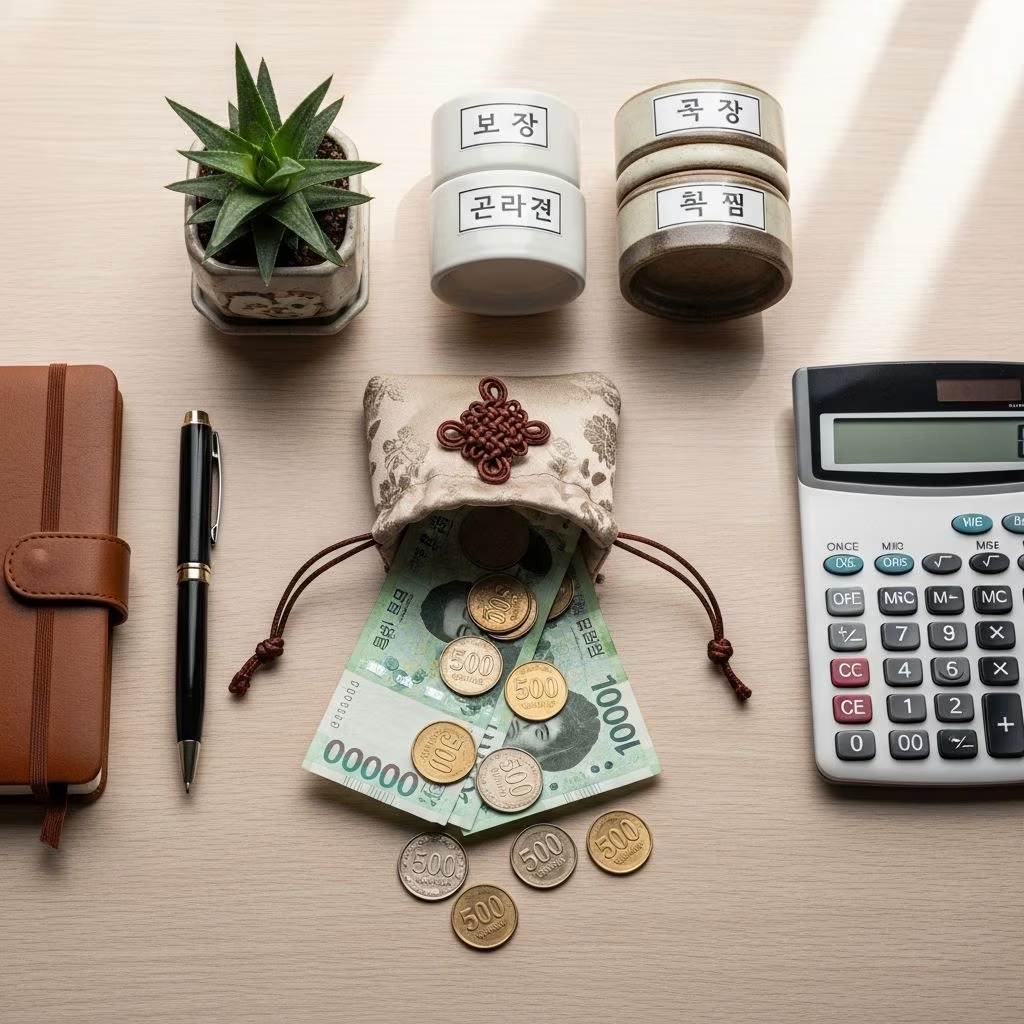
Money habits shaped during childhood often define our entire approach to personal finance. For individuals raised in Korean households, these lessons go far beyond simple budgeting—they represent a cultural philosophy deeply rooted in historical economic challenges and values of discipline. Growing up in a Korean family taught me perspectives on money that differ markedly from those prevalent in Western cultures, lessons I continue to apply throughout my adult life.
The approach to money in Korean culture reflects decades of economic hardship and recovery. My mother, born in the 1950s when Korea was among the world’s poorest nations, carried those formative experiences into her parenting philosophy. She instilled in me and my siblings a set of money principles that seemed restrictive at the time but proved invaluable as I matured and encountered different financial systems across the globe.
Upon moving to India for high school at an international boarding school, I encountered peers from diverse backgrounds with vastly different attitudes toward spending and saving. It wasn’t until I arrived in the United States for college that I fully recognized how distinctly my upbringing had shaped my financial views. What I had taken for granted as normal was actually a sophisticated, culturally-specific approach to personal finance that many Americans found puzzling.
Lesson 1: Never Waste Food
The first principle instilled in Korean households is a deep-seated respect for food and an absolute rejection of waste. This lesson extends beyond mere frugality—it represents gratitude for resources and recognition of their true value. Growing up, throwing away even small portions of food was not tolerated in my household. My mother would carefully portion meals and creatively repurpose leftovers into entirely new dishes.
This principle connects directly to financial responsibility. When you respect food enough never to waste it, you begin to respect all resources with the same intention. Food waste represents wasted money, and in a household where every won counted, this concept was paramount. The discipline required to minimize food waste builds the foundational mindset needed for all other financial decisions.
Understanding the true cost of food—not just its purchase price but the resources, labor, and privilege involved in accessing it—creates a psychological shift toward valuing money more deliberately. This lesson taught me that financial discipline begins with recognizing the intrinsic worth of every resource, starting with the food on our tables.
Lesson 2: Save as Much as Possible
Perhaps the most defining money lesson from my Korean household was the imperative to save aggressively. My family always strived to save everything possible to make large purchases and prepare for potential emergencies. This wasn’t a suggestion or preference—it was a fundamental expectation embedded in our household culture. Most Korean families followed this same principle, creating a social norm around prioritizing savings over immediate consumption.
As a child, this principle felt restrictive and unfair. My mother would collect all my birthday money and new year’s blessing money—gifts that should have felt like windfalls but instead disappeared into savings accounts I couldn’t touch. When I worked during college, she required me to save 80% of my monthly income. To my teenage mind, she functioned as a ruthless cost auditor, eliminating every discretionary expense.
Understanding the historical context helped me appreciate this approach. My mother’s generation lived through Korea’s transformation from one of the world’s poorest nations—with a per capita income lower than Iraq, Liberia, and Zimbabwe during the 1950s—to a developed economy. That lived experience of scarcity created an almost instinctive drive to accumulate reserves. What seemed like deprivation was actually wisdom forged through genuine hardship.
Now as an adult, I’m grateful for this aggressive savings discipline. It took approximately two decades to fully understand why my mother was so adamant about saving, but I now recognize that this principle provided me with financial security that many of my American peers lacked. The habit of prioritizing savings transformed my entire financial trajectory.
Lesson 3: Only Use Cash
In my Korean household, a simple rule governed all spending: if we didn’t have cash for something, we didn’t buy it. This principle meant living strictly within our means and purchasing only essentials. By completely avoiding credit, we maintained a financial discipline that prevented impulse purchases and overspending.
While not all debt is inherently negative, this cash-only philosophy shaped my entire approach to borrowing and credit. The aversion to debt that my family instilled has persisted throughout my life, even when it required significant financial sacrifice, such as pursuing education in the United States as an international student without student loans.
The cash-only approach gains additional context when examining South Korea’s economic history. The country has experienced multiple financial crises during my lifetime, witnessing heavily indebted companies fail spectacularly. These crises reinforced cultural skepticism toward credit among older generations, though younger Koreans increasingly accept debt as a normal part of modern life. My mother, however, remains convinced that cash is king.
To attend university in the United States as an international student, I needed to demonstrate financial stability through bank statements showing I had access to at least one year’s tuition in cash upfront. My family’s cash-first mentality enabled me to meet this requirement without relying on educational debt. While I now maintain a credit card for convenience and emergencies, I religiously pay off the full balance immediately, never carrying a revolving balance into the next month.
Lesson 4: Bargain for Everything You Possibly Can
The art of haggling represents a cherished skill in Korean culture. Prices are rarely set in absolute stone, and most Koreans approach negotiation as a normal part of commerce. If there exists even a small opportunity to reduce the cost of something, it’s worth making an attempt to negotiate.
This principle extends beyond traditional bargaining in markets. It represents a mindset of actively seeking value and refusing to automatically accept stated prices as final. Whether negotiating rent, service fees, or purchase prices, the willingness to engage in respectful negotiation can generate meaningful savings. The principle teaches that asking for better terms is normal, expected, and often successful.
What might appear as excessive bargaining in other cultures is simply standard practice in Korean commerce. This cultural norm reflects the broader financial philosophy: every won saved through negotiation is a won that can be redirected toward savings or emergency reserves. The skill of haggling becomes a practical tool for implementing the larger financial philosophy of maximizing savings.
Lesson 5: Always Live Frugally
Despite the international prominence of flashy Korean pop culture icons, Korean society as a whole embraces frugal living regardless of income level—particularly among older generations. My parents consistently taught me to remain humble and always maintain savings for unexpected hardships. This wasn’t a temporary teaching but a foundational value reinforced continuously throughout childhood.
Most of my friends received similar messaging from their parents, creating a cultural consistency around frugal values. The temptation to purchase frivolous items constantly surrounds us, yet the family teaching about frugality created a psychological resistance to unnecessary consumption. Discipline represents a cornerstone of Korean culture, extending far beyond money management into all life domains.
The strength of this cultural value became apparent during the 1990s when the South Korean government launched a nationwide frugality campaign specifically designed to discourage citizens from purchasing expensive luxury goods. The campaign proved remarkably successful, so much so that it generated complaints from American and European manufacturers who produced these luxury items. This government-sponsored initiative demonstrated just how deeply frugality runs through Korean cultural values.
The frugal approach differs markedly from deprivation. Instead, it represents conscious intentionality about consumption. Rather than spending impulsively because money is available, frugal living involves evaluating whether each purchase genuinely adds value to one’s life. This philosophical approach prevents financial stress while building wealth systematically over time.
Implementing Korean Money Principles in Modern Life
These five money lessons from my Korean household remain directly applicable to modern financial challenges. In an era of easy credit, aggressive marketing, and consumer culture, the principles of cash-first thinking, aggressive saving, and frugal living provide countercultural resistance to overspending.
The beauty of these principles lies in their universality. While rooted in Korean culture and history, anyone can apply them regardless of cultural background. They don’t require specialized financial knowledge or sophisticated investment strategies. Instead, they represent fundamental habits about respecting money and prioritizing long-term security over short-term gratification.
Young people facing rising housing costs, education expenses, and economic uncertainty can particularly benefit from these principles. The aggressive savings rate recommended in Korean households—saving 80% of income when possible—may seem extreme but creates a financial cushion that prevents desperate borrowing when unexpected expenses arise.
The Lasting Impact of Financial Discipline
Reflecting on my journey from a Korean household to the United States, from boarding school in India to establishing my career, these money lessons have never failed me. They provided stability during economic uncertainty, prevented me from accumulating consumer debt, and enabled me to pursue expensive education without lifelong loan burdens.
The financial discipline instilled during childhood shaped not just my spending habits but my entire approach to life security and planning. These principles taught me that financial freedom comes not from earning enormous incomes but from cultivating the discipline to spend less than you earn and maintain reserves for life’s inevitable challenges.
Frequently Asked Questions (FAQs)
Q: Is the cash-only approach still practical in modern digital economies?
A: While digital payments now dominate many transactions, the principle remains valid through disciplined spending discipline. Using cash, debit cards with strict limits, or digital budgeting apps can achieve the same goal: spending only what you have available rather than relying on credit.
Q: Can aggressive saving of 80% of income be realistic for most people?
A: The 80% savings rate is aspirational and context-dependent. The underlying principle—prioritizing savings over lifestyle inflation—remains valuable at any saving percentage. Even saving 20-30% of income builds meaningful financial security over time.
Q: How does haggling work in modern retail environments?
A: While traditional haggling is less common in standardized retail, negotiation remains applicable for large purchases (vehicles, real estate, major appliances), service contracts, and bulk buying scenarios. The principle teaches that asking respectfully for better terms is always worth attempting.
Q: Is frugal living the same as being cheap or deprived?
A: Frugal living represents intentional spending on items that provide genuine value, avoiding waste, and resisting impulse purchases. Unlike deprivation, it allows for thoughtful purchases that enhance life quality while preventing unnecessary financial stress.
Q: Can people from other cultures successfully apply these money lessons?
A: Absolutely. While rooted in Korean culture and history, these principles represent universal financial wisdom applicable across cultures and economic contexts. Financial discipline, intentional saving, and living within one’s means remain valuable regardless of background.
References
- What Growing Up in a Korean Household Taught Me About Money — The Penny Hoarder. https://www.thepennyhoarder.com/save-money/personal-finance-growing-up-korean-household/
- Meet the Typical South Korean Millennial: Income, Debt, Housing, Job — Business Insider. 2023-03. https://www.businessinsider.com/south-korean-millennial-income-housing-ambitions-jobs-2023-3
- SK Heir’s Frugal Habits: Cutting Napkins, Simple Meals — Chosun Media. 2025-11-27. https://www.chosun.com/english/market-money-en/2025/11/27/VXOIV2JS6NCRPGVA4BA5BMOPJM/
- Rich, but household debt is growing: A time bomb for South Korea? — CNA Insider. https://www.channelnewsasia.com/cnainsider/rich-but-household-debt-is-growing-time-bomb-south-korea-credit-928811
- Won for all, all for won: Why some young South Koreans embrace frugality — Korea Pro. 2023-06. https://koreapro.org/2023/06/won-for-all-all-for-won-why-some-young-south-koreans-embrace-frugality/
This article is general information, not personal financial advice. Consider your own situation, or speak with a licensed adviser, before acting on it.


