

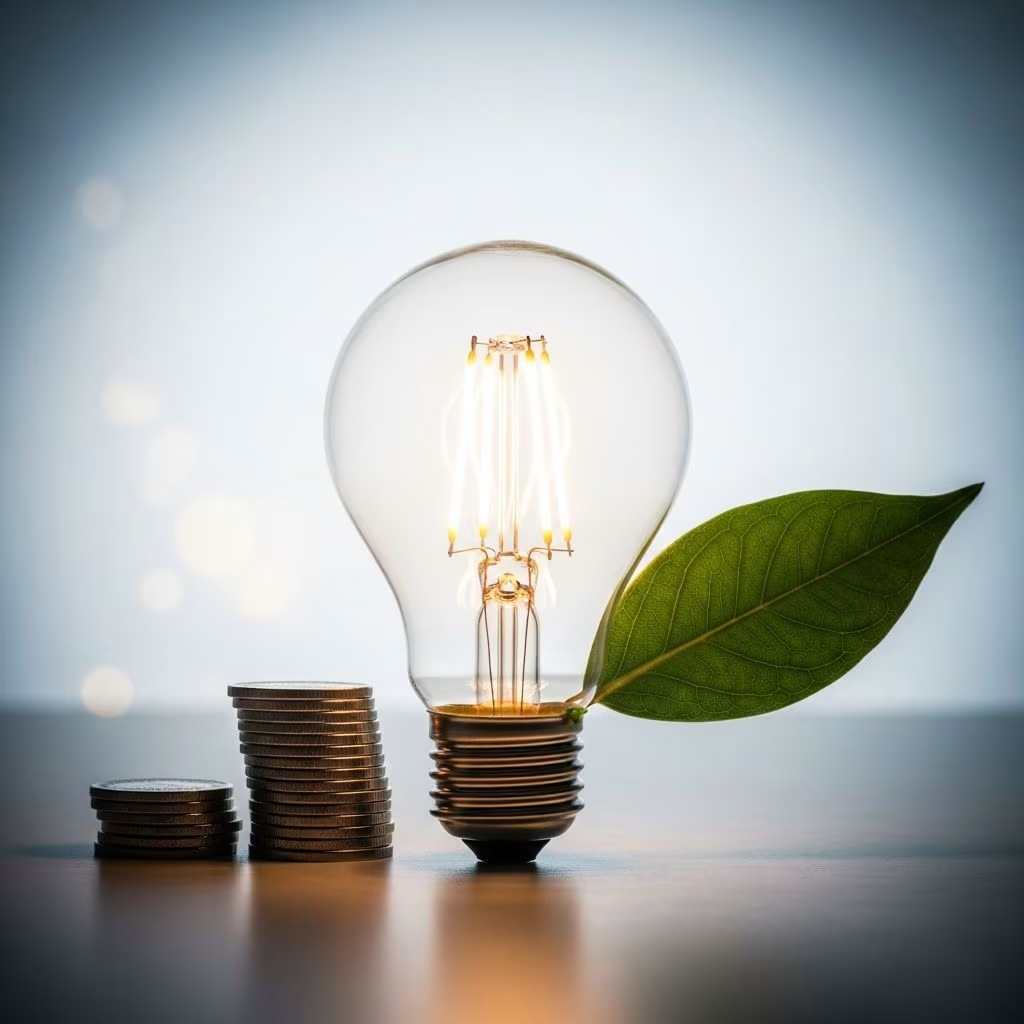
Switching to **LED lightbulbs** is one of the simplest ways to reduce your household energy bills while enjoying brighter, longer-lasting light. Lighting accounts for about 15% of a typical home’s electricity use, and LEDs can save the average household around **$225 per year** by using up to 80% less energy than traditional incandescent bulbs.
Unlike older incandescent or CFL bulbs, LEDs convert nearly all their energy into light rather than heat, making them cooler, more efficient, and environmentally friendly. With lifespans up to 25,000 hours—25 times longer than incandescents—they pay for themselves quickly through lower replacement and electricity costs.
Why Switch to LED Lightbulbs?
LEDs dominate modern lighting for good reason. They provide the same brightness as higher-wattage incandescents but sip power. For example, a **10W LED** matches the output of a **60W incandescent**, slashing energy use by 83%.
- Energy Efficiency: LEDs use 75-85% less electricity, reducing bills and carbon footprints.
- Longevity: Last 15,000-50,000 hours vs. 1,000 for incandescents.
- Durability: Shock-resistant, work in extreme temperatures, and don’t contain mercury like CFLs.
- Quality Light: Instant full brightness, dimmable options, and better color rendering for home use.
Households with 25 bulbs can save over **$3,600** over 25,000 hours by switching from incandescents to LEDs.
How Much Do LED Lightbulbs Cost?
Upfront, LEDs cost more: $3-$8 per bulb in 2025, vs. $1-$2 for incandescents. But this investment recoups fast. A single LED might cost $5 initially, but its low energy use and rare replacements make it cheaper long-term.
| Bulb Type | Initial Cost | Lifespan (Hours) | Annual Cost (3 hrs/day) |
|---|---|---|---|
| LED | $3-$8 | 25,000 | $10-$15 |
| CFL | $2 | 10,000 | $20-$30 |
| Incandescent | $1-$2 | 1,200 | $60-$75 |
Data adapted from comparisons showing LEDs save $60/year for 10 bulbs used 3 hours daily. Prices have dropped due to mass production, making LEDs accessible.
LED vs. Incandescent: Cost Breakdown
Let’s crunch the numbers for a 60W-equivalent bulb used 3 hours daily at $0.10/kWh.
| Metric | LED (8.5W) | Incandescent (60W) |
|---|---|---|
| kWh over 25,000 hrs | 212.5 | 1,500 |
| Electricity Cost | $21.25 | $150 |
| Bulbs Needed | 1 | 21 |
| Bulb Cost | $5 | $21 |
| Total Cost | $26.25 | $171 |
That’s a **$145 savings per bulb** over its life. For 25 household bulbs, total savings exceed **$3,618**. Operational savings alone hit 75% on lighting bills.
LED vs. CFL: Which is Better?
CFLs were a step up from incandescents but fall short of LEDs. CFLs use 14W for 60W brightness and last 10,000 hours, but they contain mercury, warm up slowly, and flicker.
- LEDs: Instant on, no mercury, fully dimmable.
- CFLs: Cheaper upfront ($2), but higher energy (350 kWh vs. 212.5 for LEDs over 25,000 hrs), total cost $40.
LEDs win for everyday use, especially in damp areas like bathrooms where CFLs struggle.
Environmental Benefits of LEDs
LEDs reduce energy demand, cutting emissions. They use 85% less power, lowering grid strain—crucial in high-demand areas. No mercury means safer disposal, unlike CFLs. Over a bulb’s life, LEDs prevent tons of CO2 equivalent to planting trees.
Switching home lighting to LEDs can cut a household’s lighting emissions by 80%, supporting sustainability without lifestyle changes.
Choosing the Right LED Bulb
Not all LEDs are equal. Look beyond watts—focus on **lumens** (brightness), **color temperature** (Kelvin), and **CRI** (color accuracy).
- Lumens: 800 for 60W equivalent.
- Kelvin: 2700K (warm white) for cozy feel, 5000K (daylight) for tasks.
- Base: E26 standard, GU10 for spots.
- ENERGY STAR: Certified for max savings and quality.
Shapes include A19 (standard), BR30 (flood), candelabra for chandeliers ($2.95).
Installation Tips for Maximum Savings
Easy swap: Screw in like incandescents. Tips:
- Replace high-use bulbs first (kitchens, living rooms).
- Use smart LEDs with timers/motion sensors for 10-15% extra savings.
- Pair with efficient fixtures; avoid enclosed shades that trap heat.
- Check dimmer compatibility.
Businesses see $10K-$15K annual savings on 500 fixtures.
Common Myths About LED Lightbulbs
Myth 1: LEDs don’t last. Fact: 25x longer than incandescents.
Myth 2: Too expensive upfront. Fact: Payback in 6-12 months.
Myth 3: Poor light quality. Fact: Modern LEDs rival incandescents.
Real Savings Stories
Texas homes save $50-$100/year; one swap of 10 bulbs nets $60 annually. A family reported $225 yearly drop after full switch, per DOE data.
Frequently Asked Questions (FAQs)
Are LED lightbulbs really worth the higher upfront cost?
Yes, LEDs recoup costs in under a year via 80% energy savings and 25-year lifespan, saving $225/household annually.
How much money can I save with LEDs?
Average U.S. household saves $225/year; 10 bulbs save $60/year at 3 hours/day.
Do LEDs work with existing fixtures?
Most do, using standard bases. Check dimming and enclosure compatibility.
Are LEDs better for the environment?
Absolutely—85% less energy, no mercury, lower emissions.
How long do LED bulbs last?
15,000-50,000 hours, or 15-25 years at 3 hours/day.
References
- LED Light Bulbs: Comparison Charts — Eartheasy. 2023. https://learn.eartheasy.com/guides/led-light-bulbs-comparison-charts/
- The Real Cost of LED vs. Traditional Lighting — Reliant Energy. 2024. https://www.reliant.com/en/blog/energy-efficiency-and-education/cost-of-leds-vs-incandescents
- LED vs. Traditional Lighting: A Cost & Energy Comparison for 2025 — Ankur Lighting. 2025-01-01. https://www.ankurlighting.com/blogs/general/led-vs-traditional-lighting-a-cost-energy-comparison-for-2025
- LED Light Bulbs: The Ultimate Price Comparison — Superior Lighting. 2023. https://www.superiorlighting.com/blog/led-light-bulbs-the-ultimate-price-comparison-030fcb/
- Lighting Choices to Save You Money — U.S. Department of Energy. 2024-06-15. https://www.energy.gov/energysaver/lighting-choices-save-you-money
This article is general information, not personal financial advice. Consider your own situation, or speak with a licensed adviser, before acting on it.


