

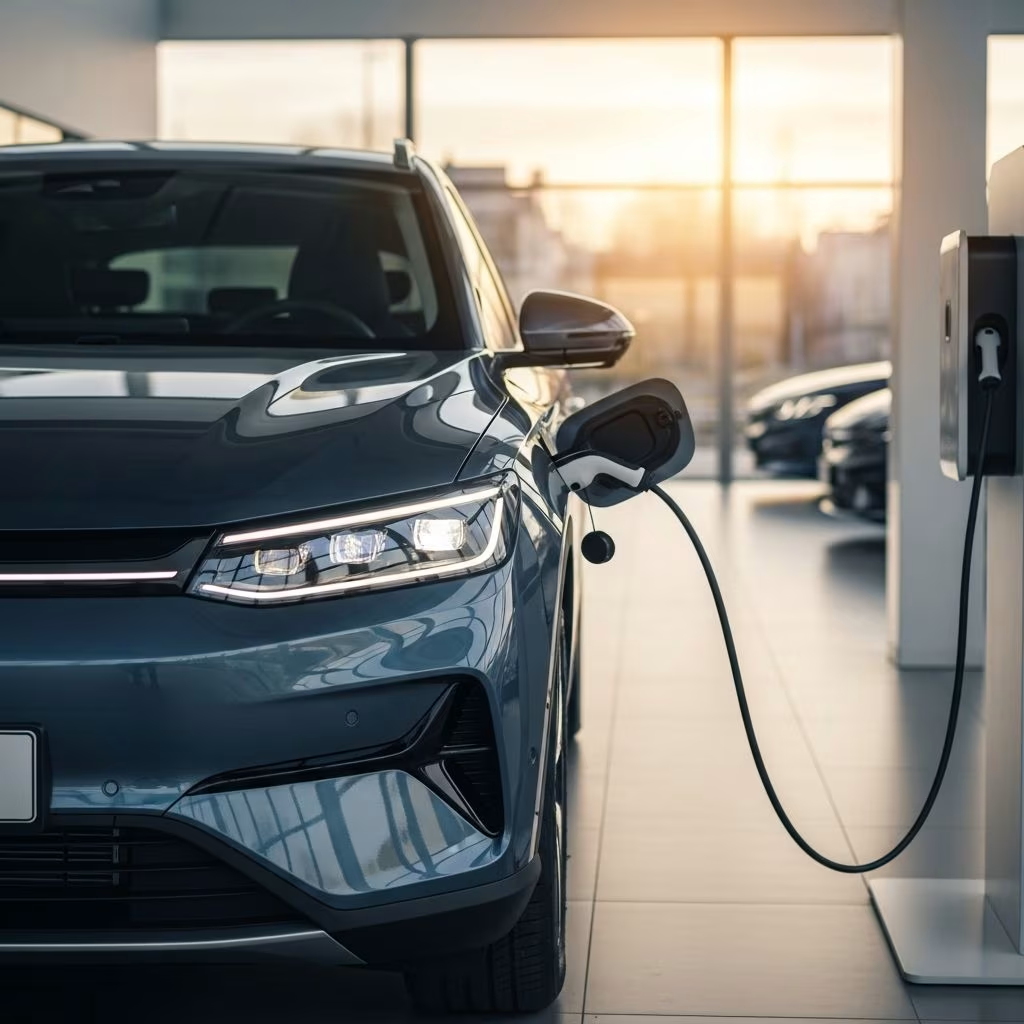
Electric vehicles (EVs) promise lower operating costs, environmental benefits, and advanced technology, but they come with unique considerations compared to gas-powered cars. Understanding total ownership costs, incentives, battery degradation, charging logistics, and maintenance can help you decide if an EV fits your lifestyle and budget. This guide covers everything you need to know before making a purchase.
The Real Cost of Owning an Electric Vehicle
While EV purchase prices have dropped, the total cost includes upfront price, incentives, fuel (electricity), maintenance, insurance, and resale value. New affordable models start under $30,000 before incentives, but used EVs offer even better value under $20,000. Electricity costs average $1.10 per equivalent full tank versus $2.50+ for gasoline, potentially saving $500+ yearly on fuel alone.
Federal tax credits remain a major factor: New EVs qualify for up to $7,500 if meeting battery sourcing rules (e.g., North American assembly and critical minerals from the U.S. or trade partners). As of 2025, eligibility tightened—check IRS guidelines for models like the Hyundai Kona Electric (261-mile range, $32,875 MSRP). Used EVs bought from dealers qualify for $4,000 or 30% of price (max $4,000) under the Inflation Reduction Act.
| Cost Factor | EV Average | Gas Car Average | Annual Savings Potential |
|---|---|---|---|
| Purchase Price (New Base) | $28,000-$45,000 | $25,000-$40,000 | Up to $7,500 credit |
| Fuel Cost (per 15,000 miles) | $400-$600 | $1,500-$2,000 | $1,000+ |
| Maintenance (5 years) | $2,000 | $5,000 | $3,000 |
| Insurance | 10-20% higher | Baseline | – |
Note: Savings vary by driving habits, electricity rates, and location. Hybrids offer a middle ground with gas backup.
Tax Credits and Incentives: What Qualifies in 2025?
Federal EV tax credits are point-of-sale rebates at qualifying dealers, reducing upfront cost. For new EVs: Income limits (e.g., $150,000 single filer), MSRP caps ($55,000 sedans/$80,000 SUVs), and battery rules exclude some Teslas or foreign-heavy models. Used credits apply to vehicles under $25,000 sold by dealers.
- New EV Credit: Up to $7,500 ($3,750 for minerals + $3,750 for components). Eligible: 2025 Hyundai Kona Electric, Kia Niro EV.
- Used EV Credit: $4,000 max for 2014+ models >2 years old.
- State Incentives: Vary—e.g., California rebates up to $7,500; check DSIRE database.
- Leasing Loophole: Lessees often get full $7,500 as dealer bonuses, even on ineligible buys.
Regulations updated April 2024 and January 2025—verify via IRS.gov or fueleconomy.gov before buying.
Battery Life and Range Anxiety: Key Concerns
EV batteries degrade 1-2% per year, retaining 70-80% capacity after 100,000-200,000 miles. Nissan Leafs (2016+) offer 149-212 miles; avoid early models with air-cooled batteries prone to faster degradation. Check state-of-health (SOH) via OBD scanner or service records.
- Daily range needs: 100-150 miles suffices for most; plan for 80% usable capacity.
- Fast charging: Level 3 DC adds 80% in 30-45 minutes but stresses batteries—limit to 20% of charges.
- Replacement cost: $5,000-$20,000, often warrantied 8 years/100,000 miles.
Prioritize liquid-cooled batteries (e.g., Tesla, newer Leafs) and verify warranty transfer using VIN.
Charging Infrastructure: Home, Public, and Road Trips
- Home Level 2: $500-$1,000 install; adds 25-30 miles/hour. Essential for daily use.
- Public DC Fast: Growing network (Electrify America, Tesla Superchargers); fees $0.30-$0.50/kWh.
- Road Trips: Apps like PlugShare/ABRP plan routes; hybrids/plug-ins as backups.
Perks include HOV lane access in some states; fees like higher registration in others.
Maintenance and Insurance: Surprising Differences
EVs have fewer parts—no oil changes, transmissions—cutting maintenance 50%. Tires wear faster due to instant torque; brakes last longer via regen. Insurance is 10-25% higher due to repair costs (batteries pricey).
- Annual service: $200-$400 vs. $800+ for gas.
- Specialist mechanics needed for high-voltage systems.
New vs. Used vs. Hybrid: Which to Choose?
New: Warranty, latest range/tech, tax credits. Used: Budget-friendly (Leaf under $15K), but check battery. Hybrids: No range anxiety, cheaper used.
| Type | Pros | Cons | Best For |
|---|---|---|---|
| New EV | Credits, range, warranty | Higher price | Daily drivers |
| Used EV | Affordable, proven | Battery risk | Budget buyers |
| Plug-in Hybrid | Gas backup | Less efficient | Long trips |
Top Tips for Buying Your First EV
- Set Budget & Range: Max $20K used? Nissan Leaf, Chevy Bolt.
- Buy from Dealer: For used tax credit.
- Check Warranty/Battery: VIN lookup, receipts.
- Test Drive & Inspect: EV specialist mechanic.
- Act Fast: Market hot—use comparison tools.
- Consider Total Costs: Install charger, insurance hike.
Frequently Asked Questions (FAQs)
What is the average cost to charge an EV?
Around $1.10 for a full equivalent tank at $0.15/kWh home rates, vs. $2.50+ gas.
Do used EVs qualify for tax credits?
Yes, up to $4,000 from dealers on qualifying models under $25,000.
How long do EV batteries last?
10-20 years/100,000+ miles with 70-90% capacity retention.
Is home charging necessary?
Highly recommended for convenience and cost savings over public stations.
Are EVs cheaper to maintain?
Yes, about half the cost due to fewer moving parts.
References
- Here Are 7 Tips for Snagging the Best Used Electric Cars Under $20K — The Penny Hoarder. 2024. https://www.thepennyhoarder.com/save-money/best-used-electric-cars/
- The 10 Most Affordable Electric Cars for 2025 — The Penny Hoarder. 2025. https://www.thepennyhoarder.com/save-money/affordable-electric-cars/
- 4 Things I Wish I Knew Before Buying an Electric Car — The Penny Hoarder. 2024. https://www.thepennyhoarder.com/save-money/know-before-buying-an-ev/
- Is the Cost of Electric Cars Really Worth It? — The Penny Hoarder. 2024. https://www.thepennyhoarder.com/save-money/cost-of-electric-cars/
- Hybrid vs. Electric: The Pros and Cons of Eco-Friendly Cars — The Penny Hoarder. 2024. https://www.thepennyhoarder.com/save-money/hybrid-vs-electric/
- There are Fees — and Perks — that May Come with Having an Electric Vehicle — EV Life / The Penny Hoarder. 2024. https://evlife.co/blog/there-are-fees-and-perks-that-may-come-with-having-an-electric-vehicle
- Should You Buy a Car Before the EV Tax Credit Changes? — The Penny Hoarder. 2024. https://www.thepennyhoarder.com/taxes/ev-tax-credit/
This article is general information, not personal financial advice. Consider your own situation, or speak with a licensed adviser, before acting on it.


