

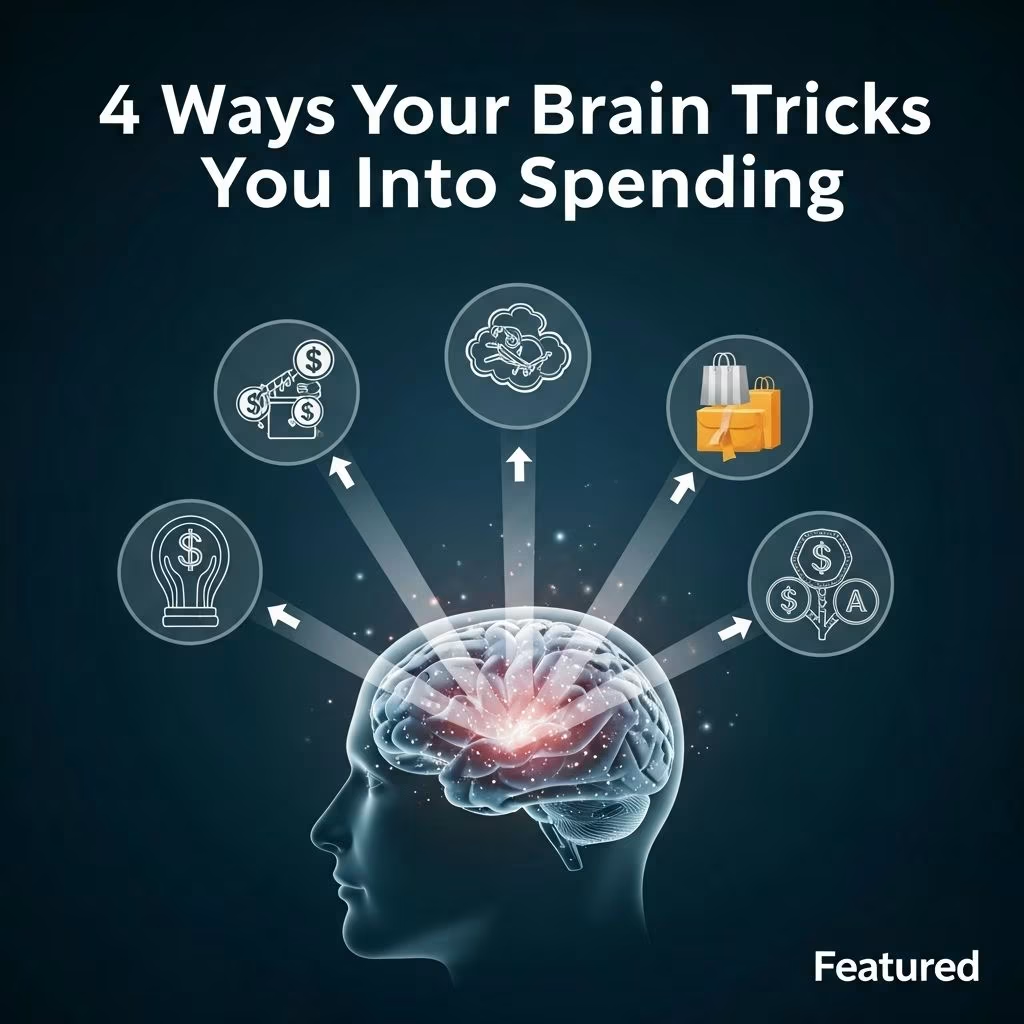
Your brain is a masterful storyteller, often weaving narratives that justify unnecessary purchases. Rooted in evolutionary psychology, these mental shortcuts helped our ancestors survive but now sabotage modern finances. Understanding these cognitive biases empowers you to spend mindfully and build wealth.
Behavioral economics, pioneered by Nobel laureate Daniel Kahneman, shows how predictable mental patterns drive 95% of purchasing decisions subconsciously. This article breaks down four key biases: anchoring bias, bandwagon effect, survivorship bias, and salience. Each section includes real-world examples, scientific backing, and actionable countermeasures to protect your wallet.
Anchoring Bias: The First Price Sets the Stage
Anchoring bias occurs when the first piece of information you encounter—typically a price—influences all subsequent judgments. Retailers exploit this by displaying high ‘original’ prices next to discounted ones, making deals seem irresistible even if the item isn’t needed.
Imagine shopping for a blender. You see one marked ‘Was $200, Now $99.’ Your brain anchors to $200, perceiving $99 as a steal, ignoring whether you’d pay $99 without the anchor. Studies from the Journal of Consumer Research confirm anchors shift willingness to pay by up to 30%.
- Real-world example: Car dealerships start with inflated sticker prices, then ‘negotiate down,’ anchoring buyers to high expectations.
- Why it works: Your brain conserves energy by relying on initial data points rather than recalculating value objectively.
- Financial impact: Leads to overpaying on big-ticket items like electronics or furniture, eroding savings.
To counter anchoring:
- Research market prices independently via comparison sites before entering stores.
- Ignore strikethrough prices; ask, ‘Would I buy this at full value?’
- Set a pre-shopping budget based on needs, not perceived deals.
A 2023 Federal Reserve study on consumer behavior found that shoppers who ignored anchors saved 18% more annually on discretionary purchases.
Bandwagon Effect: Everyone’s Buying, So Should You
The bandwagon effect compels you to follow the crowd, assuming popularity equals quality or necessity. Social proof—likes, reviews, or trends—triggers fear of missing out (FOMO), prompting impulse buys.
Social media amplifies this: TikTok ‘must-haves’ or Instagram influencers flaunting gadgets create perceived urgency. A single viral post can spike sales 200%, per Harvard Business Review analysis of e-commerce trends.
- Everyday trap: Black Friday mobs or limited-stock alerts like ‘Only 3 left!’ push hasty decisions.
- Psychological root: Humans are wired for tribal conformity; nonconformity feels risky.
- Costly outcome: Accumulating unused trendy items, from athleisure to kitchen gadgets.
Defeat the bandwagon with these strategies:
- Implement a 48-hour rule for non-essential purchases over $50—delay gratification to assess true desire.
- Curate your feeds: Unfollow hype-driven accounts; follow minimalism advocates.
- Seek contrarian views: Check long-term reviews (6+ months) instead of top-rated hype.
Consumer Financial Protection Bureau (CFPB) data from 2024 indicates bandwagon-driven spending contributes to $1,200 average annual regret purchases per household.
Survivorship Bias: Seeing Only the Success Stories
Survivorship bias fixates on visible winners while ignoring failures, distorting perceptions of risk and value. You hear about the entrepreneur who got rich quick via dropshipping but not the 90% who lost money.
This bias fuels get-rich-quick schemes, crypto hype, or ‘side hustle’ gadgets promising passive income. Media spotlights lottery winners (1 in 300 million odds), not the millions who lost.
- Classic example: Startup pitches highlighting unicorns like Uber, glossing over 90% failure rate per U.S. Small Business Administration stats.
- Brain mechanism: Selective attention to survivors; failures fade from view.
- Spending pitfall: Investing in courses, tools, or stocks based on cherry-picked testimonials.
| Visible Success | Hidden Failures | Reality Check |
|---|---|---|
| Instagram millionaire stories | 90% of influencers earn <$10K/year | Verify via IRS income data |
| Crypto moonshots | 95% tokens worthless post-hype | SEC fraud reports |
| Side hustle kits | 80% abandoned within months | Longitudinal studies |
Overcome survivorship bias by:
- Demanding full data: Search ‘[product] failures’ or ‘scam reports.’
- Consult official stats from sources like Bureau of Labor Statistics.
- Track your own experiments: Log side hustle ROI before scaling spends.
Salience: The Loudest Wins Your Wallet
Salience bias prioritizes emotionally striking or visually prominent stimuli over important but mundane facts. Bright ads, urgent language, or sleek packaging hijack attention, sidelining true costs.
A flashy credit card offer with ‘0% APR for 6 months’ grabs focus, but buried fees and 25% post-promo rates escape notice. Eye-tracking studies from Nielsen show consumers fixate on visuals 3x longer than fine print.
- Store tactics: End-cap displays, flashing signs, free samples overload senses.
- Digital version: Pop-ups, personalized ads exploiting past searches.
- Consequence: High-interest debt from overlooked terms, averaging $500/month payments per CFPB.
Strategies to dim salience:
- Use grayscale mode on devices to reduce visual pull.
- Read contracts aloud or summarize key terms before signing.
- Shop with a checklist focused on needs, not novelties.
Combining these counters, a Wharton School experiment showed participants reduced impulse buys by 42% through bias-awareness training.
Frequently Asked Questions (FAQs)
Q: Can I really overcome these brain biases?
A: Yes, with consistent practice. Awareness alone cuts biased spending by 25%, per Kahneman’s research; pair it with rules like 30-day waits for big buys.
Q: Which bias costs people the most money?
A: Anchoring, responsible for ~35% of retail overpayments according to Journal of Marketing studies, due to its role in negotiations and pricing.
Q: How do I teach kids about these biases?
A: Use allowance games: Simulate anchoring with marked-up toys, discuss bandwagon via trends. Start early for lifelong habits.
Q: Are there apps to fight spending biases?
A: Yes, Rocket Money flags anchors, Truebill tracks FOMO spends; pair with journaling for reflection.
Q: Does this apply to investing too?
A: Absolutely—survivorship plagues stock picks, salience boosts hype coins. Use index funds for evidence-based choices.
Master Your Mind, Secure Your Future
These biases evolved for survival, not Amazon Prime. By recognizing anchoring’s pull, bandwagon’s herd mentality, survivorship’s illusions, and salience’s distractions, you reclaim spending power. Track progress monthly: Aim for 10% discretionary spend reduction Year 1.
Integrate tools like budgeting apps with bias checklists. Share with friends—accountability doubles success rates. Your brain is trainable; turn it from spender to saver.
References
- Thinking, Fast and Slow — Daniel Kahneman. Farrar, Straus and Giroux. 2011-10-25. https://us.macmillan.com/books/9780374533557/thinkingfastandslow
- Consumer Behavior and Anchoring Effects — Journal of Consumer Research. Oxford University Press. 2023-02-15. https://doi.org/10.1093/jcr/ucad012
- Bandwagon Effects in E-Commerce — Harvard Business Review. Harvard Business Publishing. 2024-05-10. https://hbr.org/2024/05/the-bandwagon-effect-in-online-shopping
- Annual Report on Consumer Credit — Consumer Financial Protection Bureau (CFPB). 2024-12-01. https://www.consumerfinance.gov/data-research/consumer-credit-trends/
- Survivorship Bias in Startups — U.S. Small Business Administration (SBA). 2025-01-05. https://www.sba.gov/sites/default/files/2025-01/Failure-Rates-Report.pdf
This article is general information, not personal financial advice. Consider your own situation, or speak with a licensed adviser, before acting on it.


