

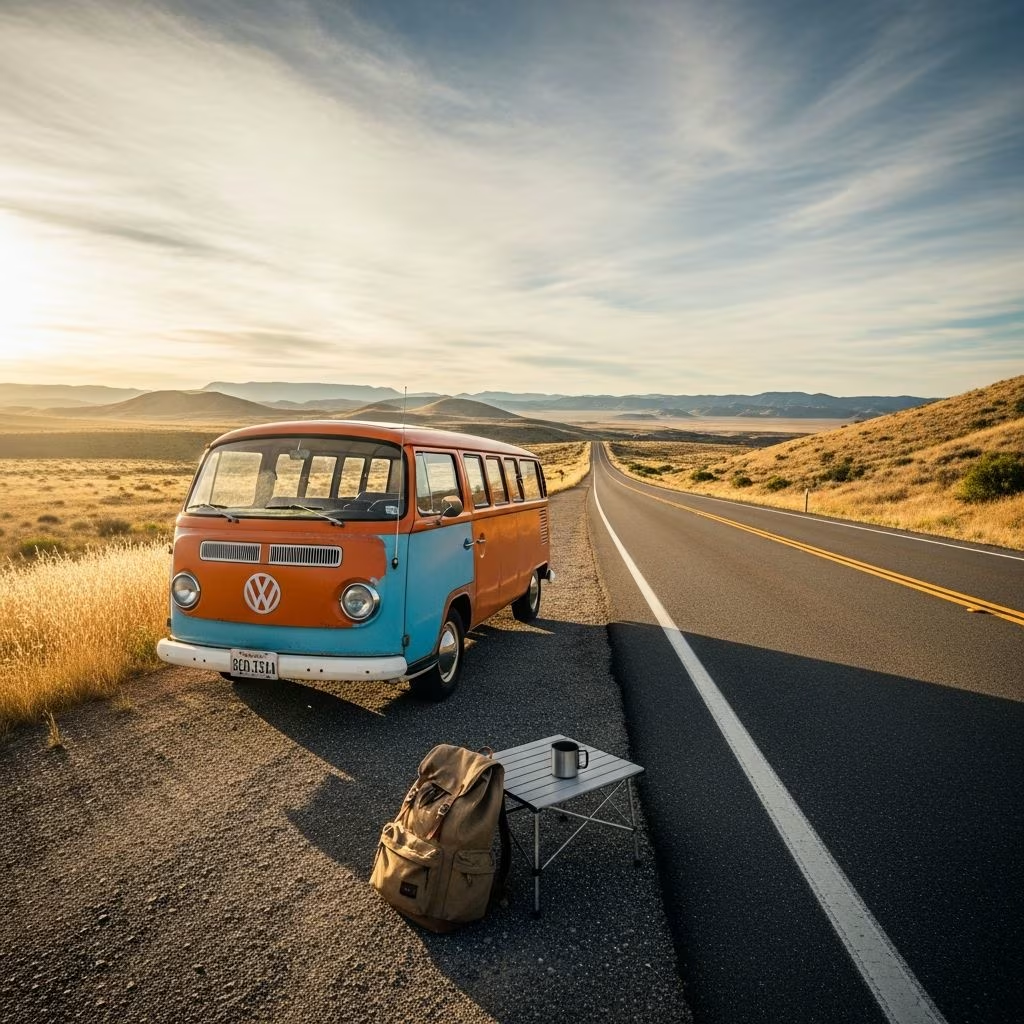
Embarking on a cross-country road trip doesn’t require a fortune. With meticulous planning, you can traverse thousands of miles in just 7 days for under $350, covering gas, food, lodging, and even attractions. This guide draws from real-world examples of budget travelers who achieved similar feats, emphasizing free camping, DIY meals, and efficient routing.
Understanding the $350 Budget Breakdown
The key to this ultra-low budget lies in a precise allocation: approximately $200 for gas, $80 for food, $50 for lodging, and $20 for miscellaneous expenses like park fees. Real trips have shown totals as low as $86 for 9 nights of lodging via free camping, with overall per-person costs around $29 daily when shared. For a solo traveler or couple splitting costs, this is achievable by prioritizing free resources and minimizing extras.
| Category | Estimated Cost | Tips to Stay Under Budget |
|---|---|---|
| Gas | $200 | Use hypermiling, apps for cheap stations |
| Food | $80 | Cooler meals, no restaurants |
| Lodging | $50 | Free campsites 90% of nights |
| Misc (fees, etc.) | $20 | America the Beautiful Pass if multiple parks |
Step 1: Choose Your Vehicle and Optimize Gas Efficiency
Select a fuel-efficient car getting at least 30 MPG; hybrids or small sedans are ideal. For a 3,000-mile round trip (about 430 miles/day), expect 100 gallons at $2/gallon average in 2026 prices, totaling $200. Hypermiling techniques—steady speeds under 65 mph, no idling, proper tire pressure—can save 20% on fuel.
- Apps like GasBuddy for cheapest stations along interstates.
- Avoid highways with high tolls; use secondary roads for scenery and savings.
- Pack light to reduce drag; remove roof racks if unused.
Vehicle prep: Oil change, check fluids, tires. Budget $0 extra by doing basics yourself.
Step 2: Map a Realistic 7-Day Itinerary
Avoid coast-to-coast in 7 days (4,500+ miles unrealistic); opt for regional cross-country like Midwest to West or themed routes like Route 66 segments. Sample itinerary based on proven 7-day trips:
- Day 1: Chicago to Badlands NP, SD (600 miles). Free dispersed camping.
- Day 2: Badlands to Mt. Rushmore/Devils Tower, WY (400 miles). Boondock nearby.
- Day 3: To Yellowstone NP backroads (500 miles). Free sites outside park.
- Day 4: Yellowstone exploration; short drives.
- Day 5: To Grand Teton/Jackson Hole (200 miles). Lakeside wild camp.
- Day 6: To Salt Lake City/Great Salt Lake (400 miles). BLM free camping.
- Day 7: Return loop or fly back; adjust for one-way.
Total ~2,800 miles. Use Google Maps or Roadtrippers for free planning. Factor 8-10 hours driving/day max for safety.
Step 3: Slash Lodging Costs with Free Camping
The game-changer: Camp 6-7 nights free. Apps like iOverlander, FreeCampsites.net, and Campendium list thousands of BLM, National Forest, and Walmart boondocking spots. Real example: $86 for 9 nights (8 camping, 5 free).
- Free Organized Sites: State wildlife areas, Corps of Engineers lands (often $0 with self-register).
- Wild Dispersed Camping: Public lands via Motor Vehicle Use Maps (MVUMs) from fs.usda.gov.
- Cheap Alternatives: $10/night KOAs or Harvest Hosts for farmers.
- Backup: Motel 6 at $40/night, but aim for zero paid nights.
Essentials: Tent, sleeping bag, bear-proof food storage. No gear? Borrow or buy used for $50 total.
Step 4: Eat Cheap Without Sacrificing Fun
Pack a 48-quart cooler, stove, and basics: bread, PB&J, oats, ramen ($40/week). Shop Walmart/aldis en route. Examples: $216 fast food avoided via $72 freeze-dried + sandwiches. Daily: $10/person.
- Breakfast: Oatmeal ($0.50/serving).
- Lunch: Sandwiches ($2).
- Dinner: Campfire hot dogs/veggies ($3).
- Snacks: Trail mix, fruit from farm stands (3 avocados/$1).
Forage berries or fish if skilled; hydrate with refillable bottles.
Step 5: Free and Low-Cost Attractions
Focus on free-entry sites: National Monuments (some free), scenic byways, state parks with day-use waivers. Budget $20 for 1-2 parks via $80 annual pass value.
- Badlands overlooks, Devils Tower trails (free).
- Great Salt Lake beaches, ghost towns.
- Route 66 diners for photo ops, no eating in.
Hidden gems: Free hot springs, vista points via AllTrails app.
Step 6: Essential Gear and Packing List
Pack multi-use items to fit $350.
| Gear | Cost if Buying | Purpose |
|---|---|---|
| Cooler + ice | $20 | Food storage |
| Camp stove/propane | $15 | Cooking |
| Tent/sleeping pad | $0 (borrow) | Lodging |
| First aid/car tools | $10 | Emergencies |
Total gear under $50 if needed. Laundry: Sink wash, public facilities.
Step 7: Safety, Legal, and Maintenance Tips
Check weather via NOAA.gov; carry spare tire, jack. Leave no trace camping. Apps: Offline maps (Gaia GPS free tier), weather. Drive daylight; rest stops for naps. Emergency: AAA membership if owned ($0 extra).
Real Budget Success Stories
– Cross-country for $86 lodging (9 nights).
– Family of 5: <$1000/week all-in.
– $29/person/day over 3 months.
– National parks 2 weeks: $2000/couple.
Scale to 7 days: Easily under $350 solo or $500/couple.
Frequently Asked Questions (FAQs)
Q: Is a 7-day cross-country trip realistic for $350?
A: Yes, for regional routes (2,500-3,000 miles) with free camping and self-cooking, as proven by multiple budget trips.
Q: Where do I find free campsites?
A: Use FreeCampsites.net, iOverlander, or fs.usda.gov MVUMs for BLM/NF lands.
Q: How much gas will I use?
A: ~100 gallons for 3,000 miles at 30 MPG, $200 at $2/gal.
Q: What if it rains? Any lodging backups?
A: Pack rain gear; fallback to $10/night KOAs or Walmart parking.
Q: Can families do this?
A: Yes, scaled up; one family did 7,000 miles under $4500 for 41 days.
Q: Best apps for planning?
A: GasBuddy, Roadtrippers, Campendium, AllTrails.
References
- How to Take a Cross Country Road Trip for less than $100 — Take Back Roads. 2019-08-14. https://takebackroads.com/2019/08/14/cheap-cross-country-road-trip/
- How to Plan a Cross-Country Road Trip for Families on a Budget — Exploration America. N/A. https://explorationamerica.com/how-to-plan-a-cross-country-road-trip-for-families-on-a-budget-7000-miles/
- Travel the U.S. for $30 A Day: The Ultimate Budget USA Road Trip — Beyond the Bucket List. N/A. https://beyondthebucketlist.co/the-ultimate-budget-usa-road-trip/
- Budget for the Ultimate National Parks Road Trip (Under $2000) — Voyages with Val. N/A. https://voyageswithval.com/budget-national-parks/
- California to the Carolinas in 7 Days — Staying Afloat Blog. 2018-08-31. https://stayingafloatblog.com/2018/08/31/7-day-cross-country-road-trip/
- How To Plan a Cross-Country Road Trip You’ll Love — AAA. N/A. https://www.aaa.com/tripcanvas/article/how-to-plan-a-cross-country-road-trip-youll-love-CM1152
This article is general information, not personal financial advice. Consider your own situation, or speak with a licensed adviser, before acting on it.


