

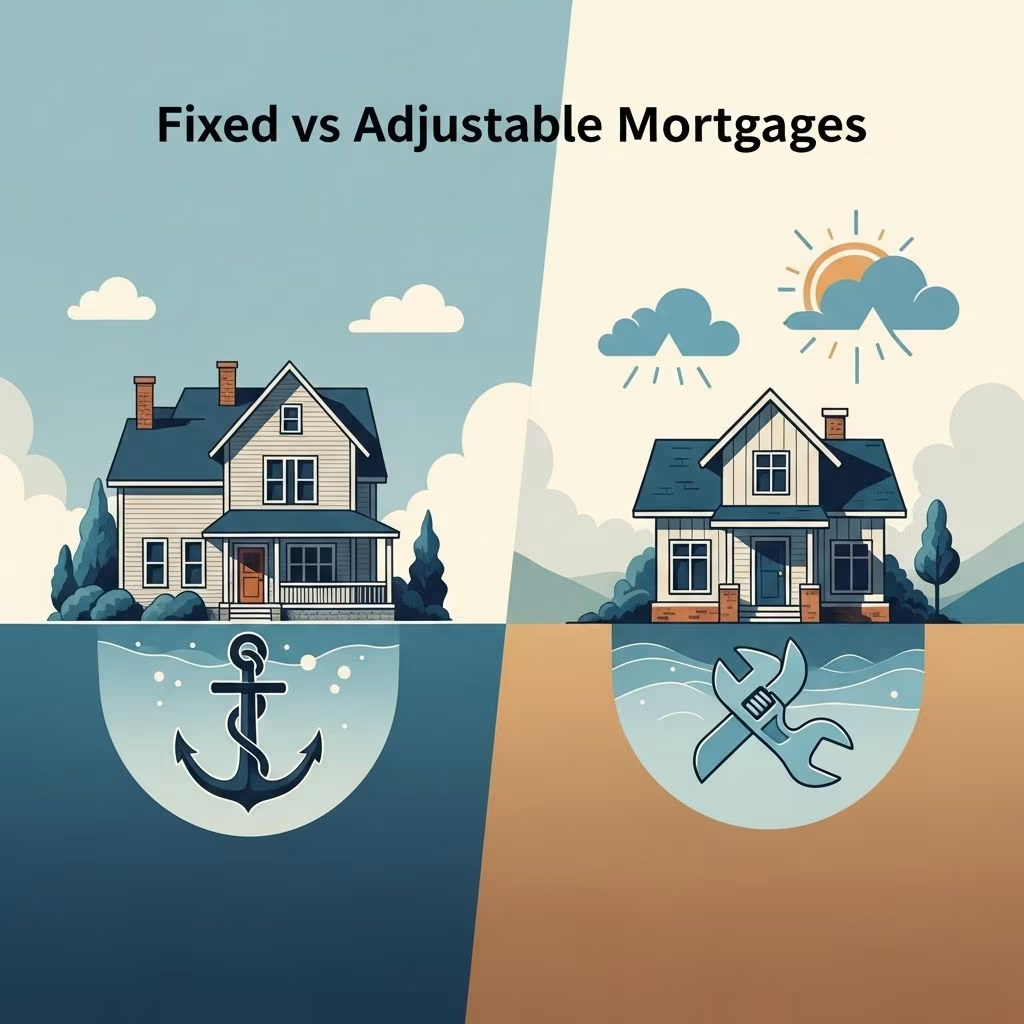
Navigating the world of home loans requires understanding the two dominant options: **fixed-rate mortgages** and **adjustable-rate mortgages (ARMs)**. Fixed-rate loans provide unchanging payments for the entire term, offering predictability in an uncertain economy. In contrast, ARMs start with lower rates that can fluctuate, potentially saving money if rates drop but risking higher costs if they rise. This guide breaks down their mechanics, benefits, drawbacks, and scenarios where one outperforms the other, helping you align your choice with long-term financial plans.
Understanding Fixed-Rate Mortgages
A **fixed-rate mortgage** locks in the interest rate from day one, ensuring your principal and interest payments remain constant throughout the loan’s life, typically 15, 20, or 30 years. This stability shields borrowers from market volatility, making budgeting straightforward regardless of economic shifts.
These loans dominate the market due to their reliability. For instance, on a 30-year fixed-rate mortgage, if you secure a 6.89% rate on a $378,300 loan, your monthly payment stays at $2,489 for principal and interest, even if broader rates climb. Shorter terms like 15 years often carry lower rates but higher monthly payments, accelerating equity buildup.
- Payment predictability: Ideal for long-term homeowners planning to stay put.
- Simpler qualification: Lenders favor them for their lower risk profile.
- Varied terms: Options from 8 to 30 years cater to diverse needs.
However, total monthly costs might still vary due to escrow changes like taxes or insurance, but the core loan payment does not.
Decoding Adjustable-Rate Mortgages (ARMs)
**Adjustable-rate mortgages** begin with a discounted introductory rate for a set period—commonly 3, 5, 7, or 10 years—before resetting periodically based on a market index plus a lender margin. Notated as 5/1 (5-year fixed, then annual adjustments) or 5/6 (annual fixed, then semiannual), ARMs tie rates to benchmarks like the Secured Overnight Financing Rate (SOFR) or Constant Maturity Treasury (CMT).
The appeal lies in initial affordability: a 5/1 ARM might offer 6.11% versus 6.89% on a fixed loan, dropping payments to $2,248 on a similar $370,500 loan. Post-introductory period, rates adjust, capped to limit spikes—typically 2% per adjustment and 5-6% lifetime.
- Introductory savings: Lower entry rates enable larger loans or upscale homes.
- Potential for decreases: Falling rates reduce payments over time.
- Caps and floors: Protections prevent extreme swings.
ARMs demand vigilance: know your index, margin, adjustment frequency, and maximum rates to assess future affordability.
Core Differences at a Glance
Fixed-rate and ARM loans diverge fundamentally in rate behavior, costs, and suitability. Here’s a comparative overview:
| Feature | Fixed-Rate Mortgage | Adjustable-Rate Mortgage (ARM) |
|---|---|---|
| Interest Rate | Locked for entire term | Fixed initially, then variable |
| Initial Rate | Higher typically | Lower, often 0.5-1% below fixed |
| Monthly Payment | Constant (P&I) | Changes post-initial period |
| Down Payment Min (Conventional) | 3% | 5% |
| Rate Calculation | Set at origination | Index + margin, subject to caps |
| Term Options | 8-30 years common | Usually 30 years |
This table highlights why fixed loans suit stability seekers, while ARMs appeal to those betting on rate declines or short stays.
Advantages and Disadvantages
Fixed-Rate Pros and Cons
Advantages:
- Immune to rate hikes, ensuring budget peace.
- Easier long-term planning with unchanging payments.
- More lender options and competitive terms for strong credit.
Disadvantages:
- Higher starting rates limit upfront affordability.
- Miss out on rate drops without refinancing, which incurs costs.
ARM Pros and Cons
Advantages:
- Lower initial payments boost qualification for bigger homes.
- Benefit from falling rates without action.
- Caps mitigate worst-case spikes.
Disadvantages:
- Payment uncertainty post-initial period.
- Higher down payment requirements.
- Risk of rate shocks straining finances.
Real-World Payment Scenarios
Consider a $390,000 home. Fixed-rate assumes 3% down ($378,300 loan at 6.89%): steady $2,489/month. A 5/1 ARM with 5% down ($370,500 at 6.11%) starts at $2,248, but could hit $3,376 max or drop in favorable conditions.
| Scenario | Year 1 Payment | Year 8 Payment (High) | Year 8 Payment (Low) |
|---|---|---|---|
| Fixed-Rate | $1,995.91 | $1,995.91 | $1,995.91 |
| ARM | $1,896.20 | $2,065.26 | $1,734.06 |
Data adapted from comparisons; actuals vary by market. Use calculators to model your situation.
When to Choose Each Option
Opt for Fixed-Rate if:
- You plan to own long-term (10+ years).
- Prioritizing payment stability over initial savings.
- Rates are moderate and expected to rise.
Opt for ARM if:
- Short-term stay (matches initial period).
- Strong income growth anticipated to handle adjustments.
- Confident in declining rates or plan to refinance.
Both require good credit (typically 620+ FICO) and allow refinancing. Conventional ARMs need 5% down minimum versus 3% for fixed.
Frequently Asked Questions (FAQs)
What happens if ARM rates rise sharply?
Caps limit increases: often 2% per period, 6% lifetime. Review terms to ensure affordability at max.
Can I switch from ARM to fixed later?
Yes, refinancing is common after initial period if rates favor it, though fees apply.
Are ARMs riskier now with high rates?
They offer entry savings but demand scenario planning amid volatility.
How do ARM indexes work?
Tied to SOFR or treasuries + fixed margin (e.g., 2-3%). Adjustments follow index changes.
Which is cheaper overall?
Fixed for long holds; ARM if selling soon or rates fall.
Key Factors Before Deciding
Assess your timeline, risk tolerance, and finances. Stress-test payments at max ARM rates. Consult lenders for personalized quotes, as both loans demand solid credit and income verification. Tools like ARM vs. fixed calculators reveal long-term costs.
Ultimately, fixed mortgages prioritize security, ARMs flexibility. Align with your goals for optimal homeownership.
References
- Fixed-Rate Mortgage Vs. ARM: What’s the Difference? — Bankrate. 2024. https://www.bankrate.com/mortgages/arm-vs-fixed-rate/
- Fixed-rate vs. adjustable-rate mortgages. Which is best for you? — First Bank. 2024. https://www.bankatfirst.com/personal/discover/flourish/fixed-rate-vs-adjustable-rate-mortgages.html
- Fixed- vs. adjustable-rate mortgage (ARM): What’s the difference? — Rocket Mortgage. 2024. https://www.rocketmortgage.com/learn/arm-vs-fixed
- What is the difference between a fixed-rate and adjustable-rate mortgage (ARM) loan? — Consumer Financial Protection Bureau (CFPB). 2024-02-06. https://www.consumerfinance.gov/ask-cfpb/what-is-the-difference-between-a-fixed-rate-and-adjustable-rate-mortgage-arm-loan-en-100/
- ARM vs. Fixed-Rate Mortgage Calculator — Brookline Bank. 2024. https://www.brooklinebank.com/calculator/arm-vs-fixed-rate-mortgage-calculator/
- Fixed-Rate Mortgage vs. ARM: How Do They Compare? — Charles Schwab. 2024. https://www.schwab.com/learn/story/fixed-rate-mortgage-vs-arm-how-do-they-compare
This article is general information, not personal financial advice. Consider your own situation, or speak with a licensed adviser, before acting on it.


