

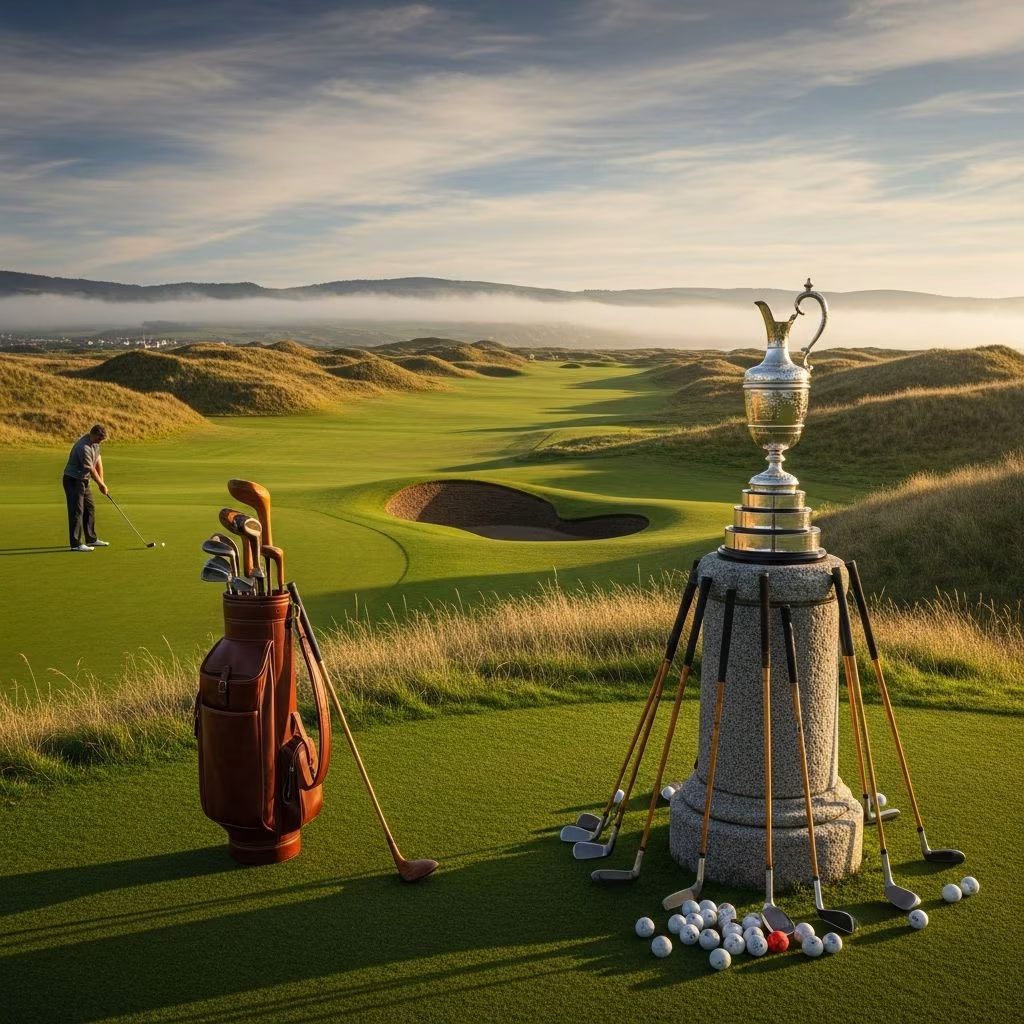
Understanding The Open Championship
The Open Championship, commonly known as The British Open until 2001, represents the world’s oldest professional golf tournament and stands as one of the four major championships in professional golf. Established in 1860, this prestigious event has become a cornerstone of golf history, attracting the finest players from around the globe to compete for the title of Champion Golfer of the Year. The tournament has evolved significantly over its more than 160-year history, transforming from a modest regional competition into an international spectacle that commands global attention.
The championship distinguishes itself through its unique format, rotating venues across some of the most iconic links courses in the United Kingdom and Ireland. This rotating structure ensures that no single course monopolizes the event, creating a diverse competitive landscape that tests different skill sets and playing styles. The tournament’s enduring appeal lies in its tradition, prestige, and the challenge of competing on the championship’s demanding links courses, which reward precision, course management, and mental fortitude.
The Era of Early Champions and Dominant Figures
The inaugural Open Championship in 1860 marked the beginning of an extraordinary legacy in professional golf. The early decades established a pattern of greatness that continues to define the sport. Among the earliest champions, certain names emerged as generational talents who would dominate the championship for extended periods.
The Great Triumvirate—James Braid, J.H. Taylor, and Harry Vardon—collectively won 16 Open Championships, fundamentally shaping the tournament’s identity and setting standards of excellence that influenced generations of competitors. Harry Vardon’s six victories remain unmatched in championship history, establishing a benchmark of sustained excellence that few competitors have approached. These pioneers not only won tournaments but elevated the sport itself, bringing professionalism and credibility to competitive golf when the profession was still in its infancy.
Multiple Champions and Record Holders
The Open Championship’s history showcases numerous players who captured the title multiple times, demonstrating the combination of skill, dedication, and mental resilience required to win at the sport’s highest level. Several competitors stand out for their repeated success:
- Five-time champions: James Braid, John Henry Taylor, Peter Thomson, and Tom Watson each secured five championships, establishing themselves among the sport’s elite. These players achieved sustained success across different eras and competitive environments.
- Three-time champions: This group includes notable figures such as Jack Nicklaus, Gary Player, Seve Ballesteros, Nick Faldo, and Tiger Woods. Their achievements demonstrate exceptional consistency and adaptability to varying course conditions and competitive fields.
- Legendary four-time winners: Bobby Locke, Walter Hagen, and the Morris brothers—both Tom Morris Sr. and Tom Morris Jr.—each won four championships, cementing their places in golf’s pantheon.
The Modern Era: Contemporary Champions and New Records
The contemporary period of The Open Championship, spanning the late 20th century through the early 21st century, introduced new champions while confirming that excellence transcends generations. The 1970s and 1980s witnessed Tom Watson’s dominance, with five victories that established him as one of the championship’s greatest competitors. His success influenced the competitive landscape and inspired subsequent generations of golfers.
Tiger Woods emerged in the early 2000s as a transformative figure in golf, winning three Open Championships and securing back-to-back victories in 2005 and 2006. His performances elevated global interest in the championship and attracted international viewership that expanded the tournament’s profile considerably. The combination of Woods’ individual achievements and his influence on the sport’s global reach marked a significant transition in how the championship was perceived and consumed.
More recent champions have continued the tradition of excellence, with players like Padraig Harrington, Ernie Els, and Francesco Molinari each inscribing their names on the famous Claret Jug. Shane Lowry’s 2019 victory represented a triumph for Irish golf, capturing the championship at Royal Portrush in his home country, an emotional milestone that resonated throughout the sport.
Notable Playoff Moments and Dramatic Finishes
Throughout its extensive history, The Open Championship has produced memorable playoff scenarios that tested competitors’ mental strength and technical prowess. These dramatic moments often define a player’s legacy and remain etched in championship folklore.
Jack Nicklaus faced Doug Sanders in an 18-hole playoff in 1970, ultimately prevailing through sustained excellence under pressure. This victory exemplified the kind of championship mentality that separates good golfers from great ones. Similarly, Tom Watson defeated Jack Newton in an 18-hole playoff in 1975, demonstrating Watson’s ability to perform when the stakes reached their highest.
More recent tournaments have featured 4-hole playoff formats, with Todd Hamilton overcoming Ernie Els in 2004 and Padraig Harrington defeating Sergio Garcia in 2007. These shortened playoff formats reflect the evolution of tournament management and television scheduling while maintaining the competitive integrity that playoff competition demands.
Age Milestones and Remarkable Achievements
The Open Championship has witnessed extraordinary performances from players at different stages of their careers. Young Tom Morris established himself as golf’s first teenage champion, winning at just 17 years and 156 days old in 1868, a record that showcases the exceptional talent that occasionally emerges in the sport. This precocious achievement remains one of professional golf’s most remarkable milestones.
At the opposite end of the age spectrum, Old Tom Morris demonstrated longevity and competitive excellence by winning the championship at 46 years and 99 days old in 1867, proving that experience and skill could overcome the physical challenges of aging in competitive athletics. This achievement underscores the diverse pathways to success in championship golf.
Evolution of Scoring and Playing Standards
Examining the championship’s scoring records reveals the evolution of equipment, course design, and playing standards across different historical periods. Early championships saw scores that reflected the challenges of primitive equipment and less refined playing techniques. As the sport progressed, better equipment and improved conditioning contributed to lower winning scores.
The transition from 36-hole playoffs to 4-hole playoffs reflected not only scheduling considerations but also the increasing quality and consistency of championship-level play. Winners from the 1950s and 1960s frequently posted scores that seemed elevated by contemporary standards, yet these scores represented the pinnacle of excellence for their respective eras. Tiger Woods’ 270 at St. Andrews in 2000 exemplified the modern era’s lower-scoring capabilities, driven by equipment advancements and more rigorous player preparation.
International Representation and Global Impact
The Open Championship’s significance extends beyond English or British success, as the tournament has attracted champions from numerous nations. International players including Gary Player from South Africa, Seve Ballesteros from Spain, José María Olazábal, and players from Australia, Argentina, and numerous other countries have claimed the title, transforming the championship into a truly global competition.
This international composition has enriched the championship’s legacy while spreading the sport’s influence across continents. The tournament’s rotation through different links courses across the UK and Ireland ensures that players from diverse golfing backgrounds must adapt to specific environmental and technical challenges, testing the depth of their competitive capabilities.
Frequently Asked Questions
Which player holds the record for most Open Championship victories?
Harry Vardon stands atop the all-time list with six Open Championship victories, achieved between 1896 and 1914. His dominance across multiple decades established standards of excellence that influenced championship golf for generations.
How many times has each member of the Great Triumvirate won?
James Braid and J.H. Taylor each won five championships, while Harry Vardon claimed six titles. Together, these three pioneers accumulated 16 victories, representing an extraordinary concentration of championship success during the sport’s formative period.
What is the youngest age at which someone has won The Open Championship?
Young Tom Morris achieved this remarkable feat in 1868 at just 17 years and 156 days old, a record that remains one of professional golf’s most impressive accomplishments.
Which modern player has won The Open Championship most recently?
Shane Lowry won The Open Championship in 2019 at Royal Portrush, capturing one of the sport’s most prestigious titles on Irish soil.
How has the format of playoffs evolved in The Open Championship?
The championship has transitioned from 18-hole and 36-hole playoffs in earlier decades to modern 4-hole playoff formats, reflecting changes in tournament management and television scheduling while preserving competitive integrity.
The Enduring Legacy of Championship Excellence
The Open Championship’s extensive history encompasses more than 160 years of competitive excellence, memorable moments, and transformative achievements. From the pioneering efforts of the Great Triumvirate through the modern era’s internationally diverse champions, the tournament has consistently produced performances that define careers and inspire future generations of competitors.
The championship’s rotating venues, challenging links courses, and prestigious status ensure its continued relevance in professional golf’s competitive landscape. As new champions inscribe their names on the Claret Jug, they join a continuum of excellence that spans from the Victorian era through the contemporary period, cementing The Open Championship’s position as golf’s most storied and respected major tournament.
References
- British Open Winners: The Full List of Champions — Golf Compendium. Retrieved from https://www.golfcompendium.com/2018/11/british-open-winners.html
- Open Championship Winners: List of British Open champions by year — Fox Sports. Retrieved from https://www.foxsports.com/stories/golf/open-championship-winners-list-british-open-champions-year
- List of The Open Championship champions — Wikipedia. Retrieved from https://en.wikipedia.org/wiki/List_of_The_Open_Championship_champions
- Previous Open Championship Results and Winners — The Open. Retrieved from https://www.theopen.com/previous-opens
- Records, All-Time Feats of The Open — PerryGolf. Retrieved from https://www.perrygolf.com/theopen/british-golf-the-open-championship-records.php
- The Open Championship — Wikipedia. Retrieved from https://en.wikipedia.org/wiki/The_Open_Championship
This article is general information, not personal financial advice. Consider your own situation, or speak with a licensed adviser, before acting on it.


