

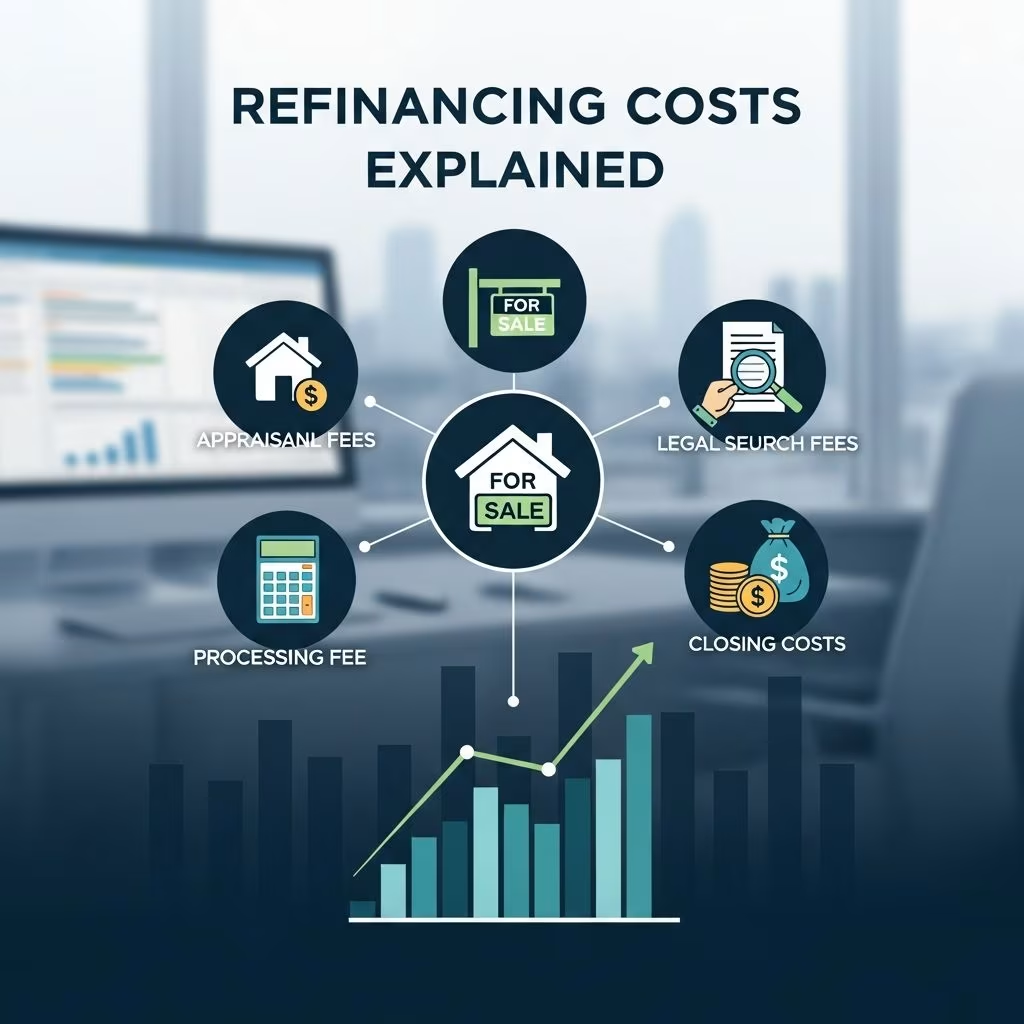
Mortgage refinancing involves replacing your current home loan with a new one, often to secure better rates or terms, but it comes with various upfront expenses that can add up quickly. Understanding these costs is crucial to determine if the potential savings justify the investment.
Understanding the Basics of Mortgage Refinancing Expenses
Refinancing your mortgage means obtaining a new loan to pay off the existing one, potentially lowering your interest rate, adjusting the loan term, or accessing home equity. However, this process incurs fees similar to those of an original mortgage application. These expenses typically range from 2% to 6% of the loan amount, depending on factors like loan size, location, and lender policies.
Key factors influencing costs include the type of refinance—such as rate-and-term, cash-out, or no-closing-cost options—and your home’s equity position. For instance, a cash-out refinance often carries higher fees due to the increased loan principal. Homeowners must weigh these against benefits like reduced monthly payments or interest savings over time.
Itemized Breakdown of Common Refinancing Fees
Refinancing fees can be paid upfront, rolled into the new loan, or covered through a higher interest rate in no-closing-cost options. Here’s a detailed look at the most frequent charges:
- Application Fee: Charged for processing your initial request, usually $300–$500. This covers basic credit checks and document review.
- Appraisal Fee: An independent assessment of your home’s current market value, typically $300–$700. Essential for lenders to confirm loan-to-value ratios.
- Credit Report Fee: Around $30–$50 to pull your credit history from bureaus like Experian.
- Origination Fee: Lender’s compensation for funding the loan, often 0.5%–1% of the loan amount (e.g., $1,000–$2,000 on a $200,000 loan).
- Title Search and Insurance: Ensures clear property ownership, costing $200–$400 for search and $1,000+ for insurance.
- Underwriting Fee: For risk evaluation, $500–$1,000.
- Recording Fees: Government charges to update public records, $50–$200.
- Survey Fee: If required, $300–$500 to verify property boundaries.
Additional costs may arise from discount points (prepaid interest to lower rates, 1 point = 1% of loan) or flood certification fees.
Comparing Refinance Types and Their Cost Profiles
Different refinance strategies carry unique cost structures. Use this table to compare:
| Refinance Type | Primary Purpose | Avg. Costs (% of Loan) | Pros | Cons |
|---|---|---|---|---|
| Rate-and-Term | Lower rate/term adjustment | 2–5% | Reduces payments/interest | Standard fees apply |
| Cash-Out | Access equity as cash | 3–6% | Liquid funds for needs | Higher loan balance |
| Cash-In | Pay down principal | 2–4% | Lowers LTV, drops MIP | Requires upfront cash |
| No-Closing-Cost | Avoid upfront payment | 0% upfront (higher rate) | No immediate outlay | Increased long-term cost |
Data synthesized from lender guidelines; actual costs vary. Cash-out options increase principal, amplifying future interest.
Strategies to Reduce or Offset Refinancing Expenses
Minimize outlays by shopping multiple lenders for competitive quotes, negotiating fees, or opting for lender credits. Some lenders waive origination fees for existing customers.
- Compare Loan Estimates within 3 business days of application to spot discrepancies.
- Lock rates early to avoid hikes during processing (30–45 days typical timeline).
- Roll costs into the loan if cash flow is tight, though this extends repayment.
- Choose no-closing-cost if selling soon (under 3 years), despite higher rates.
Ask about prepaid interest refunds from your old loan, which can offset new costs.
Calculating the Break-Even Point for Refinancing
The break-even point shows how long you need to stay in the home to recoup costs via savings. Formula: Total Costs ÷ Monthly Savings = Months to Break Even.
Example: $4,000 costs, $200 monthly savings → 20 months break-even. If staying 5+ years, proceed.
Tools like online calculators factor in rate drops (e.g., 0.5%–1% savings significant on large loans). Ignore if break-even exceeds planned tenure.
When Refinancing Makes Financial Sense
Ideal scenarios include rates 0.75%+ lower, improved credit for better terms, or equity buildup for cash-out without high LTV. Avoid if recent refinance, short ownership, or rising rates. Post-closing, a 3-day rescission period allows backing out.
Frequently Asked Questions
How long does refinancing take?
Typically 30–45 days from application to closing, varying by lender and documentation speed.
Can I refinance multiple times?
Yes, after seasoning periods (e.g., 6–12 months), based on equity and loan type.
What’s a no-closing-cost refinance?
Costs are financed via higher rate; saves upfront but costs more over time.
Does refinancing hurt credit?
Temporary dip from inquiries; limit to 2–3 lenders.
Is cash-out refinancing risky?
Increases debt; use for value-adding improvements, not consumption.
Navigating the Refinancing Process Step-by-Step
1. Define goals (rate drop, term change).
2. Check finances/credit.
3. Shop lenders.
4. Submit docs (income proof, statements).
5. Appraisal/underwriting.
6. Rate lock/review estimate.
7. Close/pay fees.
Post-close, new loan services old one; escrow handles taxes/insurance.
References
- Mortgage Refinancing Process and Its Benefits — Fifth Third Bank. 2023. https://www.53.com/content/fifth-third/en/financial-insights/personal/home-ownership/the-mortgage-refinancing-process-and-its-benefits.html
- How Mortgage Refinancing Works — Space Coast Credit Union. 2024. https://www.sccu.com/articles/home-mortgage/how-mortgage-refinancing-works
- 5 Steps of the Mortgage Refinancing Process — Citizens Bank. 2023. https://www.citizensbank.com/learning/refinance-process.aspx
- Refinancing: What is it and how does it work? — Rocket Mortgage. 2025. https://www.rocketmortgage.com/learn/how-does-refinancing-work
- How Does Refinancing a Mortgage Work? — Experian. 2024. https://www.experian.com/blogs/ask-experian/how-does-refinancing-a-mortgage-work/
- Refinancing A Mortgage: What It Means, How It Works — Bankrate. 2024. https://www.bankrate.com/mortgages/how-does-refinancing-a-mortgage-work/
- A Consumer’s Guide to Mortgage Refinancings — Federal Reserve. 2006 (authoritative guide, remains relevant for core processes). https://www.federalreserve.gov/pubs/refinancings/
This article is general information, not personal financial advice. Consider your own situation, or speak with a licensed adviser, before acting on it.


