

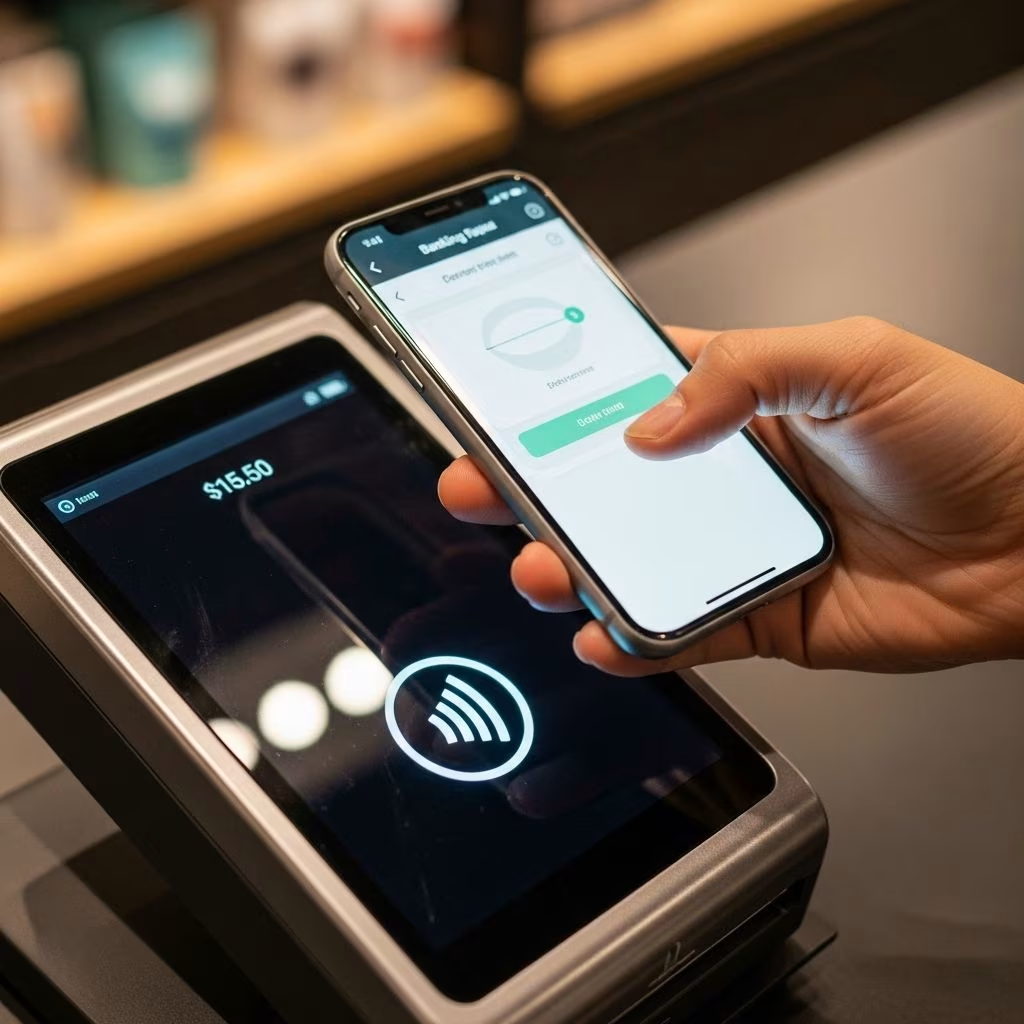
The retail landscape is undergoing a profound transformation as businesses increasingly opt for cashless operations. This shift prioritizes speed, security, and hygiene, driven by advancements in digital wallets, contactless cards, and biometric verification. While convenient for many, it raises concerns for those reliant on physical currency. Understanding this evolution helps consumers prepare for broader adoption.
Why Retailers Are Ditching Cash
Businesses cite multiple benefits for eliminating cash handling. Processing digital transactions reduces theft risks and speeds up checkout lines. In high-traffic venues like stadiums and festivals, cashless systems via RFID wristbands or mobile apps handle thousands of payments per minute, minimizing queues. Hygiene also plays a role post-pandemic, as contactless methods limit germ transmission on bills and coins.
Operational efficiency stands out: digital systems integrate with inventory tracking and loyalty programs, providing real-time data analytics. Merchants report higher average transaction values since customers spend more freely without the ‘pain of paying’ associated with handing over cash. Projections indicate digital wallets will dominate 61% of e-commerce by 2026, spilling over into physical retail.
Legal Landscape: Must Stores Accept Cash?
In the United States, no federal law mandates cash acceptance by private businesses. Retailers can legally refuse cash unless state or local regulations specify otherwise. For instance, certain municipalities require cash options to prevent discrimination against unbanked populations. Massachusetts law compels businesses to accept cash for face-to-face transactions under specific conditions.
Globally, patterns vary. Sweden nears cashless status, with cash comprising under 1% of payments, supported by high digital trust and e-krona pilots. Singapore limits cash to 2% of transactions by recent forecasts. In contrast, some regions enforce cash acceptance to ensure financial inclusion. Consumers should verify local rules before shopping.
| Region | Cash Acceptance Rule | Digital Dominance |
|---|---|---|
| United States (Federal) | Not required | Growing via wallets |
| Sweden | Voluntary | Nearly 100% digital |
| Singapore | Limited enforcement | 98% non-cash |
| Massachusetts (US) | Required for in-person | Hybrid |
Common Cashless Environments
Several venue types lead the cashless charge. Sports arenas and concert halls use prepaid cards or apps loaded via credit at entry points. Universities equip campuses with vending machines and dining halls accepting only digital tenders. Transit systems worldwide, from London’s Oyster cards to New York’s OMNY, phase out cash for tap-and-go efficiency.
- Stadiums and Events: RFID-enabled wearables track spending and access, boosting impulse buys by 20-30%.
- College Campuses: Meal plans and laundry services digitize entirely for administrative ease.
- Public Transportation: Contactless fares reduce boarding delays.
- Festivals and Fairs: Mobile wallets prevent loss and enable data-driven marketing.
These setups thrive in controlled spaces where conversion stations mitigate initial barriers.
Consumer Rights and Challenges
Unbanked or underbanked individuals—about 4.5% of US households—face exclusion without cash options. Federal protections like the Electronic Fund Transfer Act safeguard digital transactions, capping liability for unauthorized charges at $50 if reported promptly. However, cash offers finality; reversals rarely occur.
Discrimination claims arise when policies disproportionately affect low-income or elderly groups. Advocacy pushes for hybrid models. Businesses counter by offering free loading stations and fee waivers, though lines form during peak times.
Alternatives to Carrying Cash
Adaptation involves embracing digital tools. Prepaid cards convert cash to usable funds without bank accounts. Digital wallets like Apple Pay, Google Pay, and PayPal store cards securely, using tokenization to prevent data breaches.
- Load cash at retailers onto prepaid cards.
- Use peer-to-peer apps for splitting bills.
- Opt for bank-issued debit cards with low fees.
- Explore buy-now-pay-later for larger purchases.
Biometrics enhance security: facial scans or fingerprints verify without PINs, projected to hit $70 billion market by 2032.
Pros and Cons of Cashless Systems
| Advantages | Disadvantages |
|---|---|
| Faster transactions (<2 sec with NFC) | Requires smartphone/internet |
| Lower fraud via AI detection | Power outages disable systems |
| Real-time analytics for businesses | Fees for some conversions |
| Hygiene and security | Exclusion of unbanked |
AI processes trillions of data points to flag fraud in milliseconds, while blockchain ensures tamper-proof records.
Global Cashless Momentum
Sweden’s trajectory exemplifies the trend: buses banned cash years ago, e-commerce is 99% digital. India’s demonetization accelerated UPI adoption, dropping cash-on-delivery. Mastercard forecasts one-click checkouts and real-time settlements by 2026, fueled by tokenization.
Cross-border growth demands interoperability; stablecoins and A2A models streamline international flows. By 2026, 5.2 billion users will wield digital wallets, over 60% globally.
Future Innovations Accelerating Adoption
2026 brings agentic commerce, where AI agents handle purchases autonomously. Embedded finance in IoT devices—like smart fridges reordering groceries—blurs payment lines. Quantum-resistant encryption fortifies against threats, and circular economy payments incentivize sustainability via micro-transactions.
Real-time payments free merchant capital, with systems like Mastercard’s clearing instantly. Expect super apps merging payments, rides, and entertainment.
Tips for Thriving in Cashless Retail
- Carry a backup prepaid card.
- Enable mobile wallet notifications for balances.
- Check venue policies online pre-visit.
- Report issues immediately to limit liability.
- Advocate locally for inclusive policies.
Frequently Asked Questions
Can stores legally refuse cash?
Yes, in most US states, but check local laws. No federal mandate exists.
What if I’m unbanked?
Use prepaid cards or ask about cash-loading options at entry.
Are digital payments safe?
Yes, with tokenization and biometrics reducing risks significantly.
Will all stores go cashless?
Not immediately; small businesses may retain cash for accessibility.
How do I convert cash at events?
Visit kiosks; many waive fees for first loads.
References
- Top Trends in Cashless Payment Solutions for 2026: What’s Next? — Billfold Tech. 2026. https://www.billfold.tech/blog/top-trends-in-cashless-payment-solutions-for-2026-whats-next
- Digital technology and local culture influence global noncash — J.P. Morgan. 2023. https://www.jpmorgan.com/insights/payments/merchant-services/digital-wallets-drive-cashless-society
- The future of payments: Six industry trends shaping 2026 — Mastercard. 2025. https://www.mastercard.com/global/en/news-and-trends/stories/2025/2026-payment-trends.html
- 6 Key E-Commerce Payment Trends to Look Out For in 2026 — Brite Payments. 2026. https://britepayments.com/resources/article/e-commerce-payment-trends-2026/
- Five payment trends to watch in 2026 — Beeteller. 2026. https://beeteller.com/blog/five-payment-trends-to-watch-in-2026
This article is general information, not personal financial advice. Consider your own situation, or speak with a licensed adviser, before acting on it.


