

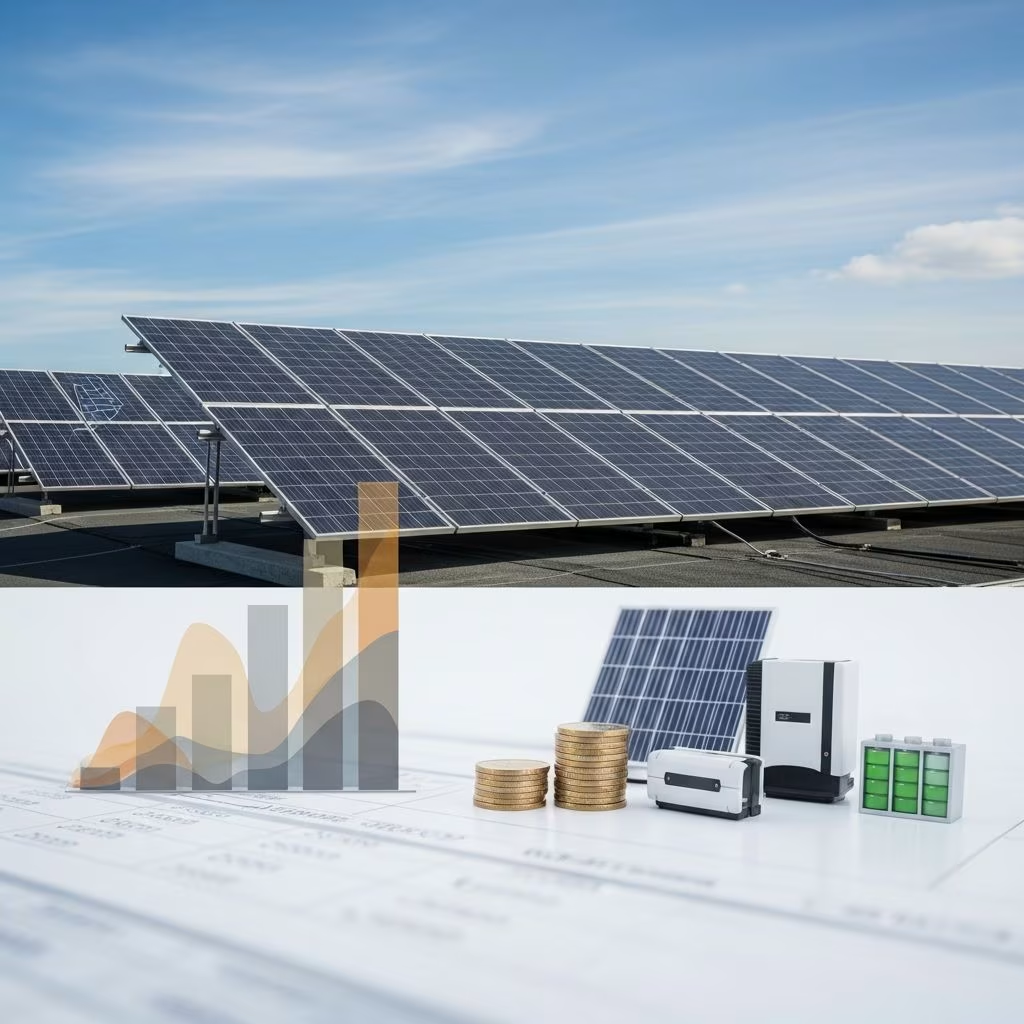
Solar panel installations in 2026 typically range from $25,000 to $45,000 for residential systems before incentives, with costs per watt averaging $2.50 to $3.00 depending on location and system size. After applying the 30% federal Investment Tax Credit (ITC), net expenses often fall to $18,000-$38,000, making solar a viable option for many households aiming to reduce energy bills and environmental impact.
Understanding Average Solar System Pricing
The baseline cost for a home solar setup hinges on its capacity, measured in kilowatts (kW). A standard 5-15 kW system suits most residences, covering typical monthly electric bills from $60 to $180. National data shows gross costs between $2.55-$2.86 per watt, translating to $12,600-$36,600 for common sizes before any rebates.
| System Size (kW) | Avg Cost per Watt | Gross Cost | After 30% ITC |
|---|---|---|---|
| 5 kW | $2.86 | $14,300 | $10,010 |
| 10 kW | $2.75 | $27,500 | $19,250 |
| 12 kW | $2.56 | $30,720 | $21,504 |
| 15 kW | $2.44 | $36,600 | $25,620 |
These figures draw from aggregated marketplace data, reflecting quotes for complete installations including panels, inverters, and labor. Larger systems benefit from economies of scale, slightly lowering the per-watt price.
Key Components Driving Solar Expenses
Solar system prices break down into hardware, labor, and soft costs. Panels account for about 30% of total outlay at roughly $0.30 per watt, while inverters—converting DC to AC power—add $0.34 per watt. Labor runs $0.22 per watt, and balance-of-system (BOS) elements like mounting and wiring contribute $0.37 combined.
- Panels: Monocrystalline options dominate for efficiency (18-22%), costing more than polycrystalline but yielding better output per space.
- Inverters: String inverters are cheapest; microinverters or optimizers increase costs by 10-20% for shaded roofs.
- Mounting & Wiring: Rooftop setups average lower than ground-mounts, which add $5,000-$15,000 for racking.
- Permits & Inspections: 5-10% of total, varying by local codes.
Optional add-ons like battery storage (e.g., $10,000-$20,000 for 10-13 kWh) or EV chargers push totals higher but enhance self-consumption and resilience.
Federal and State Incentives Reducing Net Costs
The cornerstone incentive remains the federal ITC, offering 30% off qualified expenses through 2032, phasing down afterward. For a $30,000 system, this yields $9,000 in tax savings. Additional rebates via state programs, net metering, or utility grants can shave off another 10-20%.
- Residential Clean Energy Credit: Covers panels, batteries, and labor.
- State Rebates: E.g., New York offers up to $5,000 via NY-Sun.
- Net Metering: Credits excess power at retail rates, accelerating payback.
Post-incentive, a 10 kW system might net at $23,000, with payback in 6-10 years based on $0.15-$0.25/kWh local rates.
Regional Variations in Solar Pricing
Costs fluctuate by state due to labor rates, sunlight hours, and incentives. Sunny California sees $2.50/W averages, while New York’s complex roofs and regulations hit $2.76-$3.30/W, equating to $35,000 for 12 kW systems.
| Region | Avg $/W | 12 kW System Cost (Pre-ITC) |
|---|---|---|
| National Avg | $2.65 | $31,800 |
| California | $2.50 | $30,000 |
| New York | $2.76 | $33,120 |
| Texas | $2.60 | $31,200 |
High-insolation areas like the Southwest justify investments faster due to greater energy production.
Ground-Mount vs Rooftop Installations
Rooftop systems are standard and cheaper at $2.50-$3/W, but ground-mounts suit unsuitable roofs, costing 20-50% more ($20,000-$40,000 for homes) from extra foundations and trenching. They offer easier maintenance and scalability.
Financing Options to Manage Upfront Costs
Cash purchases maximize ITC benefits, but loans (4-6% interest), leases, or Power Purchase Agreements (PPAs) spread payments. Loans preserve ownership and credits; leases lower barriers but cap savings.
- Cash: Full control, fastest ROI.
- Loan: 10-20 year terms, ITC applies to principal.
- Lease/PPA: No upfront, fixed monthly ~$0.10-$0.20/kWh.
Long-Term Savings and Payback Analysis
Over 25-30 years, solar offsets $37,000-$154,000 in bills, per production models. Payback averages 7-12 years, with lifetime ROI of 10-20%. Add rising utility rates (3-5% annually), and net gains compound.
Maintenance is minimal: $150-300/year for cleaning/inspections. Inverters last 10-15 years ($1,000-$4,000 replacement); panels 25+ years with <1%/year degradation.
Is Solar Worth It in 2026?
With costs down 45% since 2010 and stable incentives, yes—for homes with south-facing roofs, average+ bills, and 10+ year stays. Tools like NREL’s PVWatts calculator estimate site-specific output.
Frequently Asked Questions
How long do solar panels last?
25-30 years with 80-90% efficiency retention; performance warranties guarantee this.
Do solar panels increase home value?
Yes, by 4% nationally (~$15,000 for $400K home), per Lawrence Berkeley Lab studies.
Can I install solar in shaded areas?
Yes, via microinverters or optimizers mitigating 20-30% shade losses.
What if I move before payback?
Transferable leases or boosted resale value; loans allow payoff assumption.
Are there solar grants for low-income?
Yes, via DOE’s Solar for All, state programs covering 50-100% for qualifiers.
References
- Solar Installed System Cost Analysis — National Renewable Energy Laboratory. 2025. https://www.nrel.gov/docs/fy23osti/87303.pdf
- Solar Panel Cost In 2026 — EnergySage. 2026. https://www.energysage.com/local-data/solar-panel-cost/
- How Much Do Solar Panels Cost? (2026) — ConsumerAffairs. 2026. https://www.consumeraffairs.com/solar-energy/how-much-do-solar-panels-cost.html
- How Much Do Solar Panels Cost to Install in 2026? — Paradise Solar Energy (citing NREL data). 2026. https://www.paradisesolarenergy.com/blog/how-much-do-solar-panels-cost/
- Solar Panel Cost In 2025 (Homeowner’s Installation Savings Guide) — EcoWatch. 2025. https://www.ecowatch.com/solar/incentives-rebates/solar-panel-cost
This article is general information, not personal financial advice. Consider your own situation, or speak with a licensed adviser, before acting on it.


