

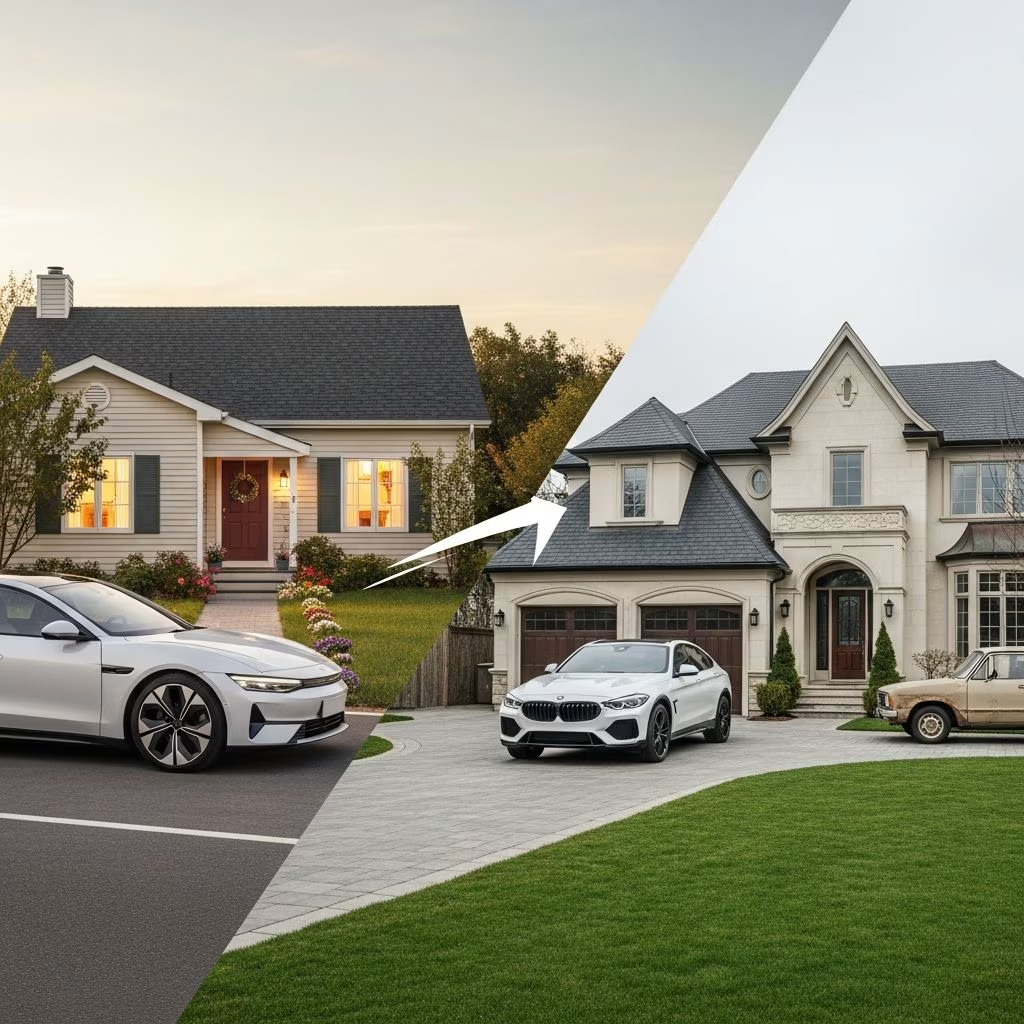
Deciding between purchasing a vehicle or a home represents a pivotal financial crossroads for many individuals. Homes typically appreciate in value over time, fostering wealth accumulation, whereas cars depreciate rapidly, often losing significant worth immediately after purchase. This core distinction influences whether securing a house prior to a car—or vice versa—best serves one’s circumstances.
Financial Hurdles: Debt-to-Income Ratio and Qualification Challenges
An auto loan introduces monthly payments that elevate your debt-to-income (DTI) ratio, a critical metric lenders evaluate for mortgage eligibility. Lenders generally prefer a DTI below 43%, and each additional $100 in car payments can diminish home-buying capacity by roughly $14,000, depending on interest rates and terms.
Consider this illustrative table showing how car payments affect maximum affordable home prices at a fixed $3,000 monthly mortgage budget:
| Monthly Car Payment | Max Monthly Home Payment | Max Home Price |
|---|---|---|
| $200 | $3,000 | $370,000 |
| $400 | $2,950 | $361,000 |
| $500 | $2,900 | $355,000 |
These figures highlight how even moderate auto debt constrains housing options, potentially delaying homeownership by years.
Savings Demands: Comparing Down Payment Realities
Accumulating funds for a home demands more time and discipline than for a car. A conventional home down payment ranges from 3% to 20% of the purchase price—for a $300,000 property, that’s $9,000 to $60,000. In contrast, car down payments hover at 10%-20%, translating to $3,000-$6,000 for a $30,000 vehicle.
- Home savings timeline: Often 1-5 years, factoring in closing costs, inspections, and reserves.
- Car savings timeline: Typically 6-12 months, with lower barriers to entry.
Prioritizing home savings preserves mortgage affordability, avoiding the DTI pitfalls of premature car financing.
Ongoing Expenses: Total Ownership Costs Breakdown
Beyond initial outlays, evaluate lifetime expenses. Homes incur mortgage payments, homeowners insurance, property taxes, and maintenance, but they often yield equity growth. Cars demand auto loans, insurance, fuel, registration, and repairs, with no appreciation offset.
| Category | Home Costs | Car Costs |
|---|---|---|
| Financing | Mortgage (15-30 years) | Auto Loan (3-7 years) |
| Insurance | Homeowners policy | Auto coverage |
| Upkeep | Repairs, landscaping | Oil changes, tires |
| Other | Property taxes, HOA | Fuel, registration |
Homes build net worth through value increases, while cars erode it via depreciation.
Asset Dynamics: Appreciation Versus Rapid Depreciation
Housing serves as an investment vehicle, with properties gaining value amid market growth. A $300,000 home appreciating at 3% annually adds $48,000 in equity over five years. Conversely, new cars shed 10-20% value in year one and retain just 40-50% after five years—a $70,000 vehicle might dwindle to $31,500.
This disparity underscores why experts advocate home prioritization: real estate compounds wealth, cars consume it.
Market Influences: Rates, Prices, and Timing Strategies
Current economic conditions shape decisions. Mortgage rates, projected around 6% through 2025, exceed auto rates but span longer terms, amplifying total interest. If rates decline, home buys become more accessible, warranting car purchase delays.
- Rising home prices: Act swiftly to lock in affordability.
- Vehicle market volatility: Supply issues inflate prices; await normalization.
Monitor Federal Reserve updates and inventory reports for optimal timing.
Personal Necessities: When a Car Takes Precedence
Not all situations favor homes first. Reliable transportation proves essential in car-dependent regions lacking public transit.
- Your current vehicle nears breakdown, with repairs exceeding value.
- Commute demands a dependable car for job retention or new opportunities.
- Strategic credit-building: Timely auto loan payments can bolster scores for future mortgages.
- Unfavorable housing markets with escalating prices or rates postpone feasibility.
If a car enhances income stability, it indirectly supports home goals.
Strategic Home Priority: Building Equity Foundations
Opt for housing first when transportation suffices and wealth growth beckons.
- Existing reliable wheels eliminate urgency.
- Rising markets reward early entry.
- Avoid DTI inflation for smoother approvals.
- Equity accrual provides long-term security.
Homeownership marks a milestone, often the cornerstone asset in portfolios.
Quantifying Trade-Offs: A Five-Year Projection
Modeling reveals stark contrasts. Purchasing a $70,000 car first forfeits $86,000 in potential home appreciation (at 3%) while suffering $38,500 depreciation, netting substantial loss amid higher future home costs.
In high-cost areas, prolonged renting while saving for both may strain budgets, tilting toward car acquisition if it unlocks better employment.
Navigating Credit and Approval Processes
Simultaneous pursuits harm credit via inquiries and DTI spikes, delaying approvals. Sequence purchases: address essentials first, then leverage improved finances for the next.
Alternatives to Full Purchases
- Leasing cars: Lower payments preserve DTI.
- Used vehicles: Mitigate depreciation hits.
- Rentals or rideshares: Bridge gaps without debt.
- Co-signers or family aid: Ease initial burdens.
Frequently Asked Questions
Does a car loan ruin mortgage chances?
It elevates DTI, potentially reducing borrowing power by tens of thousands, but manageable payments and strong income mitigate risks.
How much down payment for each?
Homes: 3-20%; cars: 10-20%. Homes demand larger sums overall.
Can I afford both soon?
Sequencing prevents credit dings; prioritize based on needs.
What if homes are unaffordable locally?
Secure transport for income growth, then relocate or save longer.
Impact of rates in 2025?
Mortgages near 6%; watch for drops favoring homes.
Final Decision Framework
Align choices with necessities: car for mobility, house for legacy. Assess DTI, markets, and timelines meticulously.
References
- Should You Buy a Car or a House First How to Decide — MIDFLORIDA Credit Union. 2024. https://midflorida.com/resources/insights-and-blogs/insights/mortgage/should-you-buy-a-car-or-a-house-first-how-to-decide
- Investing Tips 101: Buying a Car vs Buying a House — Century 21 Northwest Realty. 2023. https://c21northwest.com/blog/buying-car-vs-buying-house/
- Buying a Car Before Buying a House: Does It Hurt Your Approval — Mortgage Research. 2024. https://www.mortgageresearch.com/articles/buying-a-car-before-buying-a-house/
- Should I Buy A House Or Car First? — Bankrate. 2024-10-15. https://www.bankrate.com/real-estate/buy-a-house-or-car/
- Should You Buy a Car or House First in 2025? — YouTube (Real Estate Insights). 2025. https://www.youtube.com/watch?v=bbUysnCKjOI
- Should you buy a car or house first? — Rocket Mortgage. 2024. https://www.rocketmortgage.com/learn/buy-a-car-or-house
This article is general information, not personal financial advice. Consider your own situation, or speak with a licensed adviser, before acting on it.


