

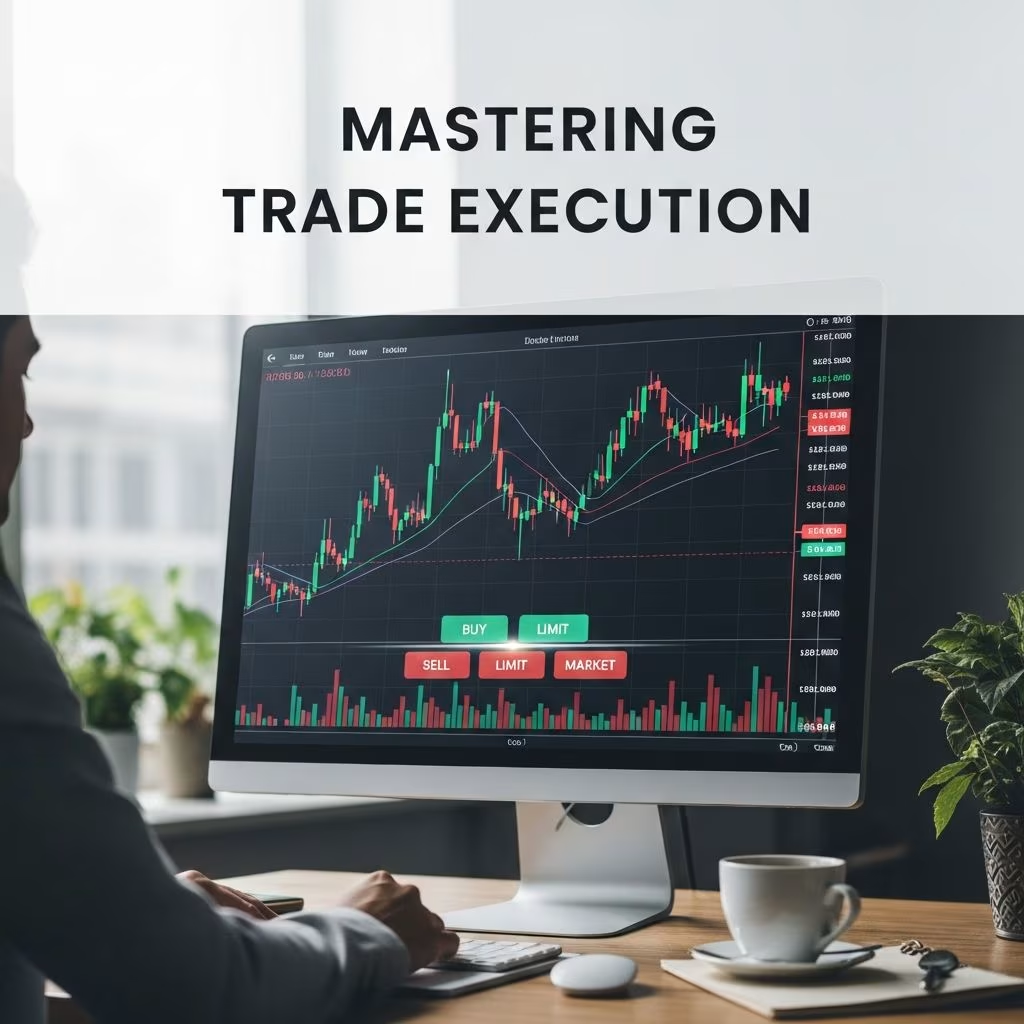
Trade execution represents the critical bridge between an investor’s decision and the actual completion of a securities transaction. When placing an order through an online brokerage platform, the process involves multiple stages handled by brokers, exchanges, and clearing entities to ensure accuracy and efficiency.
The Fundamentals of Placing a Trade Order
Investors initiate the trade execution process by submitting a buy or sell order via their brokerage account. This order specifies essential details such as the security, quantity, order type, and duration. Common order types include market orders, which execute immediately at the prevailing price, and limit orders, which activate only at a designated price or better.
- Market Orders: Prioritize speed, filling at the next available price but potentially varying from the quoted price due to market fluctuations.
- Limit Orders: Offer price control, executing only if the market meets the specified threshold, ideal for precise entry or exit points.
- Stop Orders: Trigger a market order once a stop price is reached, commonly used for risk management.
After submission, the brokerage reviews the order for compliance with regulations and internal policies before routing it for execution.
How Brokers Route and Process Orders
Brokers act as intermediaries, determining the optimal path for order fulfillment. They may handle execution internally, route to exchanges, or direct to alternative venues. This decision hinges on factors like order type, market conditions, and liquidity availability.
| Execution Venue | Description | Best For |
|---|---|---|
| Exchange | Centralized marketplace matching buyers and sellers | Large-volume trades |
| ECN (Electronic Communication Network) | Automated matching at specified prices | Limit orders |
| Market Maker | Provides liquidity by quoting buy/sell prices | OTC securities |
| Internalization | Broker fills from own inventory | Small retail orders |
Routing choices impact execution quality, measured by speed, price improvement, and fill rates. Brokers often seek “best execution,” prioritizing the most favorable terms available under current conditions.
Key Stages in the Trade Lifecycle
The journey from order placement to settlement unfolds in distinct phases, each vital for transaction integrity.
- Order Placement: Investor enters details through app or web interface.
- Broker Review: Checks for regulatory compliance and errors.
- Routing and Matching: Sent to venue where counterparties are located.
- Execution: Order fills fully, partially, or rejects if unmatched.
- Confirmation: Electronic notice details price, quantity, and fees.
- Clearing and Settlement: Verification and transfer of securities/funds, typically T+1.
Partial fills occur with limit or large orders in illiquid stocks, while halts or pauses can delay execution.
Factors Influencing Execution Speed and Quality
Several elements determine how quickly and effectively an order executes. Market volatility accelerates or hinders matching, while order size affects liquidity access. Broker technology and routing algorithms play pivotal roles in minimizing slippage—the gap between expected and actual price.
- High liquidity ensures rapid fills at quoted prices.
- Advanced order types like Fill or Kill (FOK) demand immediate full execution or cancellation.
- Fractional shares enable precise positioning without rounding up quantities.
Price improvement, where execution beats the national best bid/offer (NBBO), adds value, especially for marketable orders.
Advanced Order Types for Strategic Trading
Beyond basics, sophisticated orders enhance control. Stop-limit combines stop activation with limit pricing to cap slippage. Good-Til-Canceled (GTC) persists beyond the trading day until filled or manually withdrawn.
Notional orders base quantity on monetary value, useful for volatile assets. These tools allow tailoring strategies to risk tolerance and market views.
The Role of Technology in Modern Execution
Order management systems (OMS) integrate real-time monitoring, risk checks, and algorithmic routing. They track exposures, hedge positions, and filter orders by client profiles. Electronic platforms democratize access, reducing latency from seconds to milliseconds.
For active traders, direct market access (DMA) bypasses brokers for exchange connectivity, though retail investors rely on broker intermediation.
Regulatory Oversight and Investor Protections
Agencies like the SEC and FINRA mandate best execution practices. Rule 605 requires disclosure of execution quality statistics, empowering investors to compare brokers. Payment for order flow (PFOF), where market makers compensate brokers, remains controversial but regulated to prevent conflicts.
Evaluating Broker Execution Performance
Investors should review metrics like effective spread, fill speed, and price improvement rates. Public reports from FINRA and broker disclosures aid comparisons. Low-cost brokers often excel in execution due to scale.
Common Pitfalls and Best Practices
Avoid trading during low-volume periods to minimize slippage. Use limit orders for control in volatile markets. Monitor confirmations promptly and understand fee structures.
- Confirm order details before submission.
- Diversify brokers for benchmarking.
- Stay informed on market halts.
FAQs on Trade Execution
What happens if my order doesn’t fill?
Limit orders may remain pending if prices don’t align; market orders rarely fail but risk slippage.
How long does settlement take?
T+1 business day for equities, moving shares and funds.
What’s price improvement?
Execution better than NBBO, boosting returns.
Do all brokers offer the same execution?
No; compare via quality reports and fees.
Can I trade fractional shares?
Many platforms support them for precise investing.
Mastering these elements empowers investors to execute trades efficiently, maximizing returns while mitigating risks in dynamic markets.
References
- How Online Stock Trading Works: Understanding the Trade Lifecycle — FINRA. 2023-10-15. https://www.finra.org/investors/insights/online-trade-lifecycle
- Trade Execution — SEC.gov. 2024-01-12. https://www.sec.gov/about/reports-publications/investorpubstradexec
- Executing an Order — Investor.gov. 2023-05-20. https://www.investor.gov/introduction-investing/investing-basics/how-stock-markets-work/executing-order
- Trade Execution – The Complete Guide for Active Traders — CenterPoint Securities. 2024-08-05. https://centerpointsecurities.com/stock-trading-execution-quality/
- What is Trade Execution? A Simple Guide for Investors — Straits Financial. 2024-03-10. https://www.straitsfinancial.com/insights/what-is-trade-execution
This article is general information, not personal financial advice. Consider your own situation, or speak with a licensed adviser, before acting on it.


