

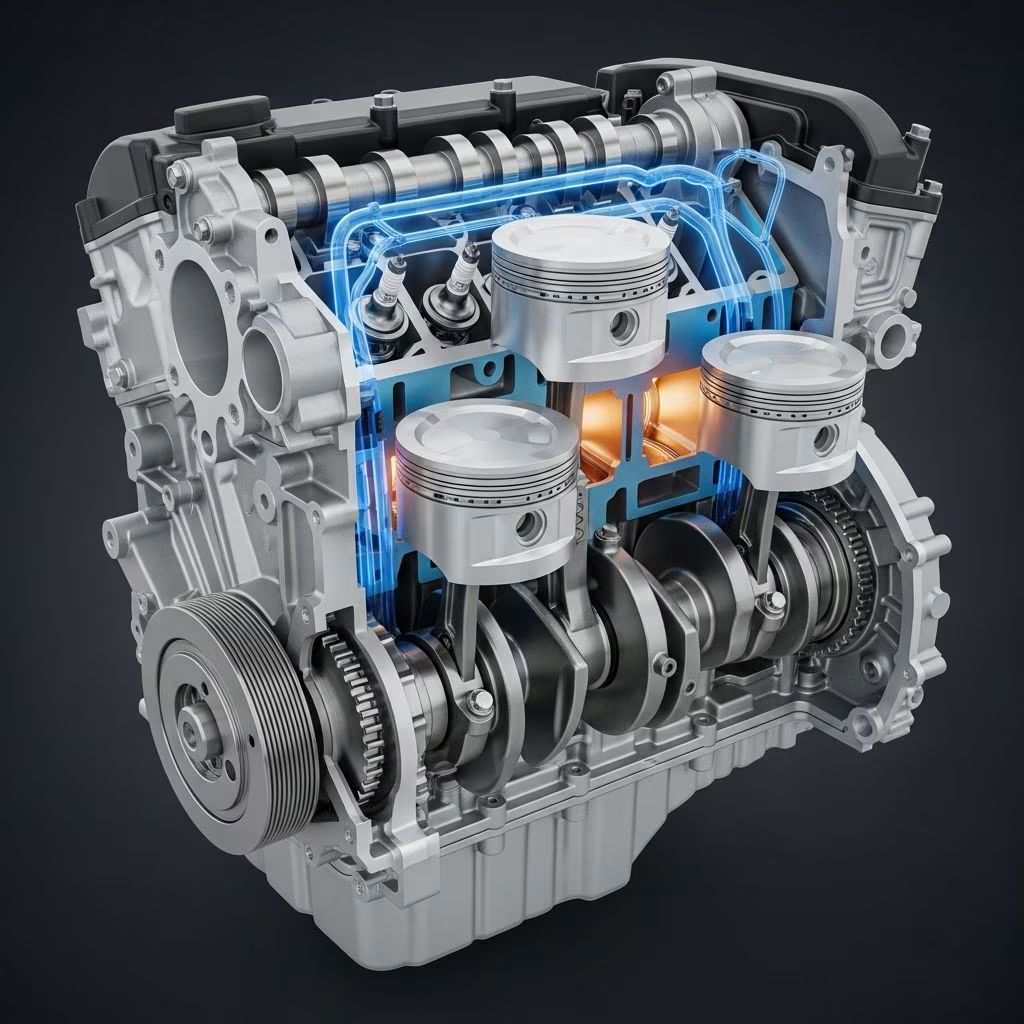
The internal combustion engine powers most vehicles on the road today by transforming the chemical energy in fuel into mechanical motion. This heat engine relies on controlled explosions within cylinders to drive pistons, which ultimately turn the wheels through a series of interconnected parts.
Core Principles of Engine Operation
At its heart, a car engine operates on the principle of internal combustion, where fuel burns inside the engine rather than externally. Oxygen from the air mixes with gasoline, igniting to produce expanding gases that push components and generate torque. Unlike external combustion engines like steam engines, this design allows for compact, high-power output directly within the vehicle.
Modern automotive engines typically feature multiple cylinders—ranging from 2 to 12—each housing a piston that reciprocates linearly. This up-and-down motion mimics pedaling a bicycle, converting to rotational force via the crankshaft to propel the car.
The Four-Stroke Cycle: Engine’s Power Rhythm
Most gasoline engines follow a four-stroke cycle, repeating every two crankshaft revolutions. Each stroke serves a distinct purpose in drawing in fuel, compressing it, igniting it, and expelling waste gases.
- Intake Stroke: The piston descends from top dead center (TDC) to bottom dead center (BDC), creating a vacuum that pulls in an air-fuel mixture through open intake valves.
- Compression Stroke: Valves close, and the piston rises, squeezing the mixture to increase its pressure and temperature for efficient burning.
- Power Stroke: Near TDC, a spark plug ignites the compressed mixture, causing rapid expansion that forces the piston downward, delivering the engine’s primary force.
- Exhaust Stroke: The piston ascends again with exhaust valves open, pushing burned gases out through the exhaust port.
This sequence ensures smooth power delivery as pistons in multi-cylinder engines fire in staggered timing.
Key Components Driving Engine Function
Several precision-engineered parts work in harmony to execute the four strokes reliably.
Pistons and Cylinders
Pistons are cylindrical components that slide within machined bores called cylinders, forming the combustion chamber’s floor. Piston rings seal the gap, preventing gas leakage while allowing lubrication and controlling oil entry into the chamber. The combustion chamber, bounded by the cylinder walls, piston crown, and cylinder head, is where fuel ignites.
Crankshaft and Connecting Rods
The crankshaft converts the pistons’ linear motion into rotation. Connecting rods link each piston to the crankshaft’s throws, transferring force as the crank spins. Positioned lengthwise in the engine block, it connects to accessories via belts at the front and the transmission at the rear.
Valvetrain and Camshaft
Intake and exhaust valves control gas flow, opened by the camshaft’s egg-shaped lobes. Driven by the crankshaft via a timing belt or chain, the camshaft ensures valves operate at precise intervals for optimal timing.
Spark Plugs and Ignition
Spark plugs deliver high-voltage electricity to ignite the mixture at the ideal moment. Timing advances with RPM to maximize power, occurring just before TDC during compression.
Engine Configurations Comparison
| Configuration | Cylinders | Pros | Cons |
|---|---|---|---|
| Inline | 4-6 | Compact, balanced | Long block |
| V-Type | 6-12 | Powerful, shorter | Complex |
| Boxer | 4-6 | Low center of gravity | Wide |
Supporting Systems for Reliability
Fuel and Air Delivery
Air enters via the intake manifold, often filtered and sometimes turbocharged for density. Fuel injectors spray gasoline directly into cylinders or ports, optimizing the air-fuel ratio—typically 14.7:1 for stoichiometry.
Lubrication System
Oil from the pan is pumped through galleries, coating bearings, cylinder walls, and the crankshaft. Piston rings meter oil to prevent combustion contamination while enabling smooth sliding. Filtered oil recirculates continuously.
Cooling Mechanisms
Heat from combustion demands cooling; liquid systems circulate coolant through the block and head, dissipating heat via radiator airflow. This maintains optimal temperatures around 195°F.
Advanced Engine Technologies
Contemporary engines incorporate variable valve timing (VVT) for better efficiency across RPMs, direct injection for precise fueling, and turbochargers to boost air intake without enlarging displacement. Hybrid systems pair ICE with electric motors for torque fill and emissions reduction.
Maintenance Essentials for Engine Health
Regular upkeep extends engine life. Change oil every 5,000-10,000 miles using manufacturer-spec viscosity. Inspect timing belts every 60,000 miles, as failure causes catastrophic damage. Monitor coolant levels and replace spark plugs per schedule to ensure reliable ignition.
- Listen for unusual noises like knocking, indicating bearing wear.
- Check for leaks around gaskets and seals.
- Use high-quality fuel to minimize carbon deposits.
Frequently Asked Questions
What is the difference between a 4-stroke and 2-stroke engine?
4-stroke engines complete the cycle in four piston movements, offering better efficiency and durability for cars. 2-stroke engines combine intake/exhaust in two strokes, common in smaller tools but less efficient.
How does diesel differ from gasoline engines?
Diesel engines compress air alone to auto-ignite injected fuel, lacking spark plugs but delivering higher torque.
Why do engines need oil?
Oil reduces friction, cools components, and cleans debris, preventing seizure and wear.
What causes engine knocking?
Premature detonation from poor fuel or timing issues creates shockwaves, damaging pistons.
Can engines run without coolant?
Briefly, but overheating warps heads and seizes pistons quickly.
Future of Car Engines
While electric vehicles rise, internal combustion evolves with efficiency gains. Synthetic fuels and mild hybrids promise sustained relevance amid emissions regulations.
(Word count: 1678)
References
- Here’s How Your Car’s Engine Works — Car and Driver. 2019-10-01. https://www.caranddriver.com/features/a26962316/how-a-car-works/
- How a Car Engine Works — YouTube (Animation Explained). 2013-05-14. https://www.youtube.com/watch?v=ZQvfHyfgBtA
- Gearhead 101: Understanding How Your Car’s Engine Works — Art of Manliness. 2022-08-15. https://www.artofmanliness.com/skills/manly-know-how/how-a-cars-engine-works/
- Internal combustion engine — Wikipedia (technical overview). 2026-02-01. https://en.wikipedia.org/wiki/Internal_combustion_engine
- Cars 101, episode 1: Basic Engines for Dummies — FinalGear Forums. 2010-07-20. https://forums.finalgear.com/threads/cars-101-episode-1-basic-engines-for-dummies.9414/
This article is general information, not personal financial advice. Consider your own situation, or speak with a licensed adviser, before acting on it.


