

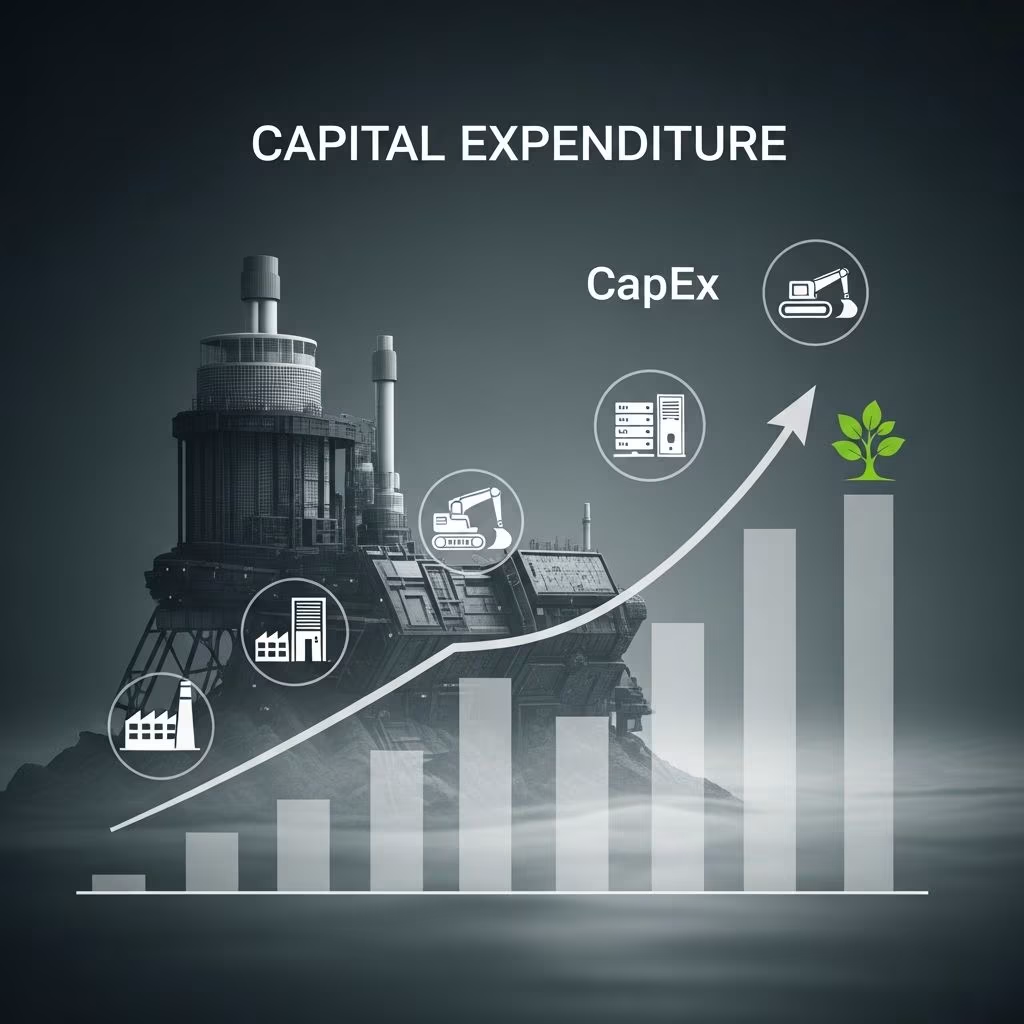
What Is Capital Expenditure?
Capital expenditure, commonly abbreviated as CapEx, represents the funds that a company invests in acquiring, upgrading, and maintaining physical assets such as property, buildings, technology, machinery, and equipment. Unlike operating expenses that are consumed during normal business operations, capital expenditures are strategic investments designed to enhance a company’s productive capacity and generate future revenue streams. These expenditures are typically substantial in nature and are capitalized on the balance sheet, meaning they are recorded as assets rather than immediate expenses.
Capital expenditures are fundamental to business growth and operational efficiency. They enable companies to expand production capabilities, enter new markets, improve operational processes, and maintain competitive advantages in their respective industries. Understanding CapEx is crucial for investors, managers, and financial analysts as it directly impacts a company’s financial health, profitability projections, and overall strategic direction.
Key Characteristics of Capital Expenditure
Capital expenditures possess several distinctive characteristics that differentiate them from ordinary business expenses:
- Long-term asset creation: CapEx investments typically result in assets that benefit the company over multiple years or decades, unlike expenses that are consumed immediately.
- Substantial cost: Capital expenditures generally involve significant monetary outlays, often requiring careful planning and financial analysis before approval.
- Balance sheet treatment: CapEx is recorded as assets on the balance sheet and is gradually expensed through depreciation over the asset’s useful life.
- Depreciation and amortization: Physical assets lose value over time and are deducted as depreciation expense, reducing taxable income.
- Strategic importance: Capital investments align with company strategy and long-term growth objectives rather than immediate operational needs.
- Capital budgeting requirement: CapEx decisions typically require rigorous financial analysis, including return on investment calculations and risk assessment.
Capital Expenditure vs. Operating Expenses
Understanding the distinction between capital expenditure and operating expenses is critical for proper financial management and reporting:
| Aspect | Capital Expenditure | Operating Expenses |
|---|---|---|
| Definition | Investment in long-term physical assets | Expenses for day-to-day business operations |
| Time Benefit | Benefits extend beyond one year | Benefits consumed within one year |
| Balance Sheet Impact | Recorded as assets | Recorded as expenses |
| Tax Treatment | Depreciated over useful life | Deducted in year incurred |
| Examples | Buildings, machinery, technology systems | Salaries, rent, utilities, office supplies |
| Impact on Profitability | Impacts profitability through depreciation | Directly reduces profitability |
Types of Capital Expenditures
Capital expenditures can be categorized based on their strategic purpose and nature:
1. Maintenance CapEx
Maintenance capital expenditures are investments required to maintain existing operational assets at their current productive capacity. These expenditures prevent asset deterioration and ensure equipment continues functioning optimally. Examples include replacing worn machinery parts, renovating office buildings, or updating computer systems. Maintenance CapEx is essential for sustaining current operations but does not necessarily increase productive capacity.
2. Growth CapEx
Growth capital expenditures are strategic investments designed to expand a company’s productive capacity and revenue-generating potential. These investments enable businesses to produce more goods, enter new markets, or launch new product lines. Examples include constructing new manufacturing facilities, opening additional retail locations, or implementing new technology platforms. Growth CapEx typically carries higher risks but offers greater potential for long-term returns.
3. Replacement CapEx
Replacement capital expenditures involve substituting outdated or obsolete assets with newer equipment or technology. Unlike maintenance CapEx that preserves existing capacity, replacement CapEx often improves efficiency and reduces operating costs. For example, replacing old manufacturing equipment with automated systems can significantly enhance productivity and reduce labor expenses.
Common Examples of Capital Expenditures
Capital expenditures vary across industries but commonly include:
- Real estate investments: Purchasing land, constructing buildings, or renovating facilities
- Manufacturing equipment: Acquiring machinery, production lines, and industrial equipment
- Technology infrastructure: Implementing computer systems, software platforms, and network equipment
- Vehicles and transportation: Purchasing company vehicles, trucks, and delivery fleet
- Tools and equipment: Acquiring specialized tools and equipment for operations
- Leasehold improvements: Making significant enhancements to leased properties
- Patents and intellectual property: Acquiring rights to patents, trademarks, or copyrights
How to Calculate Capital Expenditure
Capital expenditure can be calculated using information from a company’s financial statements, particularly the cash flow statement. The formula is:
CapEx = Change in PP&E + Current Period Depreciation
Where PP&E represents Property, Plant, and Equipment. This formula calculates the net increase in fixed assets after accounting for depreciation. Alternatively, CapEx can be calculated by adding capital additions to the change in net working capital, reflecting the total investment in operational assets.
Importance of Capital Expenditure
Capital expenditure plays a crucial role in business strategy and financial performance for several reasons:
- Business growth: CapEx enables companies to expand operations, increase production capacity, and enter new markets.
- Competitive advantage: Strategic investments in technology and infrastructure help companies maintain competitive positions within their industries.
- Operational efficiency: Upgrading equipment and systems reduces costs, improves productivity, and enhances quality control.
- Revenue generation: CapEx investments generate future revenue streams that exceed initial investment costs over time.
- Asset base valuation: CapEx determines a company’s asset base, which impacts valuation and financial stability.
- Investor confidence: Strategic capital investments signal management confidence in future growth prospects, influencing investor perception and stock performance.
Capital Expenditure in Financial Analysis
Financial analysts closely examine capital expenditure patterns to assess company strategy, financial health, and growth prospects. Key analytical considerations include capital intensity ratios, which measure CapEx relative to revenue or total assets. Companies with high capital requirements, such as utilities or manufacturing, typically display higher CapEx ratios. Additionally, free cash flow analysis incorporates CapEx as a critical deduction from operating cash flow, representing actual cash available for distribution to shareholders or debt repayment.
Factors Influencing Capital Expenditure Decisions
Companies consider multiple factors when making CapEx decisions:
- Expected return on investment: Detailed financial projections determine whether investments will generate sufficient returns to justify expenditures.
- Technology obsolescence: Rapid technological advancement necessitates periodic equipment upgrades to maintain operational relevance.
- Regulatory compliance: Environmental, safety, and industry regulations may mandate specific capital investments.
- Market conditions: Economic cycles, competitive pressures, and industry dynamics influence investment timing and magnitude.
- Available capital: Access to financing, internal cash flow, and debt capacity affect CapEx budgeting.
- Strategic objectives: Long-term growth plans and market positioning guide capital allocation decisions.
Frequently Asked Questions About Capital Expenditure
Q: What is the difference between CapEx and OpEx?
A: Capital expenditure (CapEx) involves investing in long-term physical assets recorded on the balance sheet, while operating expenses (OpEx) are day-to-day costs consumed immediately and recorded as expenses. CapEx benefits the company over multiple years through depreciation, while OpEx directly reduces profitability in the current period.
Q: How does depreciation relate to capital expenditure?
A: Capital expenditures are recorded as assets on the balance sheet and gradually expensed through depreciation over the asset’s useful life. Depreciation allocates the CapEx cost across multiple accounting periods, reflecting the asset’s declining value and contribution to operations.
Q: Why is capital expenditure important for investors?
A: Investors examine CapEx patterns to understand management’s growth strategy, assess competitive positioning, and evaluate capital efficiency. High CapEx may indicate aggressive growth plans, while declining CapEx might suggest market saturation or financial constraints.
Q: How do companies finance capital expenditures?
A: Companies finance CapEx through multiple sources including internal cash flow from operations, bank loans, corporate bonds, equity offerings, and leasing arrangements. The financing method depends on available capital, interest rates, and management preferences.
Q: What is Free Cash Flow and how does CapEx affect it?
A: Free Cash Flow represents cash available after capital expenditures have been deducted from operating cash flow. It indicates funds available for debt repayment, dividend distribution, or additional investments. Higher CapEx reduces free cash flow.
Q: How can companies minimize capital expenditure?
A: Companies can minimize CapEx through equipment leasing instead of purchasing, outsourcing capital-intensive functions, implementing efficient maintenance programs to extend asset life, and utilizing emerging technologies that reduce capital requirements.
Q: What are the tax implications of capital expenditure?
A: Capital expenditures cannot be immediately deducted as business expenses. Instead, assets are depreciated over their useful lives, generating annual depreciation deductions that reduce taxable income. Accelerated depreciation methods allow larger initial deductions.
References
- Financial Accounting Standards Board (FASB) Accounting Standards Update 2020-02: Direct-Use Software — Financial Accounting Standards Board. 2020. https://www.fasb.org
- Cash Flow Statement: Operating and Free Cash Flow — U.S. Securities and Exchange Commission (SEC). 2024. https://www.sec.gov/cgi-bin/browse-edgar
- International Accounting Standard 16: Property, Plant and Equipment — International Accounting Standards Board (IASB). 2023. https://www.ifrs.org
- Capital Budgeting: Theory and Practice — Journal of Finance, Vol. 75, No. 4. 2023. https://doi.org/10.1111/jofi.12954
- Asset Depreciation and Tax Policy Effects on Corporate Investment — National Bureau of Economic Research (NBER). 2024. https://www.nber.org
- Corporate Finance: CapEx and Strategic Planning — CFA Institute Research Foundation. 2023. https://www.cfainstitute.org
This article is general information, not personal financial advice. Consider your own situation, or speak with a licensed adviser, before acting on it.


