

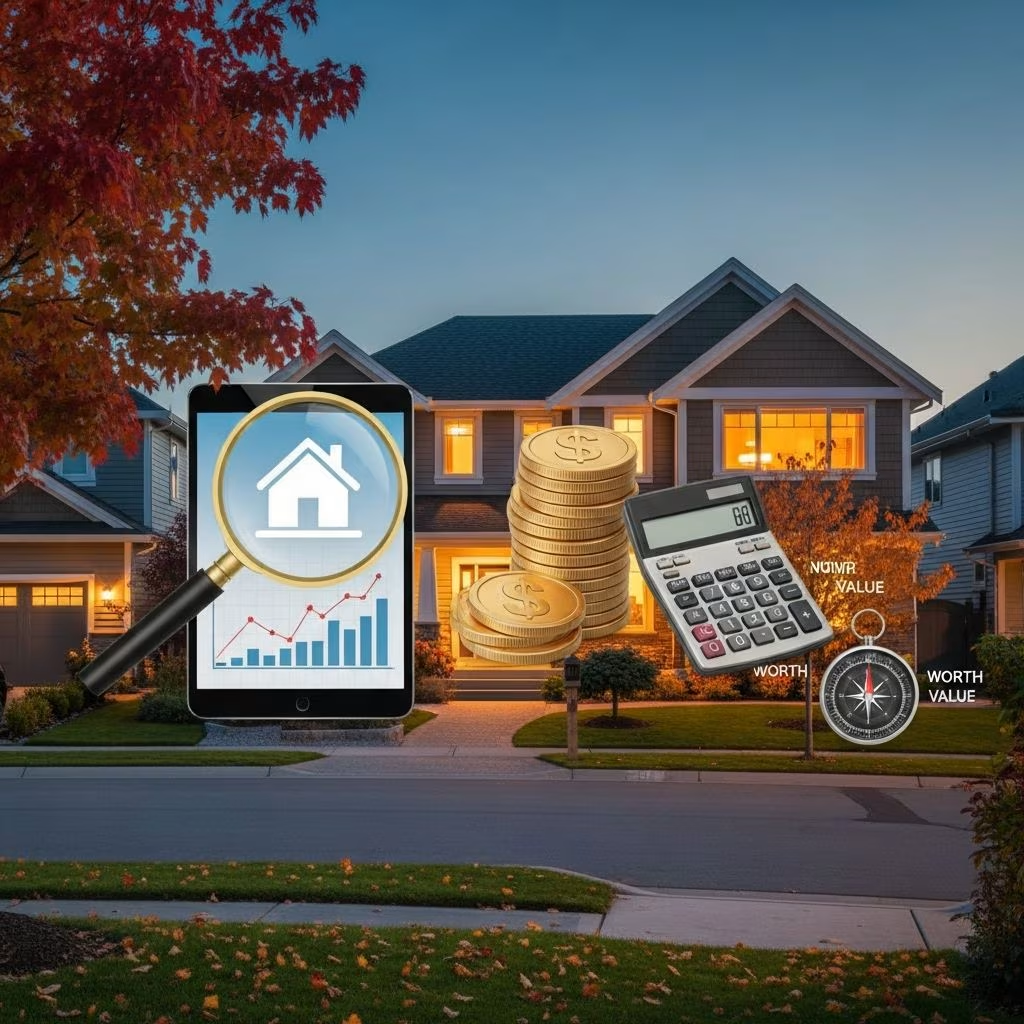
Determining the current value of your property is a critical step for homeowners considering selling, refinancing, or simply tracking their investment. In a fluctuating real estate market, understanding your home’s fair market value (FMV) empowers you to make strategic decisions. This comprehensive guide explores reliable methods to estimate your home’s worth, key influencing factors, and practical tips to maximize its value.
Understanding Fair Market Value
Fair market value represents the price a willing buyer and seller would agree upon in an open market, with both parties fully informed. Unlike tax-assessed values, which often lag behind market trends, FMV reflects current conditions including recent sales, economic shifts, and local demand. Lenders rely on FMV for mortgage approvals, while sellers use it to price listings competitively.
Accurately gauging FMV requires blending data-driven approaches with local expertise. Factors like location, property condition, and market trends play pivotal roles. For instance, homes in high-demand urban areas may appreciate faster than rural properties.
Core Valuation Methods Explained
Several established techniques exist for calculating home value, each suited to different scenarios. Here’s a breakdown of the most effective ones:
- Comparative Market Analysis (CMA): Real estate agents analyze recently sold ‘comps’ – similar homes in size, age, and location. Sales within 90-180 days yield the highest accuracy.
- Professional Appraisal: Licensed appraisers conduct on-site inspections, providing a formal report used by banks. Costs range from $300-$400.
- Online Estimators (AVMs): Tools like Zillow Zestimate or Redfin use algorithms analyzing public data for instant estimates.
- Price Per Square Foot: Multiply your home’s square footage by the average $/sqft from local comps for a quick benchmark.
- Cost Approach: Estimates rebuild costs minus depreciation, plus land value – ideal for unique properties.
- Income Approach: Divides net rental income by cap rate; best for investment properties.
Step-by-Step Guide to Comparative Market Analysis
CMA remains the cornerstone of home valuation due to its reliance on real transactions. Start by identifying 3-5 comps within a half-mile radius, matching bedrooms, bathrooms, and lot size. Adjust for differences: add value for upgrades like a renovated kitchen (+$20,000-$50,000) or subtract for outdated features.
| Property | Sale Price | Sq Ft | Price/Sq Ft | Adjustments | Adjusted Value |
|---|---|---|---|---|---|
| Your Home | ? | 2,000 | ? | – | Target |
| Comp 1 | $450,000 | 1,900 | $237 | +$10k (better lot) | $460,000 |
| Comp 2 | $480,000 | 2,100 | $229 | -$15k (no garage) | $465,000 |
| Comp 3 | $470,000 | 2,000 | $235 | – | $470,000 |
Average adjusted values to arrive at your estimate: ($460k + $465k + $470k)/3 = $465,000.
Leveraging Online Valuation Tools Effectively
Automated Valuation Models (AVMs) provide convenience but come with limitations. Zillow’s Zestimate incorporates MLS data, tax records, and user inputs, often within 5-10% of sale prices. Redfin refines estimates with agent insights. To improve accuracy:
- Update property details like recent renovations.
- Cross-reference multiple platforms.
- Avoid over-reliance; treat as a starting point.
While free, AVMs miss nuances like curb appeal or structural issues.
Professional Appraisals: When and Why
For transactions involving financing, a professional appraisal is mandatory. Appraisers follow Uniform Standards of Professional Appraisal Practice (USPAP), inspecting interiors, exteriors, and comps. Expect a 3-5 day turnaround. In 2026, rising construction costs have elevated the cost approach’s relevance for newer builds.
Advanced Techniques for Unique Properties
The Cost Approach in Detail
Calculate land value from recent vacant lot sales, then add reproduction costs using tools like Marshall & Swift. Subtract depreciation: straight-line (age/useful life) or observed condition. Formula: FMV = Land Value + (Replacement Cost – Depreciation).
Income Capitalization for Rentals
Net Operating Income (NOI) / Cap Rate = Value. Example: $24,000 NOI ÷ 0.06 = $400,000. Cap rates vary by market (lower in hot areas).
FHFA House Price Index for Trends
The Federal Housing Finance Agency’s HPI tracks metro-level changes. Input purchase price and date to project current value based on index growth.
Factors Driving Home Values in 2026
Beyond methods, external elements heavily influence worth:
- Location: Proximity to schools, transit, jobs.
- Market Conditions: Inventory shortages boost prices.
- Upgrades: Energy-efficient features add 5-10% premium.
- Economic Indicators: Interest rates, inflation.
- Neighborhood Trends: New developments or crime rates.
Tax assessments, while accessible, undervalue market FMV by 10-20% on average.
Comparing Valuation Methods: Pros and Cons
| Method | Pros | Cons | Best For |
|---|---|---|---|
| CMA | Local expertise, recent data | Agent-dependent | Sellers |
| Appraisal | Official, detailed | Costly, time-consuming | Loans |
| AVM | Free, instant | Inaccurate for uniques | Quick checks |
| Price/Sq Ft | Simple | Ignores features | Basic estimate |
| Cost Approach | Good for new/unique | Complex data needs | Custom homes |
Maximizing Your Home’s Market Value
Boost appeal with cost-effective updates:
- Minor kitchen/bath refreshes (ROI 70-80%).
- Curb appeal: landscaping, paint ($5k investment = $20k value).
- Energy upgrades: solar, insulation for eco-conscious buyers.
- Declutter and stage professionally.
Track value quarterly amid 2026’s volatile rates.
Frequently Asked Questions
How accurate are online home value estimators?
AVMs like Zillow are typically within 5-10% but falter on condition specifics. Combine with CMA for precision.
What’s the difference between appraised value and market value?
Appraised is lender-focused; market reflects buyer willingness.
How often should I get a home valuation?
Annually or post-major changes/market shifts.
Can I calculate my home value for free?
Yes, via AVMs and FHFA HPI tools.
Does home value affect property taxes?
Indirectly; assessments influence bills, often trailing FMV.
References
- FHFA House Price Index Calculators — Federal Housing Finance Agency. 2026. https://www.fhfa.gov/data/hpi
- Uniform Standards of Professional Appraisal Practice (USPAP) — The Appraisal Foundation. 2025-2026. https://appraisalfoundation.org
- Residential Cost Handbook — CoreLogic (Marshall & Swift). 2026. https://www.corelogic.com
- Home Value Estimators and AVMs — Federal Housing Finance Agency Guidelines. 2026. https://www.fhfa.gov
- Real Estate Valuation Methods — Fannie Mae Single-Family Guidelines. 2026. https://singlefamily.fanniemae.com
This article is general information, not personal financial advice. Consider your own situation, or speak with a licensed adviser, before acting on it.


