

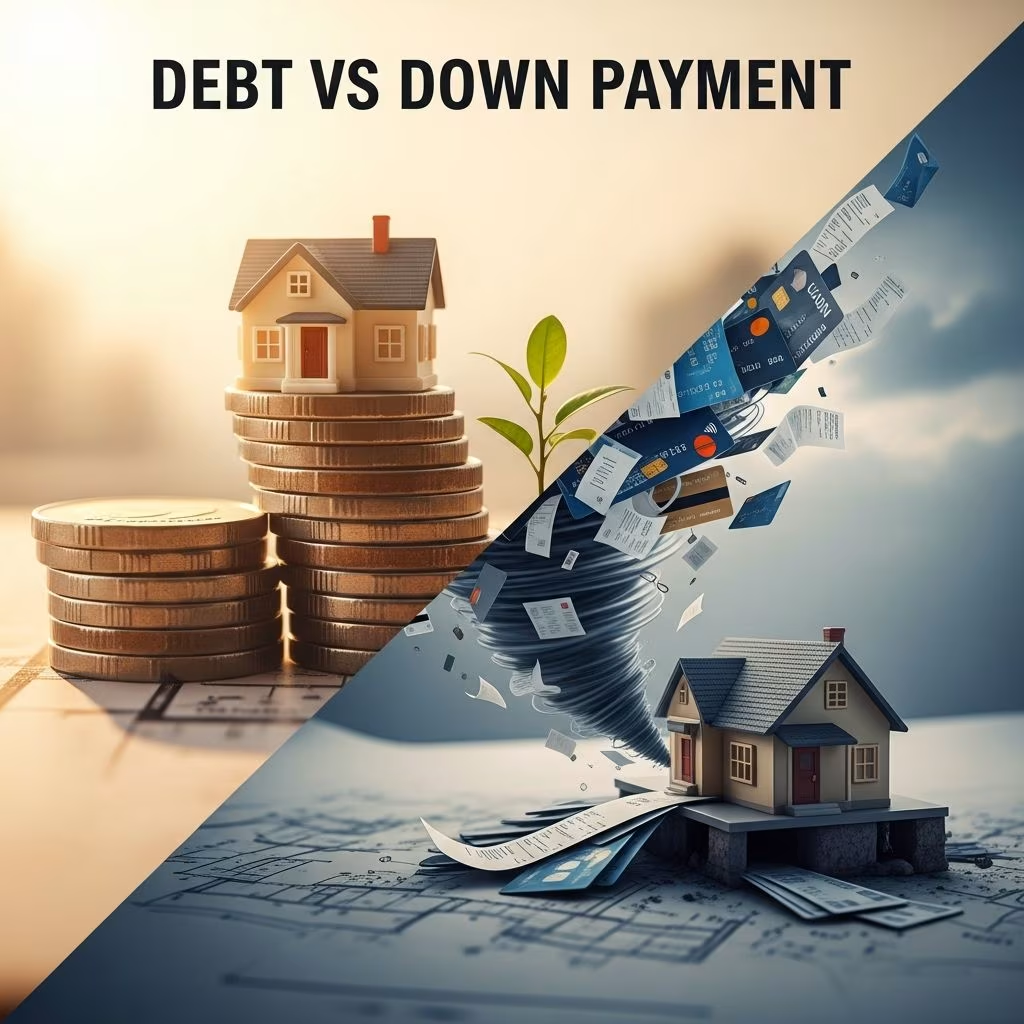
Preparing to purchase a home often involves tough financial choices, particularly when balancing existing debts against the need for a substantial down payment. High-interest obligations like credit cards can strain budgets, while insufficient savings might lead to higher mortgage costs or denial of approval. This article examines the advantages and drawbacks of each approach, providing actionable guidance to align your strategy with long-term goals.
Understanding the Core Dilemma
Homeownership represents a major milestone, yet it demands careful financial planning. Lenders evaluate applicants based on creditworthiness, income stability, and overall debt levels. A strong credit profile and low debt-to-income (DTI) ratio can unlock favorable loan terms, whereas lingering high balances may hinder progress. Prioritizing one goal over the other requires assessing personal circumstances, including interest rates on debts and current housing market conditions.
Debt typically falls into categories like credit cards (averaging around 16% interest), personal loans (9-10%), student loans (4-6%), and auto loans (5-6%). Meanwhile, mortgage rates hover lower, making it tempting to preserve cash for upfront costs. However, unresolved debt can inflate DTI ratios beyond acceptable thresholds, typically 36-43% for most loans.
Advantages of Eliminating Debt Before Saving
Focusing on debt reduction first strengthens your mortgage application foundation. Lower balances directly boost credit scores by reducing utilization rates, which comprise 30% of FICO calculations. Eliminating a monthly payment entirely drops your DTI, potentially qualifying you for larger loans.
- Enhanced Credit Profile: Paying down revolving debt lowers utilization below 30%, often raising scores by 50-100 points within months.
- Improved Cash Flow: Freed-up income from eliminated payments eases mortgage affordability and reduces stress during the buying process.
- Lower Overall Costs: Avoiding high-interest accrual saves thousands; for instance, clearing a $10,000 card at 16% prevents over $1,600 in annual interest.
This path suits those with significant consumer debt or struggling financially, as it mitigates risks of overextension.
Drawbacks of Prioritizing Debt Payoff
While beneficial, this strategy isn’t without trade-offs. Diverting funds to debt slows down payment accumulation, potentially delaying home purchase amid rising prices or rates.
- Delayed Entry to Market: Home values appreciate roughly 3-5% annually in many areas, meaning waits could increase total costs.
- Missed Equity Building: Rent payments offer no ownership benefits, unlike mortgage principal reduction.
- Potential PMI Requirement: Smaller down payments under 20% trigger private mortgage insurance, adding 0.5-2% of loan balance yearly.
Benefits of Saving Aggressively for Down Payment
Channeling resources into savings accelerates homeownership and minimizes long-term expenses. Larger contributions signal lower risk to lenders, often yielding better rates and terms.
| Down Payment Size | Potential Benefits | Estimated Savings (on $300K Loan) |
|---|---|---|
| 5-10% | Basic approval; PMI required | $1,800-$7,200/year PMI |
| 15% | Reduced PMI; slight rate discount | $900-$3,600/year saved |
| 20%+ | No PMI; best rates | $3,600+/year + 0.25-0.5% rate cut |
Data derived from conventional loan standards. A 20% down payment on a $400,000 home equates to $80,000, avoiding PMI and securing rates potentially 0.25% lower.
- Equity Accumulation: Payments immediately build wealth rather than funding landlord profits.
- Rate Advantages: Less borrowed principal reduces lender exposure, correlating with subprime avoidance.
- Quicker Ownership: Faster closings in competitive markets prevent lost opportunities.
Challenges When Saving Takes Precedence
Neglecting debt sustains high DTI and interest burdens. Lenders may reject applications or impose higher rates if scores suffer from maxed cards.
- Persistent DTI Issues: Added mortgage atop existing payments can exceed limits, blocking desired properties.
- Ongoing Interest Drain: Credit card balances compound, eroding savings potential.
- Credit Stagnation: No utilization improvement keeps scores static, limiting options.
Key Factors to Guide Your Decision
No universal rule fits all; evaluate these elements:
- Debt Interest Rates: Exceeding 6-8%, prioritize payoff over low-yield savings, akin to guaranteed returns.
- Credit Health: Scores below 700 benefit most from debt reduction.
- DTI Levels: Above 36%? Debt focus essential for approval.
- Debt Scale: Small, payoff-able balances warrant elimination; large ones need balanced approach.
- Market Dynamics: Rising rates or prices favor quicker saving.
Hybrid Strategies for Dual Progress
Simultaneous action proves feasible via structured plans. Allocate 60% to debt, 40% to savings, or use windfalls for acceleration.
- Debt Snowball/Avalanche: Target smallest/high-interest first while auto-saving $200-500 monthly.
- Side Income: Gig work funds one goal without sacrificing the other.
- Refinancing: Consolidate high-rate debt into lower personal loans pre-mortgage.
- Budget Optimization: Cut non-essentials to boost both pots equally.
This balance maintains momentum toward both objectives, minimizing opportunity costs.
Real-World Scenarios
Consider Alex with $15,000 credit card debt at 18% interest and $20,000 saved. Paying off debt first frees $400 monthly, boosts score 80 points, enabling a $350,000 mortgage at 6.5% versus denial. Conversely, Jordan with low 5% auto debt prioritizes 25% down payment, avoiding $150 monthly PMI and securing 6.25% rate.
Frequently Asked Questions
Should I pay off high-interest debt before saving for a house?
Yes, debts over 8% act like negative investments; clearing them yields better ‘returns’ than most savings accounts.
What’s the ideal DTI for mortgage approval?
Under 36% preferred; up to 43-50% possible with strong reserves.
Can I buy a home with existing debt?
Possible if DTI allows and credit solid; larger down payments help offset.
How much should my down payment be?
20% ideal to skip PMI, but 3-5% viable for FHA/VA with trade-offs.
Does paying debt always improve credit faster than saving?
Yes, via utilization drops; savings don’t directly impact scores.
Long-Term Financial Wellness
Beyond immediate choices, cultivate habits like emergency funds (3-6 months expenses) and retirement contributions post-debt. Homeownership builds wealth, but sustainability trumps speed—avoid overleveraging.
Consult advisors for tailored plans, as markets and regulations evolve. By weighing these factors, you position for approval, affordability, and equity growth.
References
- Pay Off Debt or Save for a Down Payment? — DNVR Lending. 2023. https://www.dnvrlending.com/pay-off-debt-or-save-for-a-down-payment
- Buying a home with debt and a large down payment vs. no debt — 56David. 2023. https://56david.com/buying-a-home-with-debt-and-a-large-down-payment-vs-buying-a-home-with-no-debt-and-less-of-a-down-payment/
- Should You Pay Off Debt or Save for a Down Payment? — Experian. 2024-01-15. https://www.experian.com/blogs/ask-experian/should-you-pay-off-debt-or-save-for-down-payment/
- Should You Pay Off Debt Or Save For A House? — Military Money. 2023. https://www.militarymoney.com/debt/should-you-pay-off-debt-or-save-for-house/
- Paying Off Debt vs Saving: What to Choose — Mutual of Omaha. 2024. https://www.mutualofomaha.com/advice/financial-planning/managing-debt/paying-off-debt-vs-saving-what-to-choose
- Should I pay off debt or save for a house? — Rocket Mortgage. 2024-02-20. https://www.rocketmortgage.com/learn/pay-off-debt-or-save-for-house
This article is general information, not personal financial advice. Consider your own situation, or speak with a licensed adviser, before acting on it.


