

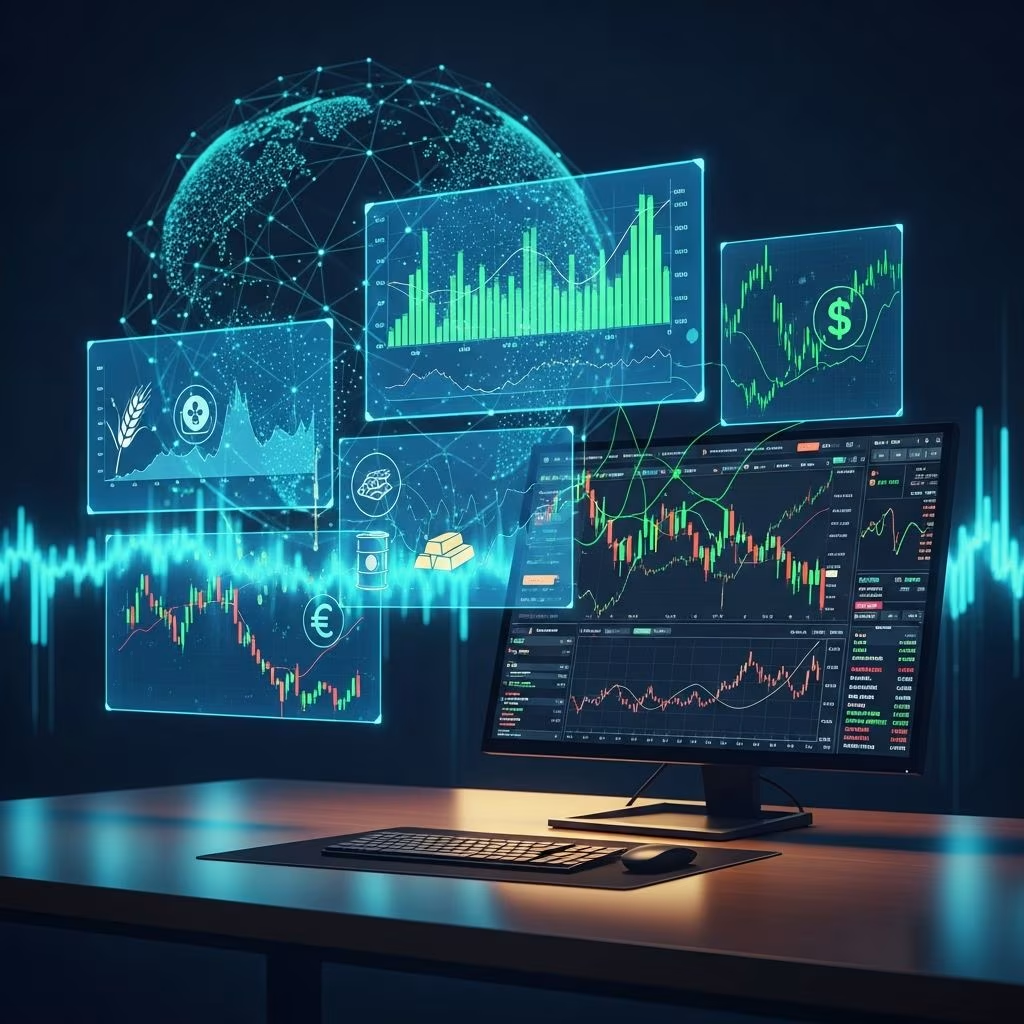
Understanding Futures Contracts
A futures contract is a standardized legal agreement to buy or sell a specific commodity, currency, or financial instrument at a predetermined price on a specified future date. These contracts are traded on organized exchanges and serve as essential tools for both risk management and speculation in financial markets. Unlike forward contracts, which are customized and traded over-the-counter, futures contracts are highly standardized, making them transparent and accessible to a broad range of investors and traders.
Futures contracts represent one of the oldest forms of derivatives, with origins tracing back centuries to agricultural markets where farmers sought to lock in prices for future harvests. Today, these instruments extend far beyond commodities to include stock indices, currencies, interest rates, and energy products, making them fundamental to modern financial markets.
Key Characteristics of Futures Contracts
Futures contracts possess several defining characteristics that distinguish them from other financial instruments:
- Standardized Terms: Each futures contract specifies the exact quantity, quality, delivery location, and settlement procedures for the underlying asset.
- Exchange Trading: Futures trade on regulated exchanges such as the Chicago Mercantile Exchange (CME), the New York Mercantile Exchange (NYMEX), and others, ensuring transparency and liquidity.
- Daily Settlement: Contracts are marked-to-market daily, meaning profits and losses are calculated and settled each trading day rather than at contract expiration.
- Leverage: Traders typically only need to deposit a margin (a percentage of the contract’s value) rather than paying the full amount upfront.
- Expiration Dates: Each futures contract has a specific expiration date, after which trading ceases and final settlement occurs.
- Centralized Counterparty: A clearinghouse stands between buyers and sellers, eliminating counterparty risk and ensuring contract fulfillment.
How Futures Contracts Work
Understanding the mechanics of futures contracts is essential for anyone considering their use. The process begins when a trader or investor decides to take a position in a futures contract by either buying (going long) or selling (going short). The buyer agrees to purchase the underlying asset at a specific price on the contract’s expiration date, while the seller agrees to deliver the asset at that price.
When a trader opens a futures position, they must deposit an initial margin with their broker, which is a percentage of the contract’s total value. This margin acts as a security deposit and is typically between 5% and 15% of the contract’s notional value. As the price of the futures contract fluctuates daily, gains and losses are calculated through a process called mark-to-market, where the contract is repriced to reflect the current market value.
If a trader’s account balance falls below the maintenance margin level, they receive a margin call requiring them to deposit additional funds. This leverage mechanism amplifies both potential profits and losses, making futures trading inherently risky but also attractive to those seeking substantial returns on limited capital.
Types of Futures Contracts
Futures contracts encompass a wide variety of underlying assets, each serving different market participants:
Commodity Futures
Commodity futures include contracts for agricultural products (wheat, corn, soybeans), energy products (crude oil, natural gas), and precious metals (gold, silver). These contracts allow farmers, producers, and consumers to hedge price risks associated with physical commodities.
Currency Futures
Currency futures enable traders to speculate on or hedge against foreign exchange rate movements. These contracts specify the amount of one currency to be exchanged for another at a future date and are essential tools for international businesses and currency traders.
Interest Rate Futures
Interest rate futures are based on debt instruments such as Treasury bonds and notes. They allow investors to hedge against interest rate risk or profit from anticipated interest rate movements without purchasing the underlying bonds directly.
Stock Index Futures
These contracts track major stock indices such as the S&P 500, Nasdaq-100, or Dow Jones Industrial Average. They allow investors to gain exposure to broad market movements without purchasing individual stocks and are popular for hedging equity portfolios.
Primary Uses of Futures Contracts
Futures contracts serve two primary functions in financial markets: hedging and speculation.
Hedging
Hedging is the process of using futures contracts to reduce or eliminate price risk associated with an existing or anticipated position in an underlying asset. For example, a wheat farmer anticipating a harvest in six months might sell wheat futures contracts to lock in a price, protecting against a potential price decline. Similarly, a company expecting to receive foreign currency payments might sell currency futures to guard against adverse exchange rate movements. Hedging shifts risk from those who cannot bear it to those willing to accept it for potential profit.
Speculation
Speculators use futures contracts to profit from anticipated price movements without any intention of taking physical delivery of the underlying asset. A speculator who believes oil prices will rise might purchase crude oil futures contracts, hoping to profit if prices increase. Conversely, someone expecting prices to fall would short the contract. Speculation adds liquidity to futures markets, making them more efficient and accessible to hedgers.
Advantages of Futures Contracts
- Price Discovery: Futures markets efficiently aggregate information and price expectations, contributing to accurate price discovery across global markets.
- Risk Management: They provide effective tools for businesses and investors to hedge against adverse price movements in commodities, currencies, and financial instruments.
- Leverage: The margin mechanism allows traders to control large positions with relatively small capital outlays.
- Liquidity: Major futures contracts trade with significant volume, allowing easy entry and exit from positions.
- Transparency: Exchange-traded contracts feature standardized terms and publicly reported prices, reducing information asymmetry.
- Lower Counterparty Risk: The clearinghouse mechanism eliminates counterparty risk, ensuring contract fulfillment regardless of the other party’s financial condition.
Disadvantages and Risks of Futures Contracts
- Leverage Risk: While leverage amplifies gains, it equally amplifies losses, potentially resulting in losses exceeding the initial margin deposit.
- Complexity: Futures contracts involve technical complexities and require understanding of margin calls, settlement procedures, and contract specifications.
- Liquidity Risk: Some futures contracts, particularly for less popular commodities, may have limited trading volume, making it difficult to exit positions quickly.
- Mark-to-Market Losses: Daily settlement means losses are realized immediately, potentially forcing margin calls even if the position would be profitable at contract expiration.
- Timing Risk: Hedgers must carefully time their futures positions, and imperfect hedges may leave residual price risk.
- Market Volatility: Futures prices can be highly volatile, particularly during periods of economic uncertainty or significant news events.
Futures Contracts vs. Other Derivatives
| Feature | Futures Contracts | Forward Contracts | Options Contracts |
|---|---|---|---|
| Trading Location | Organized exchanges | Over-the-counter | Exchanges and OTC |
| Standardization | Highly standardized | Customized | Partially standardized |
| Counterparty Risk | Eliminated by clearinghouse | Present | Reduced on exchanges |
| Settlement | Daily mark-to-market | At contract expiration | At exercise or expiration |
| Obligation | Mandatory to buy/sell | Mandatory to buy/sell | Right, not obligation |
| Margin Requirement | Yes | No | Limited (premium only) |
Key Market Participants
Futures markets comprise diverse participants with different objectives and risk tolerances. Producers and consumers of underlying assets use futures for hedging operational risks. Financial institutions participate for profit and to manage their portfolios. Hedge funds and proprietary trading firms engage in sophisticated trading strategies. Retail investors access these markets through brokers and have increasingly participated in futures trading, particularly following technological advancements that democratized market access.
Getting Started with Futures Trading
Prospective futures traders should understand several critical steps before entering the market. First, choose a regulated futures broker authorized by the Commodity Futures Trading Commission (CFTC). Open an account with sufficient capital—most brokers require minimum initial deposits ranging from $2,000 to $10,000. Thoroughly educate yourself on contract specifications, margin requirements, and trading mechanics specific to your chosen instruments. Consider starting with liquid, simpler contracts and paper trading to develop experience without risking capital.
Frequently Asked Questions
Q: What is the difference between buying and selling futures contracts?
A: Buying (going long) means you profit if prices rise, while selling (going short) means you profit if prices fall. Both positions require margin deposits and expose the trader to leverage risks.
Q: Can an individual invest in futures contracts?
A: Yes, individuals can trade futures through regulated brokers. However, they require significant capital, expertise, and risk tolerance due to leverage and complexity.
Q: What happens when a futures contract expires?
A: At expiration, the contract is settled either through physical delivery of the underlying asset (for commodity futures) or cash settlement (for index and currency futures). Most traders close positions before expiration.
Q: How is the futures price determined?
A: Futures prices reflect market expectations of future spot prices, influenced by supply and demand, interest rates, storage costs, and market sentiment.
Q: Are futures contracts suitable for retirement accounts?
A: Traditional IRAs and 401(k)s generally restrict or prohibit futures trading due to their speculative nature and leverage. Consult your custodian regarding specific rules.
Q: What is basis risk in hedging?
A: Basis risk occurs when the futures contract price doesn’t move perfectly in line with the underlying asset being hedged, leaving residual price exposure.
References
- Commodity Futures Trading Commission (CFTC) — Market Oversight and Education — U.S. Commodity Futures Trading Commission. 2024. https://www.cftc.gov/
- An Introduction to Futures Markets — Chicago Mercantile Exchange (CME). 2024. https://www.cmegroup.com/
- Options, Futures, and Other Derivatives — Hull, John C. Pearson Education. 2022 (10th Edition). ISBN: 978-0136939915
- U.S. Securities and Exchange Commission (SEC) — Investor Education Resources — U.S. Securities and Exchange Commission. 2024. https://www.sec.gov/investor
- Futures and Options Markets — World Bank Financial Market Integration Division. 2023. https://www.worldbank.org/
This article is general information, not personal financial advice. Consider your own situation, or speak with a licensed adviser, before acting on it.


