

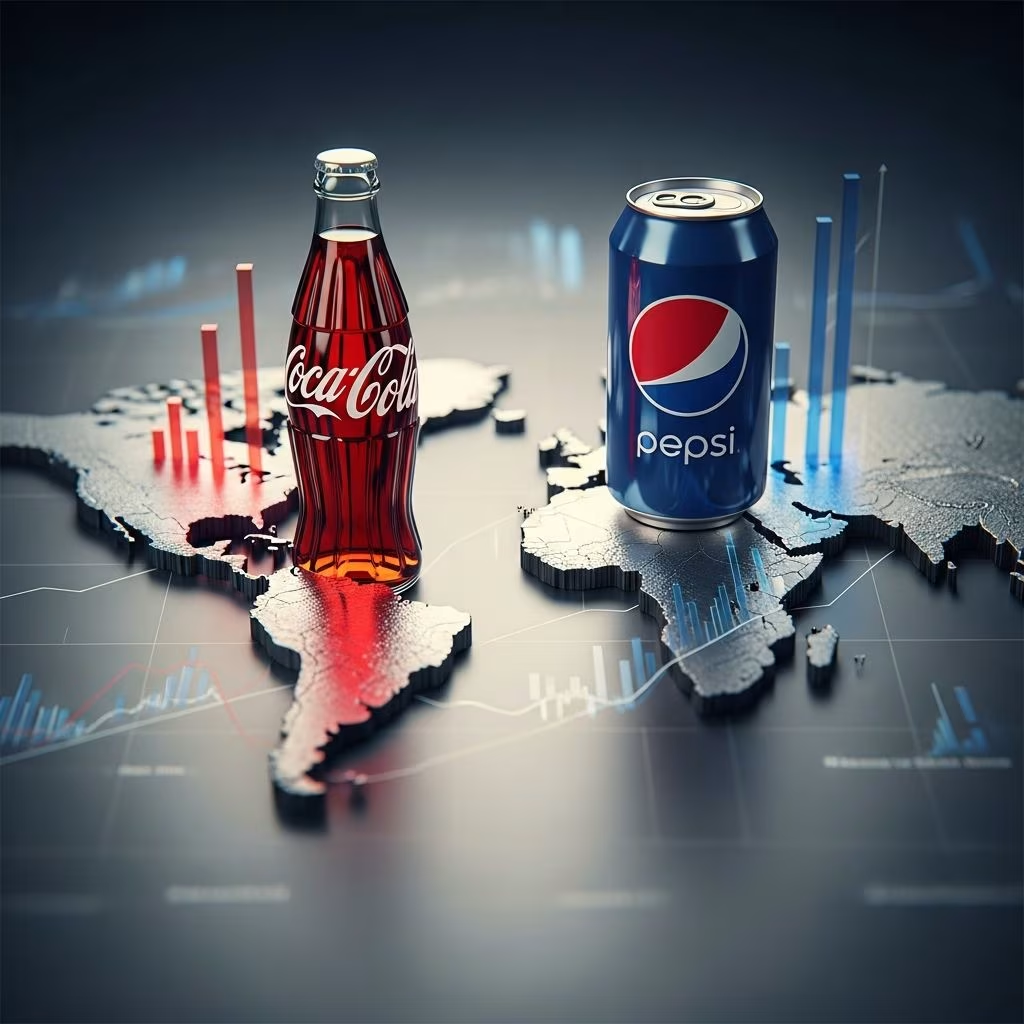
How Much of the Global Beverage Industry is Controlled by Coca-Cola and Pepsi?
The global beverage industry is one of the most consolidated markets in the world, with two companies—Coca-Cola and PepsiCo—maintaining significant control over production, distribution, and consumption patterns worldwide. These two multinational corporations have shaped consumer preferences, influenced market dynamics, and established themselves as the dominant players in soft drinks, water, juices, and various other beverage categories. Understanding their market control requires examining their market share, revenue streams, strategic positioning, and the broader implications for the beverage industry.
Market Share Dominance in the Global Beverage Sector
Coca-Cola maintains the most substantial presence in the global beverage market, commanding approximately 50% of the total global beverage market share. This remarkable dominance reflects decades of brand building, strategic acquisitions, and global distribution networks that few competitors can match. Within the carbonated soft drink (CSD) segment specifically, Coca-Cola’s control becomes even more pronounced, with a 43.7% market share of the global CSD market. This position has been maintained consistently over multiple decades, establishing Coca-Cola as the undisputed leader in one of the world’s most profitable beverage categories.
PepsiCo, while significantly smaller than Coca-Cola, remains the second-largest beverage company globally. PepsiCo controls approximately 20% of the global beverage market, demonstrating substantial market presence. Within the carbonated soft drink category alone, PepsiCo holds around 25.9% of the global CSD market share. This positions PepsiCo as a formidable competitor, though substantially behind Coca-Cola in overall beverage market dominance. The gap between these two giants and their nearest competitors is dramatic, with the third-largest player controlling a fraction of what Coca-Cola and PepsiCo command.
Regional Market Variations and Competitive Dynamics
While Coca-Cola dominates globally, regional market variations reveal different competitive landscapes. In the United States, Coca-Cola maintains a commanding 48% market share in soft drinks, while PepsiCo follows with 24% market share. This represents a significant competitive advantage for Coca-Cola even in PepsiCo’s home market. However, the North American market has witnessed notable shifts in recent years, with emerging challenges to both companies’ traditional strongholds.
Recent data indicates that in terms of case sales volume—a key metric in the beverage industry—the competitive landscape has shifted dramatically. Dr Pepper has emerged with 8.7% market share, Sprite holds 8.03% market share, and Pepsi has declined to 7.97% market share in the U.S. market. This marks a significant development, as Pepsi has experienced four consecutive years of market share losses in the United States, its most critical market. This erosion of Pepsi’s market position represents a strategic challenge for PepsiCo and demonstrates that even the second-largest beverage company faces increasing competition.
Revenue and Financial Performance Comparison
| Metric | Coca-Cola | PepsiCo |
|---|---|---|
| Global CSD Market Share | 43.7% | 25.9% |
| Beverage Revenue (2023) | $45.8 billion | $92 billion (overall) |
| Market Capitalization (Oct 2025) | $296 billion | $200 billion |
| Global Brand Valuation | $57.5 billion | Not specified |
| Countries of Operation | 200+ | Global presence |
The financial disparities between Coca-Cola and PepsiCo reveal interesting dynamics in the beverage industry. While Coca-Cola generates substantial beverage-focused revenue at $45.8 billion annually, PepsiCo’s overall revenue of $92 billion reflects its diversified business model. Despite lower beverage-specific revenue, PepsiCo maintains competitive relevance through its snacks and packaged food divisions, which contribute approximately 45% of its total revenue. This diversification strategy has become increasingly important as the beverage market faces headwinds from changing consumer preferences toward healthier options.
Market capitalization differences underscore investor confidence in each company’s long-term prospects. Coca-Cola’s market cap of $296 billion significantly exceeds PepsiCo’s $200 billion, creating a valuation gap of $96 billion as of October 2025. This gap has fluctuated considerably, reaching $132 billion in June 2025 before narrowing somewhat—representing the largest disparity in approximately 25 years. The valuation premium for Coca-Cola reflects investor perception of its pure-play beverage leadership and global brand strength.
Brand Portfolio and Product Diversification
Coca-Cola’s market control extends across an impressive portfolio of brands. The company operates over 500 brands globally and serves over 1.9 billion servings daily across all continents. The Coca-Cola brand itself represents one of the most valuable brands globally, valued at $57.5 billion by Interbrand in 2023. Beyond its flagship cola product, Coca-Cola produces Fanta, Sprite, Dasani water, and numerous other beverage categories, giving it diversified revenue streams across multiple consumer segments.
PepsiCo operates 23 distinct beverage brands, providing significant diversity within the beverage category. Additionally, PepsiCo’s ownership of Frito-Lay and Quaker provides snacks and packaged food options that complement its beverage offerings. This combination allows PepsiCo to capture more of consumers’ spending on refreshment and nutrition, even if its beverage market share remains smaller than Coca-Cola’s. The diversification strategy has become increasingly valuable as consumer preferences shift toward healthier beverages and plant-based snacks.
Recent Product Innovation and Market Trends
Both companies have recognized shifting consumer preferences toward healthier beverage options, particularly zero-sugar and reduced-calorie products. Coca-Cola Zero Sugar achieved notable success with a 14% increase in sales, demonstrating strong consumer demand for premium cola alternatives. PepsiCo similarly experienced success with Pepsi Zero Sugar, which surged 18% in sales during 2024. These innovations represent strategic responses to health-conscious consumers who want cola taste without sugar concerns.
Beyond carbonated soft drinks, both companies have expanded into sports beverages, juices, water, and ready-to-drink beverages. Coca-Cola reported that water, tea, and juice drinks saw slight increases in sales, while sparkling drinks like Coca-Cola and Fanta grew by 2%. PepsiCo gained significant traction with Gatorade in the sports beverage category, which helped offset some challenges in traditional soft drink sales. These broader category expansions reflect both companies’ recognition that future growth lies beyond traditional carbonated soft drinks.
Global Distribution and Operational Reach
Coca-Cola’s market control is fundamentally enabled by its unparalleled distribution network spanning over 200 countries. This global reach allows the company to maintain consistent brand messaging, manage supply chains efficiently, and respond rapidly to regional market changes. The company’s bottling operations, though recently shifting toward partner-based models, continue to provide competitive advantages in logistics and market access that smaller competitors struggle to replicate.
Regional performance data reveals how Coca-Cola and PepsiCo maintain their market positions across diverse geographic segments. In Europe, Middle East, and Africa, Coca-Cola sales increased 3% with maintained profitability despite currency pressures. Asia Pacific demonstrated particularly strong performance for Coca-Cola with 6% sales growth across all drink types. Meanwhile, PepsiCo reported strong international demand in emerging markets like India, Brazil, and Egypt, indicating that both companies maintain significant presence beyond developed Western markets.
Strategic Responses to Market Challenges
Despite their dominant positions, both Coca-Cola and PepsiCo face increasing strategic challenges. Costco’s decision to swap Coca-Cola for Pepsi in its food courts, while maintaining its iconic $1.50 hot dog combo price, demonstrates how even dominant brands must respond to retailer demands and cost pressures. This shift highlights that market control, while substantial, remains contested in specific channels and customer segments.
Coca-Cola has responded with innovation initiatives including its 2025 “Real Magic” campaign that utilizes artificial intelligence for personalization. This marketing-focused approach emphasizes brand differentiation and emotional connection with consumers. PepsiCo, conversely, has emphasized cultural relevance and continued expansion of its snacks and packaged food offerings, leveraging its diversified portfolio to maintain competitive position even as beverage market share erodes.
Competitive Landscape and Market Alternatives
While Coca-Cola and PepsiCo control the majority of the global beverage market, alternative competitors maintain meaningful positions in specific segments. Dr Pepper Snapple Group focuses primarily on the North American market with revenue of $14.8 billion in 2023, significantly lower than Coca-Cola’s beverage revenue. Nestlé, while not primarily a soft drink competitor, maintains strong positions in bottled water and ready-to-drink beverages with revenue of $104.6 billion across diverse product categories.
These competitors collectively demonstrate that while Coca-Cola and PepsiCo dominate, the beverage market remains competitive. Regional players and specialized beverage companies continue to capture market share in specific categories or geographic markets, limiting the absolute control that Coca-Cola and PepsiCo can exercise globally.
Market Outlook and Future Projections
The global beverage market continues to evolve with urbanization, health-consciousness, and non-carbonated beverage preferences driving growth patterns. PepsiCo’s recent guidance indicating flat earnings growth for the remainder of 2025 due to inflation and global uncertainty reflects broader economic pressures affecting both companies. However, the dominance of Coca-Cola and PepsiCo in distribution, branding, and innovation suggests they will maintain market leadership despite headwinds.
Future market control will likely depend on how effectively these companies adapt to consumer preferences for healthier beverages, sustainability concerns, and regional taste preferences. Innovation in zero-sugar formulations, functional beverages, and plant-based options will determine competitive positioning in coming years.
Frequently Asked Questions (FAQs)
Q: What percentage of the global beverage market do Coca-Cola and PepsiCo control combined?
A: Together, Coca-Cola and PepsiCo control approximately 70% of the global beverage market, with Coca-Cola commanding 50% and PepsiCo holding 20%. This combined dominance underscores their significant influence over global beverage consumption patterns and industry dynamics.
Q: Why does PepsiCo generate more revenue than Coca-Cola despite smaller beverage market share?
A: PepsiCo’s total revenue of $92 billion significantly exceeds its beverage revenue because approximately 45% of revenues derive from snacks and packaged foods through brands like Frito-Lay and Quaker. This diversified portfolio strategy provides PepsiCo with multiple revenue streams beyond beverages, complementing its beverage business.
Q: How has Pepsi’s market position changed in recent years?
A: Pepsi has experienced four consecutive years of market share losses in the U.S., declining to 7.97% market share by case sales volume, falling behind Dr Pepper (8.7%) and Sprite (8.03%). This trend reflects changing consumer preferences and increased competition in the soft drink category.
Q: What strategies are Coca-Cola and PepsiCo using to maintain market dominance?
A: Coca-Cola focuses on AI-driven personalization through campaigns like “Real Magic” and innovation in zero-sugar beverages. PepsiCo emphasizes cultural relevance, product innovation in zero-sugar drinks like Pepsi Zero Sugar (up 18% in 2024), and leverages its diversified portfolio of snacks and beverages to maintain competitive advantage.
Q: How do regional markets affect Coca-Cola and PepsiCo’s global market control?
A: Regional preferences, pricing strategies, and local competition create variations in market dominance. While Coca-Cola maintains strong global leadership, both companies adjust strategies regionally—Coca-Cola achieved 6% sales growth in Asia Pacific, while PepsiCo focuses on emerging markets like India, Brazil, and Egypt.
References
- Coke and Pepsi Market Share Trends: Latest Data & Analysis — Accio. 2025. https://www.accio.com/business/coke-and-pepsi-market-share-trend
- Coca-Cola Vs PepsiCo, Dr Pepper, and Nestlé – Marketing Maverick — Marketing Maverick. 2025. https://marketingmaverick.io/p/the-marketing-case-study-of-coca-cola
- Pepsi vs Coke: Who Sells More in 2025? Revenue Comparison — Accio. 2025. https://www.accio.com/business/who-sells-more-pepsi-or-coke
- Coca-Cola vs PepsiCo 2025: Who’s Leading on Profits—and Planet Goals — Carbon Credits. 2025. https://carboncredits.com/coca-cola-vs-pepsico-2025-whos-leading-on-profits-and-planet-goals/
- Leading soft drink companies in the U.S. 2024 — Statista. 2024. https://www.statista.com/statistics/225504/leading-carbonated-soft-drink-companies-in-the-us/
This article is general information, not personal financial advice. Consider your own situation, or speak with a licensed adviser, before acting on it.


