

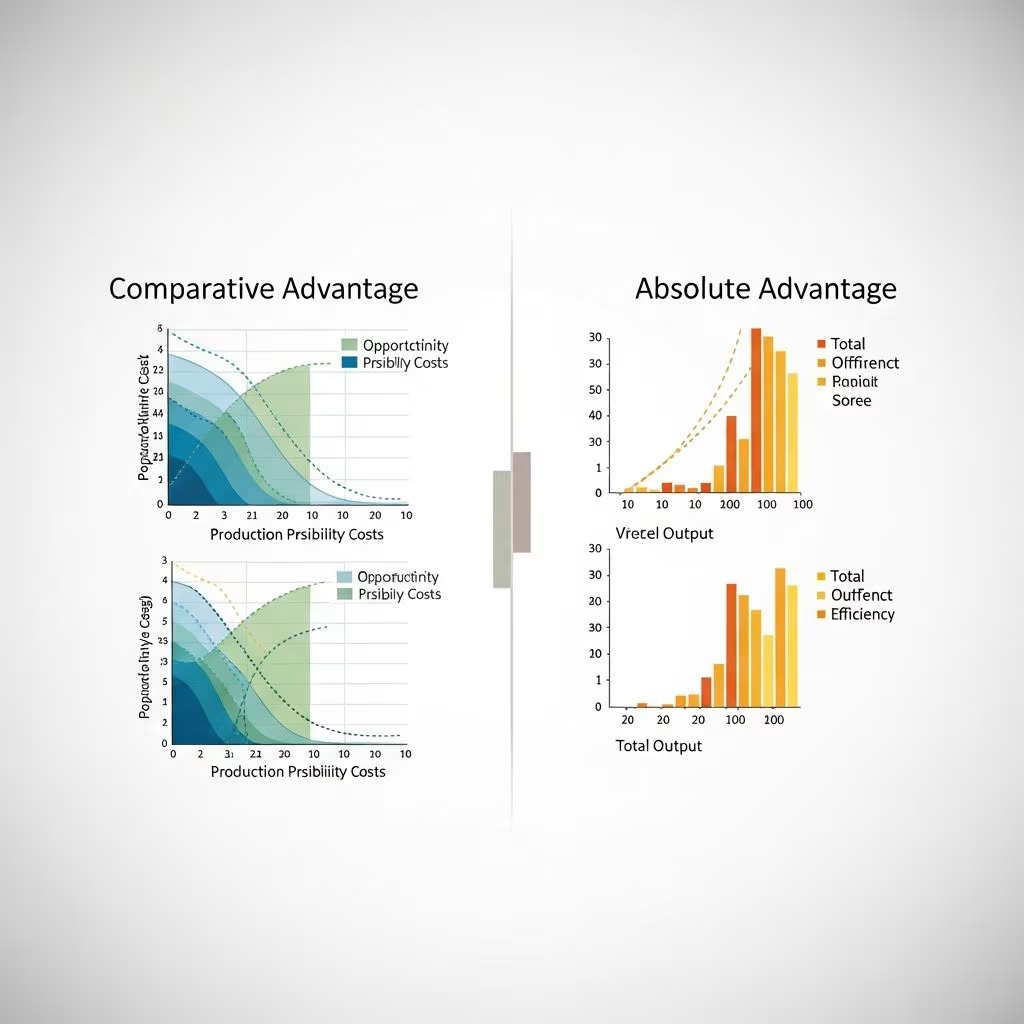
Understanding Absolute Advantage and Comparative Advantage
In the realm of international economics and trade, two fundamental concepts shape how countries and businesses determine what to produce, how to allocate resources, and which goods to import or export: absolute advantage and comparative advantage. While these terms are often used interchangeably in casual conversation, they represent distinct economic principles that have profound implications for global commerce, specialization, and economic growth.
Absolute advantage refers to the ability of an entity—whether an individual, business, or nation—to produce a good or service more efficiently than competitors using the same amount of resources. Comparative advantage, conversely, centers on the opportunity cost of production and considers which products an entity can produce with the lowest forgone benefits. Understanding these differences is essential for policymakers, business leaders, and anyone seeking to comprehend the dynamics of international trade.
What is Absolute Advantage?
Absolute advantage exists when one producer can generate more output than another producer using identical resources, or alternatively, can produce the same output using fewer resources. This concept measures production efficiency in its most straightforward form—comparing the raw productivity of different entities in creating a specific good or service.
The hallmark of absolute advantage is its focus on production cost and output efficiency. An entity possessing an absolute advantage demonstrates superior manufacturing capabilities, whether through advanced technology, skilled labor, superior natural resources, or optimized processes. For example, if Germany and France both produce automobile engines, Germany might be able to manufacture more engines per day using the same labor force and machinery, thereby holding an absolute advantage in engine production.
Consider a practical illustration: suppose two carpenters, Harry and Lloyd, both build rocking chairs. If Harry can construct two chairs per day while Lloyd produces only one chair daily, Harry possesses an absolute advantage in furniture-making. His superior output rate gives him a competitive edge in this particular market.
Characteristics of Absolute Advantage
Absolute advantage is characterized by several defining features:
- Focuses on direct comparison of production costs and output levels
- Evaluates efficiency of resource utilization in creating a single product
- Does not consider opportunity costs or trade-offs
- Relies on specialized skills, unique factors, or superior resources
- May not necessitate trade or collaboration with other entities
- Determines which entity should produce a specific good based purely on efficiency
What is Comparative Advantage?
Comparative advantage represents a more nuanced economic concept. It describes the ability of an entity to produce a good or service at a lower opportunity cost compared to alternative producers. This principle recognizes that even if one producer has an absolute advantage across all goods, both producers can still benefit from specialization and trade.
The critical distinction lies in opportunity cost—the value of the next best alternative foregone when making a choice. Comparative advantage asks not “who can produce this most efficiently in isolation?” but rather “who gives up the least valuable alternative production to make this product?”
Consider two countries, Italy and Greece, both capable of producing red wine and white wine. Italy might have the resources to produce either 100,000 bottles of red wine or 100,000 bottles of white wine. Greece might produce either 50,000 bottles of red wine or 80,000 bottles of white wine. While Italy can produce more of both products (absolute advantage), Greece might have a comparative advantage in white wine production because giving up white wine production represents a smaller loss in potential output compared to red wine.
Key Characteristics of Comparative Advantage
Comparative advantage possesses distinctive features that differentiate it from absolute advantage:
- Emphasizes opportunity cost and trade-offs in production decisions
- Considers relative efficiency of resource allocation among different goods
- Accounts for scarcity of resources and their effective allocation
- Encourages specialization in areas with lowest opportunity costs
- Promotes beneficial trade and collaboration between entities
- Allows for flexible resource allocation and adaptation to market changes
- Considers economies of scale and increased production benefits
Comparative Analysis: Absolute vs. Comparative Advantage
| Aspect | Absolute Advantage | Comparative Advantage |
|---|---|---|
| Definition | Ability to produce more with same resources or same with fewer resources | Ability to produce at lower opportunity cost than competitors |
| Focus Area | Production efficiency and output quantity | Opportunity cost and resource trade-offs |
| Resource Efficiency | Emphasizes maximizing output with available resources | Emphasizes cost-effective allocation decisions |
| Specialization | Based on superior production capabilities | Based on lowest opportunity cost production |
| International Trade | May limit trade if one entity dominates all production | Promotes mutually beneficial international trade |
| Measurement | Measured by comparing production efficiency and costs | Measured by comparing opportunity costs |
| Resource Scarcity | Does not account for resource limitations | Directly addresses resource scarcity and constraints |
| Long-term Sustainability | May become obsolete if advantages diminish | Promotes sustainable economic growth and adaptation |
Production Specialization and Resource Allocation
The concepts of absolute and comparative advantage have profound implications for how entities decide to specialize in production. With absolute advantage, specialization typically occurs in industries where an entity demonstrates exceptional production capabilities regarding product quality and manufacturing speed. A manufacturer with absolute advantage in furniture production might dedicate all resources to this sector, leveraging superior technology and skilled labor.
Conversely, comparative advantage encourages specialization based on opportunity cost considerations. An entity might specialize in producing goods where it gives up the least valuable alternative production. This approach often leads to more efficient global resource allocation and higher overall productivity across trading partners.
Comparative advantage proves particularly valuable because it demonstrates that trade can benefit all parties, even when one entity possesses absolute advantage in multiple products. This principle underpins modern international trade theory and explains why economically developed nations continue trading with less developed nations—each has comparative advantages in different sectors.
Production Costs and Economic Effectiveness
When analyzing production costs, absolute advantage emphasizes reducing direct production expenses—wages, materials, factory maintenance, and shipping. An entity with absolute advantage can typically lower these costs more substantially than competitors.
Comparative advantage takes a broader approach, incorporating both direct production costs and opportunity costs. While an entity might not produce goods at lower absolute cost or higher quality, it might have lower opportunity cost, making it more economically effective for that entity to specialize in that product while trading for others.
From an economic effectiveness standpoint, comparative advantage often provides superior solutions. It encourages resource reallocation and import-export relationships that improve monetary returns for all involved parties. This framework helps explain why countries with seemingly inferior technology or resources can still participate productively in global commerce through strategic specialization.
Real-World Applications and Examples
Consider two countries, Country A and Country B, capable of producing both coffee and sugar. Country A’s climate and soil are ideally suited to coffee production, providing absolute advantage in this sector. However, Country B might have comparative advantage in coffee production because specializing in coffee requires Country B to sacrifice less valuable alternative production compared to Country A’s sacrifice.
In contemporary global commerce, this principle explains why:
- Technology-advanced nations concentrate on software and semiconductor manufacturing while importing textiles and agricultural products
- Agricultural-rich nations specialize in farming despite having lower technological capacity overall
- Countries develop distinct economic specializations even when wealthier nations could theoretically produce everything more efficiently
- International supply chains organize around comparative advantages rather than absolute advantages
Implications for International Trade
Absolute advantage suggests that entities with superior production capabilities should dominate global markets. However, this rarely occurs in practice. Instead, international trade patterns align much more closely with comparative advantage theory. Nations engage in trade because specializing according to comparative advantage and exchanging goods produces greater total output and welfare for all trading partners than autarky (self-sufficiency).
Comparative advantage encourages:
- Specialization in sectors where opportunity costs are lowest
- Import of goods where other nations have comparative advantage
- Development of expertise and economies of scale in specialized sectors
- Mutual economic benefits even when trade partners have vastly different overall productivity levels
- Dynamic competitive advantages based on evolving capabilities
Understanding Opportunity Cost in Trade Decisions
Opportunity cost represents the fundamental distinction between absolute and comparative advantage. When deciding whether to produce good X or good Y, entities must consider what production is foregone. An entity has comparative advantage in good X if giving up X represents a smaller sacrifice compared to an alternative producer.
This principle resolves a seemingly paradoxical situation: a highly productive nation with absolute advantage in all goods can still benefit from trade. By specializing where comparative advantage is greatest, that nation frees resources to focus on highest-return activities while importing other goods from trading partners with larger comparative advantages in those sectors.
Long-term Economic Growth and Competitiveness
While absolute advantage provides short-term competitive benefits, comparative advantage frameworks promote sustainable long-term growth. Relying solely on absolute advantage creates vulnerability—if competitors develop comparable capabilities or technologies diffuse globally, absolute advantages erode. Japan’s electronics industry, once dominant through absolute advantage, faced competition as production techniques spread internationally.
Comparative advantage frameworks encourage continuous adaptation and specialization based on evolving opportunity costs. Countries can reposition themselves in global value chains, develop new competencies, and maintain competitiveness through strategic focus on areas where they maintain lowest opportunity cost production.
Frequently Asked Questions
Q: Can a country have absolute advantage in all products but still benefit from trade?
A: Yes. Even with absolute advantage across all goods, a nation benefits from specializing in products where it has greatest comparative advantage and trading for others. This maximizes total output and welfare for all trading partners.
Q: How do opportunity costs determine comparative advantage?
A: Comparative advantage depends on which producer gives up the least valuable alternative when producing a specific good. The producer with lower opportunity cost in producing that good possesses comparative advantage.
Q: Why is comparative advantage more important than absolute advantage in modern trade?
A: Comparative advantage better explains real-world trade patterns and demonstrates how all nations benefit from specialization and exchange, regardless of absolute productivity differences. It provides a more comprehensive framework for understanding international commerce.
Q: Can absolute advantage change over time?
A: Yes. Through technological advancement, capital investment, and skill development, entities can gain or lose absolute advantage. Comparative advantages may shift more gradually as they reflect fundamental trade-offs in production.
Q: How do businesses apply these concepts in practice?
A: Businesses use absolute advantage analysis to identify competitive edges in specific products, while comparative advantage guides decisions about outsourcing, specialization, and supply chain positioning to optimize profitability.
Conclusion
Absolute advantage and comparative advantage represent distinct yet complementary economic concepts that shape international trade, business strategy, and resource allocation decisions. While absolute advantage identifies entities capable of producing goods most efficiently using fewer resources, comparative advantage recognizes that mutual benefits emerge from specialization based on opportunity costs.
In an increasingly interconnected global economy, comparative advantage provides superior explanatory and predictive power for trade patterns. Understanding both concepts enables policymakers, business leaders, and economists to make informed decisions about production, specialization, and international commerce. By recognizing where comparative advantages lie and specializing accordingly, nations and businesses can maximize economic efficiency, foster mutually beneficial trade relationships, and achieve sustainable long-term growth in competitive global markets.
References
- Absolute Advantage vs. Comparative Advantage — Khan Academy. https://www.khanacademy.org/economics-finance-domain/ap-macroeconomics/basic-economics-concepts-macro/scarcity-and-growth/v/comparative-advantage-and-absolute-advantage
- Absolute and Comparative Advantage — Cuyamaca College. https://www.cuyamaca.edu/student-support/tutoring-center/files/student-resources/econ-absolute-and-comparative-advantage.pdf
- Absolute vs. Comparative Advantage: Key Differences — Indeed Career Advice. https://www.indeed.com/career-advice/career-development/absolute-advantage-vs-comparative-advantage
- Learn the Difference Between Absolute and Comparative Advantage — Testbook. https://testbook.com/key-differences/difference-between-absolute-and-comparative-advantage
This article is general information, not personal financial advice. Consider your own situation, or speak with a licensed adviser, before acting on it.


