

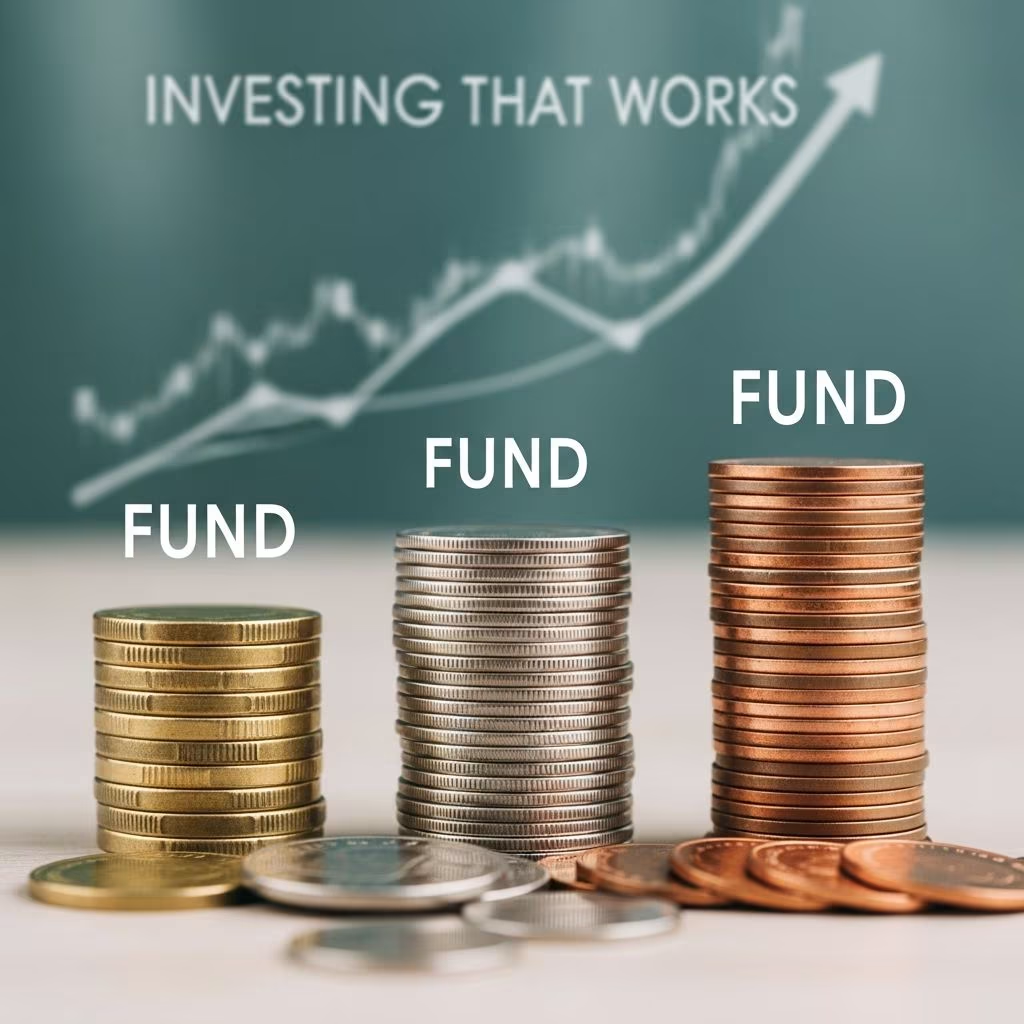
The 3-fund portfolio is a straightforward investing strategy built around just three broadly diversified funds, typically covering U.S. stocks, international stocks, and bonds. It is designed to be simple, low-cost, and easy to manage, while still providing strong diversification and long-term growth potential.
Many investors are overwhelmed by the thousands of funds and individual stocks available. A three-fund portfolio offers a clear, rules-based way to invest without needing to pick winning stocks or actively trade. By focusing on total-market index funds or ETFs, this strategy aims to capture the overall performance of broad markets at minimal cost.
What Is a 3 Fund Portfolio?
A 3-fund portfolio is an investment approach where your entire portfolio is built from just three main building blocks:
- U.S. stock fund (e.g., a total U.S. stock market index fund)
- International stock fund (e.g., a total international stock market index fund)
- Bond fund (e.g., a broad U.S. investment-grade bond market fund)
Each of these funds usually tracks a well-known market index and is offered as either an index mutual fund or an ETF (exchange-traded fund). Index funds and ETFs are widely used by individual and institutional investors because they are typically low-cost and provide broad diversification.
In practice, investors select three low-cost funds that together cover:
- U.S. equity market (large, mid, and small-cap companies)
- Non-U.S. equity markets (developed and sometimes emerging markets)
- High-quality bonds (government and investment-grade corporate bonds)
Because these funds hold hundreds or even thousands of securities, a 3-fund portfolio is broadly diversified without being complicated to manage.
Why the 3-Fund Portfolio Strategy Works
The three-fund portfolio strategy is popular because it meets several key goals that research has linked to better investing outcomes over the long term: diversification, low costs, and a clear asset allocation framework.
A well-diversified portfolio
Each of the three funds in this strategy represents a broad slice of the global market, instead of a narrow sector or a handful of individual companies. Diversification across many securities reduces the impact of any single company or sector performing poorly.
- U.S. stocks provide exposure to the domestic economy and many global leaders.
- International stocks add diversification by including companies outside your home market.
- Bonds add income and help cushion stock market volatility.
Modern portfolio theory and subsequent research show that holding a mix of asset classes can reduce risk for a given level of expected return, compared with holding a single asset class.
Low-cost investing
The 3-fund portfolio is typically implemented using low-cost index funds. Lower fees mean more of your investment returns stay in your account rather than going to fund managers. Studies by the U.S. Securities and Exchange Commission (SEC) and others show that seemingly small differences in fees can significantly reduce portfolio balances over decades.
- Index funds and ETFs often have much lower expense ratios than actively managed funds.
- There is no need for frequent trading, which keeps transaction costs and taxes lower.
Simplified asset allocation
Asset allocation is the mix of stocks and bonds in your portfolio. It is one of the primary drivers of long-term portfolio risk and return. The 3-fund approach makes asset allocation easier because you only need to decide how much to put into each of the three core funds.
Instead of picking among dozens of sector funds or individual stocks, you choose a small number of broad funds and set target percentages for each. You can then adjust these percentages over time as your goals, age, and risk tolerance change.
Easy rebalancing
Rebalancing means periodically adjusting your holdings back to your chosen target allocations when markets move them out of line. With only three funds, rebalancing is straightforward: you compare your current percentages with your target percentages and buy or sell enough of each fund to realign them.
For example, if your target is 33% U.S. stocks, 33% international stocks, and 34% bonds, and strong stock performance causes stocks to rise to 75% of your portfolio, you would sell some stock fund shares and buy bond fund shares to restore balance.
3 Fund Portfolio Asset Allocation
Although the three-fund portfolio always uses the same three building blocks, the percentages you allocate to each can vary widely. Investors customize allocations based on their time horizon, risk tolerance, and goals.
Here are three common allocation styles described in the original framework:
| Portfolio Type | U.S. Stocks | International Stocks | Bonds | Risk Profile |
|---|---|---|---|---|
| 80/20 Portfolio | 64% | 16% | 20% | Aggressive |
| Equal Portfolio | 33% | 33% | 33% | Moderate |
| 20/80 Portfolio | 14% | 6% | 80% | Conservative |
These are illustrative examples, not strict rules. You can adjust the stock-to-bond mix to match how much volatility you are comfortable with and how long you plan to invest.
Using the “100 minus your age” guideline
One simple rule of thumb sometimes used to decide how much to hold in bonds is the “100 minus your age” guideline. While not a guarantee or personalized advice, it provides a basic starting point for thinking about risk.
- Take 100 and subtract your age.
- The result is the percentage of your portfolio in stocks.
- The remainder is allocated to bonds.
For instance, if you are 30 years old, this rough heuristic suggests 70% in stocks and 30% in bonds. Within the stock portion, you could split between U.S. and international stocks (for example, 60% U.S. and 10% international). Within bonds, you might hold 30% in a broad bond market fund.
Investors may adjust this rule based on their circumstances, and expert research emphasizes tailoring asset allocation to individual situations rather than relying solely on a single formula.
How to Build a 3-Fund Portfolio Step by Step
Creating a 3-fund portfolio follows a logical sequence. While exact details vary by country and brokerage, the general steps are similar.
1. Set clear objectives and goals
Before selecting any funds, clarify:
- Your goals (retirement, financial independence, education, large purchase, etc.)
- Your time horizon (how long before you need the money)
- Your risk tolerance (how comfortable you are with temporary losses)
Having clear objectives makes it easier to choose an appropriate stock/bond mix and to stay disciplined during market ups and downs.
2. Choose where to invest (brokerage or platform)
Next, decide which brokerage or investing platform you will use. Look for:
- Access to low-cost index funds and ETFs
- Low or zero trading commissions on core funds
- Easy account setup for retirement and taxable accounts
Many long-term investors use tax-advantaged accounts (such as employer retirement plans or individual retirement accounts) when available, because of the tax benefits.
3. Select your three funds
The key is to select funds that are broadly diversified and low cost:
- A total U.S. stock market index fund (or broad domestic equity fund)
- A total international stock market index fund
- A total bond market fund focusing on investment-grade bonds
When comparing funds, consider factors like expense ratio, index tracked, and how broadly diversified they are.
4. Decide your asset allocation
Choose the percentage of your portfolio that will be in stocks vs. bonds and how to split stocks between U.S. and international. Some investors prefer a higher U.S. stock share; others prefer a more even global stock mix.
You can use one of the example allocations (80/20, equal thirds, 20/80) as a starting point and adjust over time.
5. Invest and automate contributions
Once you have your funds and allocation, you can:
- Invest a lump sum according to your target percentages, or
- Use dollar-cost averaging by investing a fixed amount regularly.
Automating contributions—such as monthly transfers into your three funds—helps you stay consistent and removes the need to time the market.
6. Monitor and rebalance periodically
Over time, market movements will cause your allocations to drift. Set a rebalancing schedule (for example, once per year) or thresholds (such as when an asset class is more than a certain percentage away from its target) and make adjustments accordingly.
Rebalancing may involve:
- Buying more of the underweight fund with new contributions
- Selling a portion of the overweight fund and buying the underweight one
Many investors rebalance annually or semiannually, balancing transaction costs, taxes, and the need to maintain their risk profile.
Variations: 1, 2, 3, and 4-Fund Portfolios
Although the 3-fund portfolio is a popular “sweet spot” between simplicity and diversification, there are related approaches with fewer or more funds.
The one-fund portfolio
A 1-fund portfolio typically uses a single, all-in-one fund such as a target-date fund or a balanced fund. These funds automatically manage the stock/bond mix for you. While convenient, this approach gives you less control over the specific allocation and may come with slightly higher costs than building your own 3-fund mix.
The two-fund portfolio
A 2-fund portfolio usually combines a total stock market fund with a bond fund.
- Stock fund for growth over the long term
- Bond fund to reduce volatility and provide income
Dropping international stocks simplifies things further but reduces geographic diversification. Investors who primarily want a domestic focus or who prefer maximum simplicity sometimes choose this path.
The four-fund portfolio
A 4-fund portfolio adds another layer of diversification while remaining relatively simple. One common version includes:
- Total U.S. stock market fund
- Total international stock market fund
- Total U.S. bond market fund
- Total international bond fund (or another diversifying asset, such as REITs)
For example, investors may add an international bond fund to increase diversification across global fixed income markets. Others may add a real estate investment trust (REIT) fund for additional income and diversification.
Pros and Cons of a 3-Fund Portfolio
Like any strategy, the 3-fund portfolio has benefits and trade-offs.
Advantages
- Simplicity: Only three funds to choose, monitor, and rebalance.
- Diversification: Exposure to thousands of securities across global stock and bond markets.
- Low fees: Built with low-cost index funds and ETFs, which research links to better net returns over time.
- Transparency: Easy to understand what you own and how your money is allocated.
- Flexibility: Allocation can be tailored to different risk levels and life stages.
Potential drawbacks
- No active management: You do not have a manager trying to beat the market; the strategy aims to match market performance before costs.
- Requires discipline: You must stay the course during market volatility and handle rebalancing yourself.
- Less customization: Investors who want sector tilts, factor strategies, or individual stock picking may find it too basic.
However, many long-term investors and experts favor simple, diversified, low-cost strategies like this one, especially for those who do not want to spend significant time managing investments.
Frequently Asked Questions (FAQs)
Q: Is a 3-fund portfolio enough diversification?
A: For many investors, yes. A three-fund portfolio that uses total-market funds holds thousands of stocks and bonds across multiple sectors and regions. This level of diversification is often comparable to, or greater than, what investors achieve using many actively managed funds.
Q: How often should I rebalance a 3-fund portfolio?
A: Common approaches include rebalancing once a year or when an asset class drifts beyond a chosen threshold (for example, more than 5 percentage points from its target). The goal is to keep your risk level aligned with your plan without trading excessively.
Q: Do I need an international stock fund?
A: Adding international stocks increases geographic diversification, as U.S. and non-U.S. markets do not always move together. Some investors choose to include them for a more global portfolio, while others prefer a home-country bias. The 3-fund strategy typically includes international stocks as a core component.
Q: Can I use ETFs instead of mutual funds?
A: Yes. The 3-fund portfolio can be implemented with either mutual funds or ETFs, as long as they are broadly diversified and low cost. ETFs may offer lower minimum investments and intra-day trading, while mutual funds can be easier to automate contributions with at some providers.
Q: Is the 3-fund portfolio suitable for beginners?
A: The 3-fund portfolio is often recommended for beginners because it minimizes decisions, focuses on broad markets, and avoids the need to pick individual stocks. It can also work well for experienced investors who prefer a low-maintenance, evidence-based approach.
References
- Three-fund portfolio: What it is and how it works — Bankrate. 2024-02-15. https://www.bankrate.com/investing/three-fund-portfolio/
- The 3 Fund Portfolio: Simple Investing That Works — Clever Girl Finance. 2023-11-10. https://www.clevergirlfinance.com/3-fund-portfolio/
- Investments: Exchange-traded funds (ETFs) — U.S. Securities and Exchange Commission (SEC). 2023-08-01. https://www.investor.gov/introduction-investing/investing-basics/investment-products/exchange-traded-funds-etfs
- Investments: Mutual funds — U.S. Securities and Exchange Commission (SEC). 2023-07-10. https://www.investor.gov/introduction-investing/investing-basics/investment-products/mutual-funds-and-etfs
- Rebalancing your portfolio — Financial Industry Regulatory Authority (FINRA). 2022-09-30. https://www.finra.org/investors/insights/rebalancing-your-portfolio
This article is general information, not personal financial advice. Consider your own situation, or speak with a licensed adviser, before acting on it.


