

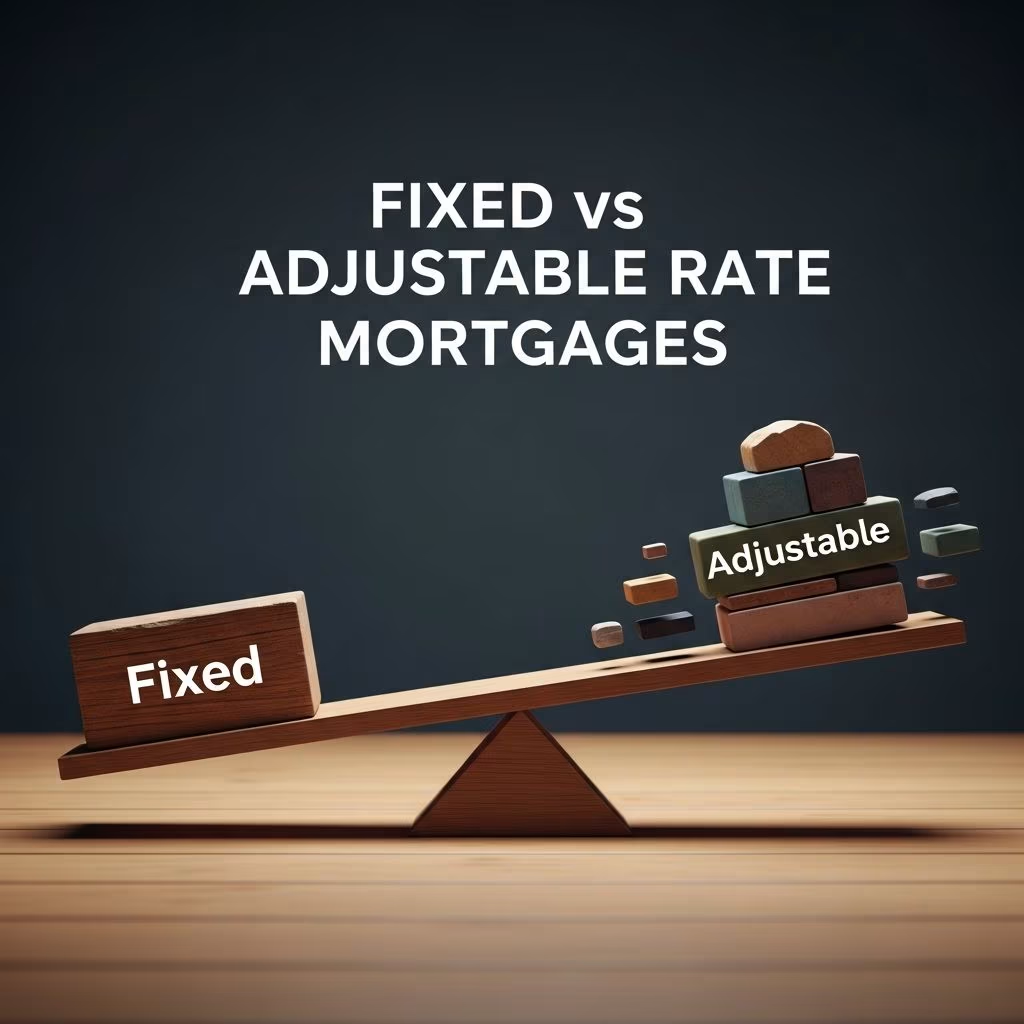
When financing a home, one of the most critical decisions is selecting between a **fixed-rate mortgage** and an **adjustable-rate mortgage (ARM)**. Fixed-rate loans offer unchanging payments throughout the term, providing budget predictability, while ARMs start with lower rates that can fluctuate, potentially saving money or increasing costs over time.
Understanding Fixed-Rate Mortgages
A fixed-rate mortgage locks in the interest rate from the start, ensuring the principal and interest portion of your monthly payment remains constant for the entire loan duration, typically 15 or 30 years. This stability shields borrowers from market fluctuations, making it ideal for long-term homeowners planning to stay in their property for decades.
Common terms include 30-year options for lower monthly payments and 15-year loans for faster payoff with reduced total interest, though higher payments. Even if property taxes or insurance rise, the core loan payment stays the same, simplifying financial planning.
How Adjustable-Rate Mortgages Operate
ARMs feature an initial fixed-rate period, often 3, 5, 7, or 10 years, followed by periodic adjustments based on a market index like the Secured Overnight Financing Rate (SOFR) plus a lender’s margin. The notation, such as 5/1 ARM, indicates five years fixed then annual adjustments.
These loans often begin with lower rates than fixed options, reducing early payments and aiding qualification for pricier homes. Adjustments are capped to limit increases—typically 2% per adjustment and 5-6% lifetime—to mitigate risk.
Key Differences at a Glance
Fixed-rate mortgages prioritize consistency, while ARMs emphasize initial affordability with variability later. Here’s a comparison:
| Feature | Fixed-Rate Mortgage | Adjustable-Rate Mortgage (ARM) |
|---|---|---|
| Interest Rate | Fixed for entire term | Fixed initially, then adjusts |
| Initial Rate | Higher typically | Lower, often 0.5-1% below fixed |
| Monthly Payment | Stable (principal + interest) | Changes with adjustments |
| Down Payment Min (Conventional) | 3% | 5% |
| Term Options | 8-30+ years | Usually 30 years |
| Rate Caps | None needed | Initial, periodic, lifetime caps |
This table illustrates how fixed loans suit stability seekers, while ARMs appeal to those expecting short-term ownership or rate drops.
Advantages and Drawbacks of Each Option
Benefits of Fixed-Rate Mortgages
- Predictable budgeting: No surprises in payments, easing long-term planning.
- Rate protection: Insulated from rising rates, valuable in volatile markets.
- Flexible terms: Choices like 15-year for equity building or 30-year for affordability.
- Simpler qualification: Lower down payment options.
Drawbacks of Fixed-Rate Mortgages
- Higher starting rates and payments compared to ARMs.
- Less benefit if rates fall; refinance needed to capitalize.
Benefits of Adjustable-Rate Mortgages
- Lower entry costs: Affordable initial payments for larger homes or tighter budgets.
- Potential savings: If rates drop, payments decrease.
- Caps for protection: Limits on increases prevent extreme hikes.
Drawbacks of Adjustable-Rate Mortgages
- Payment uncertainty: Rises could strain finances post-initial period.
- Higher down payments: 5% minimum for conventional ARMs.
- Complexity: Understanding indexes, margins, and caps is essential.
Real-World Payment Scenarios
Consider a $390,000 home: A 30-year fixed-rate mortgage at 6.89% with 3% down yields ~$2,489 monthly principal/interest. A 5/1 ARM at 6.11% with 5% down starts at ~$2,248 but could reach $3,376 max.
| Scenario | Year 1 Payment | Year 8 Payment (High) | Year 8 Payment (Low) |
|---|---|---|---|
| Fixed-Rate | $1,996 | $1,996 | $1,996 |
| ARM | $1,896 | $2,065 | $1,734 |
Data adapted from examples showing ARMs’ initial edge but potential variability. Use calculators to model personal scenarios.
Factors to Consider When Choosing
Your decision hinges on timeline, risk tolerance, and finances:
- Long-term stay (10+ years): Fixed-rate for peace of mind.
- Short-term (under 5-7 years): ARM to capture low intro rates.
- Expect rate drops: ARM could lower costs further.
- Rising rate fears: Fixed locks in current levels.
- Budget flexibility: Ensure you afford max ARM payments.
Both require strong credit; shop multiple lenders. Refinancing is viable for either to switch types later.
Current Market Insights
In high-rate environments like 2026, ARMs’ teaser rates attract buyers, but fixed loans dominate for security—over 90% market share historically. Monitor Federal Reserve actions influencing indexes.
Frequently Asked Questions (FAQs)
What happens if ARM rates rise sharply?
Caps limit increases: e.g., 2% first adjustment, 2% yearly, 5% lifetime. Verify terms before signing.
Can I refinance from ARM to fixed?
Yes, during or after intro period, subject to credit and rates.
Are ARMs riskier than fixed?
They introduce variability; fixed offers certainty. Suitability depends on your plans.
How are ARM rates determined?
Index (e.g., SOFR) + fixed margin, adjusted periodically.
Which has lower closing costs?
Similar, but ARMs may have prepayment penalties in intro phase—check disclosures.
Steps to Decide and Apply
- Assess finances: Income stability, savings for max payments.
- Use online calculators for scenarios.
- Get pre-approved from 3+ lenders.
- Review loan estimates for APR, fees.
- Consult advisor if uncertain.
Ultimately, align your choice with goals: stability via fixed or optimized savings via ARM.
References
- Fixed-Rate Mortgage Vs. ARM: What’s the Difference? — Bankrate. 2023. https://www.bankrate.com/mortgages/arm-vs-fixed-rate/
- Comparing ARM vs Fixed Rate Mortgages — NerdWallet. 2023. https://www.nerdwallet.com/mortgages/learn/arm-vs-fixed-rate-mortgage
- What is the difference between a fixed-rate and adjustable-rate mortgage (ARM) loan? — Consumer Financial Protection Bureau (.gov). 2023-10-01. https://www.consumerfinance.gov/ask-cfpb/what-is-the-difference-between-a-fixed-rate-and-adjustable-rate-mortgage-arm-loan-en-100/
- Fixed- vs. adjustable-rate mortgage (ARM): What’s the difference? — Rocket Mortgage. 2023. https://www.rocketmortgage.com/learn/arm-vs-fixed
- Fixed-Rate Mortgage vs. ARM: How Do They Compare? — Charles Schwab. 2023. https://www.schwab.com/learn/story/fixed-rate-mortgage-vs-arm-how-do-they-compare
This article is general information, not personal financial advice. Consider your own situation, or speak with a licensed adviser, before acting on it.


