

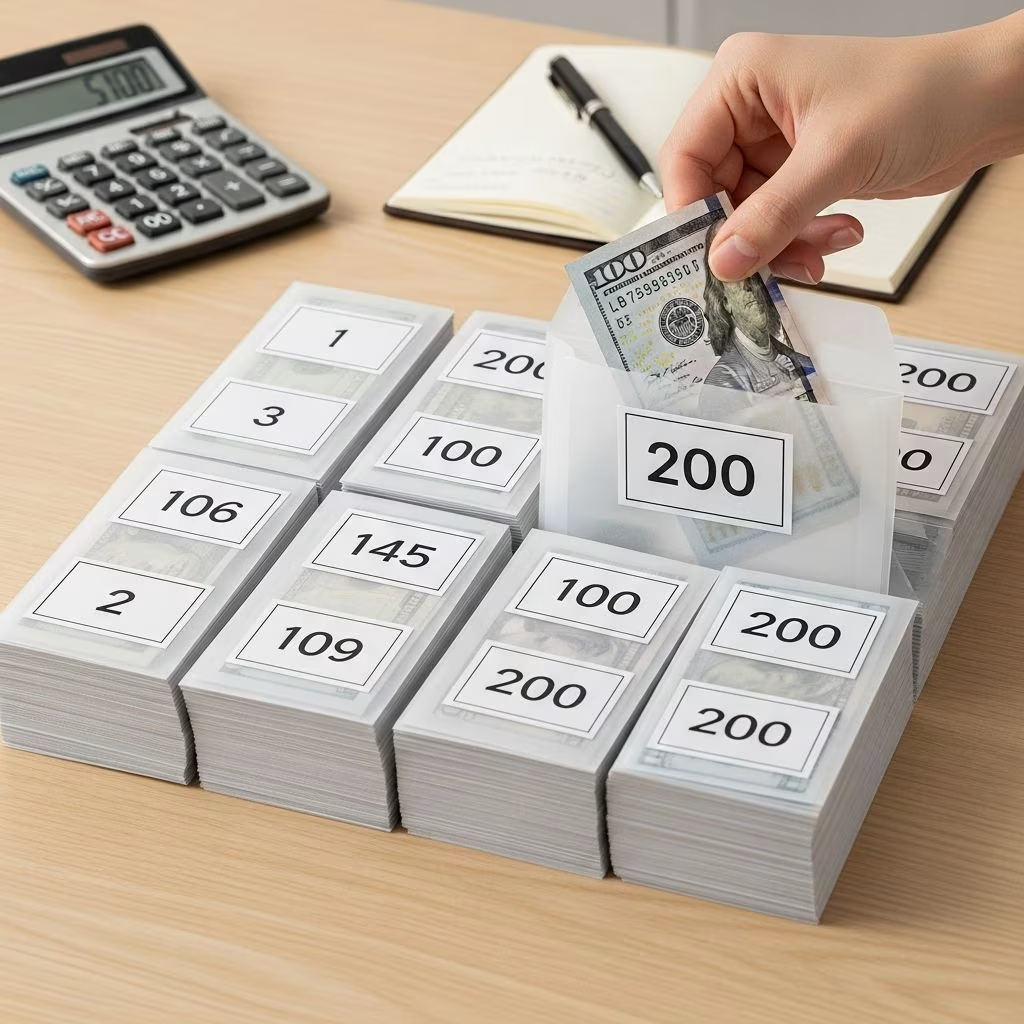
Building savings can feel overwhelming, especially when regular bills, unexpected expenses, and day-to-day spending compete for your money. The 200 envelope challenge offers a simple, visual way to stay focused and save over $5,000 in 200 days by setting aside small amounts every single day.
This article explains what the 200 envelope challenge is, how it works, why it can be easier than the 100 envelope challenge, and exactly how to get started using either cash envelopes or digital alternatives. You will also find a printable-style savings chart, tips for success, and FAQs.
What Is The 200 Envelope Challenge?
The 200 envelope challenge is a short-term savings challenge where you commit to saving a set amount of money every days for 200 days. At the end of the challenge, you will have saved $5,100 if you follow the standard version correctly.
Instead of trying to come up with one large lump sum, you break the goal into daily amounts. Each day, you draw an envelope labeled with a number between 1 and 50; the number you pick is the dollar amount you save that day. You repeat this process until you have completed 200 days of saving.
How Much Will You Save?
- Total days: 200
- Daily savings range: $1 to $50
- Final amount: $5,100 in savings if you complete all 200 days
By focusing on one envelope and one number at a time, you build a consistent savings habit without feeling like you are doing anything extreme.
How The 200 Envelope Challenge Works
The 200 envelope challenge follows the same basic idea as other cash envelope challenges but uses a more manageable range of daily contributions than the original 100 envelope version.
Step-by-Step Process
- Prepare 200 envelopes. Divide them into four groups of 50.
- Number each set from 1 to 50. You will end up with four complete sets labeled 1–50.
- Shuffle and store the envelopes. Keep them in a box, basket, or drawer.
- Every days, draw one envelope at random. The number on the envelope is how many dollars you save that day.
- Place the cash inside and seal it. If you are using a digital method, transfer the amount to a dedicated savings account or tracker.
- Repeat for 200 days. At the end, your total savings will be $5,100 if you complete all envelopes.
Why 4 Sets Of 1–50 Instead Of 1–200?
Some envelope challenges ask you to number envelopes from 1 to 200. That means you could be required to save up to $200 in a single day, which is not realistic for many budgets. By using four sets of 1–50 instead, your maximum daily savings is capped at $50, creating a more achievable, less stressful challenge while reaching a similar total savings goal over more days.
Example Day
Imagine you draw an envelope labeled 20. That day you will:
- Set aside $20 in cash and put it into the envelope, or
- Transfer $20 into your designated savings account and mark that envelope as completed.
Repeat this simple action daily and watch the balance grow.
Benefits Of The 200 Envelope Challenge
Many people struggle to save because traditional goals feel too big or too vague. A structured challenge like this can provide clear rules, visible progress, and a finish line to stay motivated.
More Time To Reach Your Goal
The 200 envelope challenge stretches the savings journey out over 200 days, giving you more time to find the money you need each day compared with a 100-day challenge. Economic research suggests that people are more likely to stick with financial behavior changes when the required daily actions feel manageable and predictable.
Spreading the challenge out means you can adjust more easily for weeks when money is tight and avoid feeling forced to give up because you cannot make a high daily contribution.
Less Aggressive Than The 100 Envelope Challenge
With the original 100 envelope challenge, envelopes numbered 51–100 can require you to save $51 to $100 per day, which is difficult for many households, especially those with lower or variable income.
By contrast, the 200 envelope version:
- Keeps the maximum daily amount at $50
- Offers the same approximate overall savings goal (just over $5,000)
- Gives twice as many days to hit the goal
This makes it a more realistic entry point if you want a serious challenge without overwhelming your budget.
Builds A Daily Savings Habit
Behavioral finance research indicates that small, repeated actions are a powerful way to build long-term financial habits. The 200 envelope challenge encourages you to:
- Interact with your money every single day
- Prioritize saving before spending
- See saving as a normal, automatic part of your routine
By the end of the 200 days, many people find that saving regularly feels natural, making it easier to continue with other goals like building an emergency fund or investing for retirement.
200 Envelope Challenge vs. 100 Envelope Challenge
Both challenges can help you save over $5,000, but they differ in intensity and timeline.
| Feature | 100 Envelope Challenge | 200 Envelope Challenge |
|---|---|---|
| Number of days | 100 | 200 |
| Envelope numbers | 1–100 (one set) | 1–50 (four sets) |
| Daily savings range | $1–$100 | $1–$50 |
| Approximate total saved | About $5,050 | $5,100 |
| Difficulty level | More aggressive | More flexible, less aggressive |
What You Need To Set Up Your 200 Envelope Challenge
Getting started is simple and inexpensive. You can use a traditional cash-based method or a digital alternative depending on your preferences.
Supplies For The Traditional Cash Method
- 200 small envelopes (standard or cash-sized)
- Marker or pen for numbering each envelope
- Stickers or tape to seal envelopes once funded (optional)
- Box, basket, or container to store your envelopes
- Cash from your budget to fund envelopes daily
Digital or Hybrid Variations
If you rarely use cash, you can still do the challenge:
- Use numbered index cards or a digital list instead of envelopes.
- Each days, draw a card or random number between 1 and 50.
- Transfer that amount to a separate savings account or sub-account labeled “200 Envelope Challenge.”
- Record completed numbers in a spreadsheet, notes app, or printout.
Many banks and credit unions allow you to create multiple savings accounts or “buckets,” which can help you keep challenge funds separate from your main checking balance.
Tips To Be Successful With The 200 Envelope Challenge
The rules of the challenge are straightforward, but staying consistent for 200 days requires planning and motivation. The following strategies can help you follow through.
1. Choose A Realistic Start Date
Pick a time when your schedule and budget are relatively stable, such as right after a paycheck or after paying off a seasonal expense. Research on financial planning suggests that aligning new habits with existing routines increases follow-through.
2. Adjust Your Budget In Advance
Before the challenge begins, review your monthly budget:
- Identify areas where you can cut back slightly (e.g., dining out, subscriptions).
- Redirect those amounts to the challenge as a fixed savings line-item.
- Plan ahead for weeks when you might draw several high-number envelopes in a row.
3. Use Visual Motivation
Humans are strongly motivated by visible progress. To stay encouraged:
- Hang a printed chart on your fridge or wall and color in numbers as you complete them.
- Track your total saved so far at the end of each week.
- Take a photo of the growing stack of envelopes or screenshots of your savings balance.
4. Set A Clear Purpose For The Money
You are more likely to stay committed if you know exactly why you are saving.
- Emergency fund or starter emergency cushion
- Debt payoff lump sum
- Down payment for a car or move
- Holiday, vacation, or special event fund
Write your goal on your envelope box or at the top of your savings chart to remind yourself what you are working toward.
5. Give Yourself Flexibility
Life happens. Build flexibility into your challenge so a tough week does not derail you:
- If you cannot afford a number one day, swap it with a smaller number and save the bigger one for later.
- If you miss a day, double up later in the week when you have funds.
- Allow occasional “catch-up weekends” to fill in envelopes you skipped.
6. Protect Your Cash
If you use physical cash envelopes, keep them in a safe place:
- Store them in a locked drawer or small safe.
- Avoid carrying funded envelopes in your daily bag or car.
- Once the stack grows, consider depositing completed envelopes into a separate savings account regularly for security.
7. Celebrate Milestones
Plan small, low-cost rewards when you hit key milestones, such as:
- Finishing the first 50 envelopes
- Reaching $1,000, $2,500, and $4,000 saved
Non-financial rewards, like a movie night at home or a relaxing day with a favorite hobby, can reinforce the positive habit without undoing your progress.
200 Envelope Savings Chart
A savings chart helps you see the overall structure of the challenge. Below is a simplified representation of the amounts used for one set of 1–50, which you will repeat four times during the 200 days.
| Days | Amounts To Save |
|---|---|
| Days 1–10 | $1, $2, $3, $4, $5, $6, $7, $8, $9, $10 |
| Days 11–20 | $11, $12, $13, $14, $15, $16, $17, $18, $19, $20 |
| Days 21–30 | $21, $22, $23, $24, $25, $26, $27, $28, $29, $30 |
| Days 31–40 | $31, $32, $33, $34, $35, $36, $37, $38, $39, $40 |
| Days 41–50 | $41, $42, $43, $44, $45, $46, $47, $48, $49, $50 |
Save $5,100 And Kickstart Your Money Goals
By the end of the 200 envelope challenge, you will have more than $5,000 set aside, plus a stronger saving habit and greater confidence in your ability to follow through on financial goals. Whether you use the money to build an emergency fund, pay off debt, or get ahead on major expenses, the discipline you practice over 200 days can make a lasting difference in your financial life.
Even if you do not complete every single envelope, any amount saved is progress. Focus on consistency, celebrate small wins along the way, and use what you learn to design future savings plans that fit your lifestyle.
Frequently Asked Questions (FAQs)
Q: How much can I save with the 200 envelope challenge?
A: If you follow the standard approach of completing four sets of envelopes numbered 1–50, you will save a total of $5,100 over 200 days.
Q: Do I have to use physical envelopes?
A: No. You can simulate envelopes with digital tools by using a random number generator, a written list, or printable chart and transferring the corresponding amount into a dedicated savings account each day.
Q: What if I cannot afford a high number on a given day?
A: You can swap envelopes with a lower number, postpone the higher one to a future day, or break it into two or more smaller transfers across several days. The key is to keep making progress rather than quitting.
Q: Can I change the amounts or the time frame?
A: Yes. You can tailor the challenge to your income and goals by lowering the highest number (for example, 1–30 instead of 1–50) and extending the timeline, or by repeating the sets more or fewer times, as long as you pick rules you can realistically follow.
Q: Is it better to keep the cash at home or in the bank?
A: Keeping large amounts of cash at home can pose both security and loss risks. Many experts recommend depositing savings into an insured bank or credit union account, where funds are protected up to applicable limits and may earn interest.
References
- Save $5k With The 200 Envelope Challenge! — Clever Girl Finance. 2024-2025 (approx., online article, accessed via site). https://www.clevergirlfinance.com/200-envelope-challenge/
- The 200 Envelope Challenge: A Money-Saving Odyssey — Nasdaq. 2023-08-29. https://www.nasdaq.com/articles/200-envelope-challenge-money-saving-odyssey
- Financial Literacy Around the World: Insights from the Standard & Poor’s Ratings Services Global Financial Literacy Survey — Klapper, Lusardi, van Oudheusden, World Bank. 2015-11-01. https://documents.worldbank.org/en/publication/documents-reports/documentdetail/187761468179367706/financial-literacy-around-the-world-insights-from-the-standard-poor-s-ratings-services-global-financial-literacy-survey
- Behavioral Economics: Past, Present, and Future — Camerer, Loewenstein, Rabin (eds.), Princeton University Press. 2004-01-01. https://press.princeton.edu/books/hardcover/9780691090399/behavioral-economics
- How to Use the Cash Envelope System to Master Your Budget — Clever Girl Finance. 2023-2024 (approx., online article, accessed via site). https://www.clevergirlfinance.com/how-to-use-the-cash-envelope-system/
- Deposit Insurance FAQs — Federal Deposit Insurance Corporation (FDIC). 2024-01-01 (last updated, approximate). https://www.fdic.gov/resources/deposit-insurance/
This article is general information, not personal financial advice. Consider your own situation, or speak with a licensed adviser, before acting on it.


