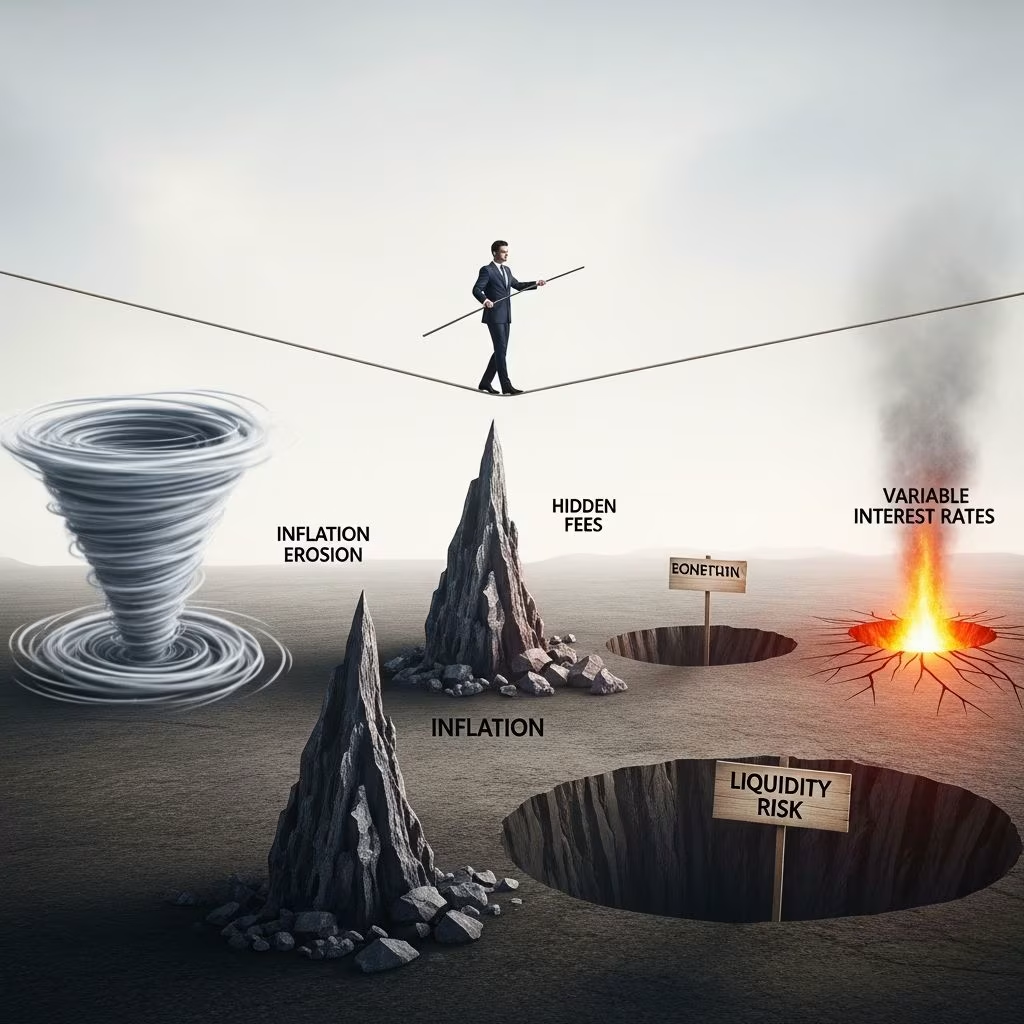
High-yield savings accounts (HYSAs) offer savers a powerful way to earn competitive interest rates on cash reserves, far surpassing traditional savings options. These accounts are FDIC-insured up to $250,000 per depositor per bank, providing security while allowing funds to grow through compound interest. However, many individuals undermine their potential by falling into common traps that erode returns or expose them to unnecessary risks. This article explores these pitfalls in depth, offering actionable strategies to optimize your savings approach.
Understanding High-Yield Savings Basics
Before diving into mistakes, it’s essential to grasp what sets HYSAs apart. Unlike standard savings accounts yielding under 0.50% APY, HYSAs from online banks often provide 4-5% APY or higher, thanks to lower overhead costs. This makes them ideal for emergency funds, short-term goals like vacations or car purchases, and liquidity needs. The Federal Reserve’s rate environment influences these yields, with adjustments expected in late 2025 and beyond, emphasizing the need for vigilance.
Key features include no monthly fees in most cases, easy online access, and automatic transfers. Yet, success hinges on disciplined use—treating these as savings vehicles, not spending accounts.
Pitfall 1: Settling for Subpar Interest Rates
One of the most frequent errors is failing to compare rates across institutions. Rates can differ by 1% or more among “high-yield” options, translating to hundreds of dollars in lost earnings annually on a $10,000 balance. Local branches often lag behind online competitors due to higher operating costs.
- Rate shop effectively: Use aggregator sites or direct bank comparisons, focusing on APY, not advertised headlines.
- Check variable terms: HYSAs have fluctuating rates tied to federal funds, so monitor quarterly.
- Example impact: At 5% vs. 4% APY on $20,000, you earn an extra $200 yearly through compounding.
To counter this, dedicate 15 minutes monthly to rate checks. Tools from the FDIC or consumer sites can highlight top performers without bias.
Pitfall 2: Overlooking Fees and Restrictions
Focusing solely on APY ignores hidden drags like minimum balances, withdrawal limits (often six per month under Regulation D, though eased post-2020), or transfer fees. Some accounts demand direct deposits for bonuses, excluding retirees reliant on Social Security or annuities.
| Factor | Potential Cost | Solution |
|---|---|---|
| Minimum Balance | $100-$1,000 or yield drops | Choose no-minimum options |
| Withdrawal Limits | Excess fees or account closure | Plan transfers wisely |
| Mobile/ATM Access | Limited reimbursements | Prioritize robust apps |
Evaluate the full package: app usability, customer service, and integration with your checking account. Online-only banks excel here, but verify FDIC coverage.
Pitfall 3: Neglecting Regular Contributions
Opening an HYSA without automating deposits dooms many to stagnation. Life’s expenses eclipse manual savings efforts, leaving balances idle. Automation ensures consistency, harnessing dollar-cost averaging for interest growth.
- Set recurring transfers from checking, even $50/paycheck.
- Use roundup features to siphon spare change effortlessly.
- Target 3-6 months’ expenses for emergencies first.
For instance, $200 monthly at 4.5% APY grows to over $12,000 in five years via compounding, versus $12,000 without interest.
Pitfall 4: Commingling Multiple Goals
Lumping all savings into one account muddles tracking for distinct objectives—like a home down payment versus wedding costs. This invites impulsive dips into one “bucket” for another need.
Solution: Open separate HYSAs per goal. Most banks allow multiple without credit impact. Label them digitally (e.g., “Car Fund”) and allocate proportionally.
- Emergency fund: 3-6 months living costs.
- Short-term (1-2 years): Vacations, appliances.
- Medium-term: Avoid if over 2 years; shift to CDs or investments.
Pitfall 5: Ignoring Progress and Over-Saving
“Set it and forget it” leads to excess cash earning suboptimal returns. Review quarterly: If a goal is met, redirect funds. Excess beyond FDIC limits ($250,000) risks loss in failures, though rare post-SVB.
Track via apps showing projections. Taxes on interest (ordinary income) also erode gains—report accurately to avoid IRS issues.
Pitfall 6: Sticking to Traditional Banks
Physical branches offer familiarity but dismal rates under 0.50% APY. Online banks dominate HYSAs with superior yields from cost savings.
- Credit unions: Often competitive, member-owned.
- Big banks: Convenient but low-yield.
- Neobanks: Feature-rich, like bonuses up to $300.
Pitfall 7: Over-Reliance Without Diversification
HYSAs suit liquidity but not wealth-building. For horizons beyond 1-2 years, CDs lock rates amid cuts, or stocks/bonds offer higher potential (with risk). Don’t park all eggs here—balance with a portfolio.
Best Practices for HYSA Success
To thrive:
- Shop annually: Rates shift; ladder with CDs.
- Automate and monitor: Use apps for insights.
- Diversify banks: Stay under FDIC caps across institutions.
- Align with goals: Short-term only; invest long-term.
In 2026’s rate environment, strategic HYSA use can yield 4-5x traditional returns safely.
Frequently Asked Questions (FAQs)
Are high-yield savings accounts safe?
Yes, FDIC-insured up to $250,000 protects principal.
How often do rates change?
Variable, tied to Fed; check monthly.
Can I have multiple HYSAs?
Absolutely, no credit hit; ideal for goals.
Are there taxes on interest?
Yes, reported on 1099-INT as income.
What’s better than HYSA long-term?
Index funds or CDs for locked rates.
References
- 7 High-Yield Savings Account Mistakes to Avoid — Experian. 2023-10-15. https://www.experian.com/blogs/ask-experian/high-yield-savings-account-mistakes-to-avoid/
- 3 Costly High-Yield Savings Account Mistakes to Avoid This Fall — CBS News. 2025-09-20. https://www.cbsnews.com/news/costly-high-yield-savings-account-mistakes-to-avoid-fall-2025/
- 5 High-Yield Savings Mistakes I Made (So You Don’t Have To!) — YouTube (Colin Exelby, CFP®). 2024-05-10. https://www.youtube.com/watch?v=ilYD8bqafNo
- The Dos and Don’ts of High-Yield Savings Accounts — Freedman Financial. 2024-08-05. https://www.freedmanfinancial.com/blog/the-dos-and-donts-of-high-yield-savings-accounts
This article is general information, not personal financial advice. Consider your own situation, or speak with a licensed adviser, before acting on it.