

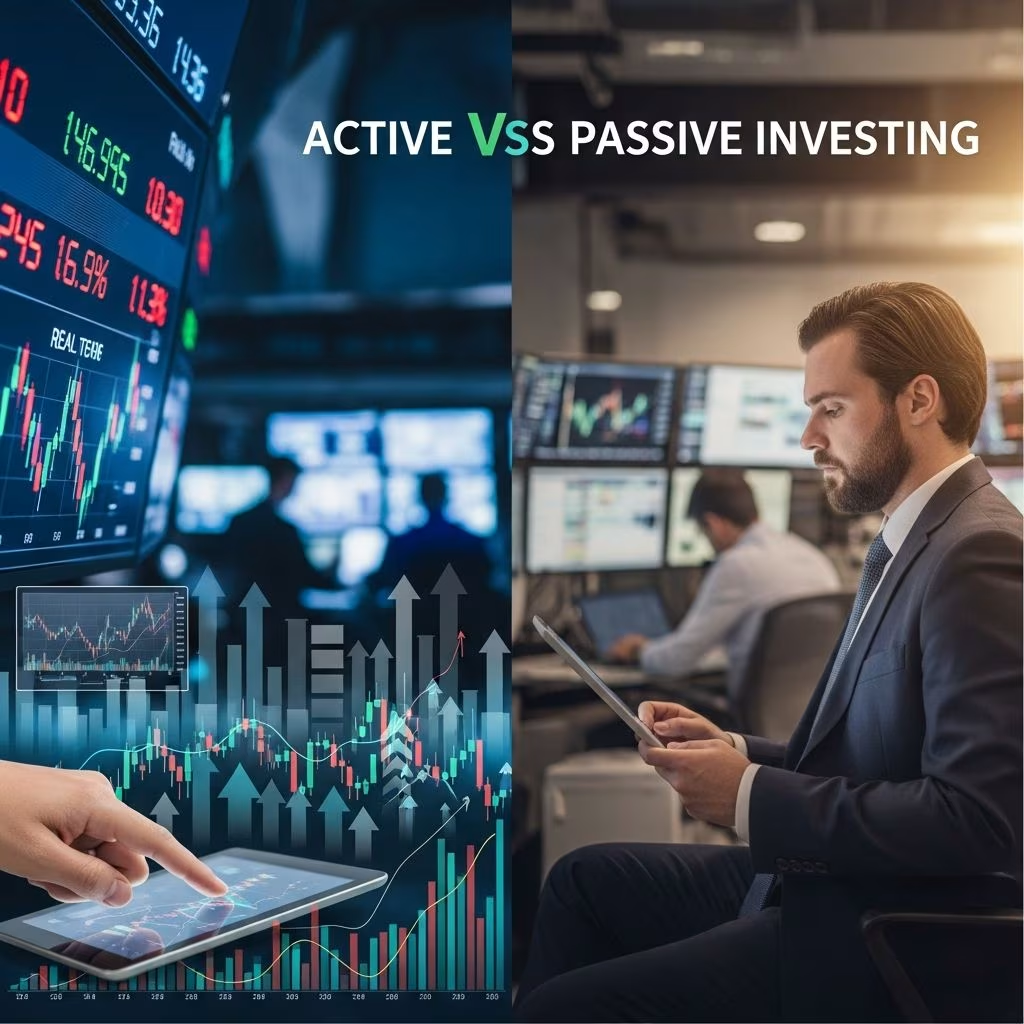
Investors today face a fundamental choice between two primary approaches: active investing, which seeks to exceed market benchmarks through expert selection and timing, and passive investing, which aims to replicate market returns at minimal cost. This decision shapes portfolio performance, expenses, and involvement level over time.
Defining the Core Approaches
Active investing relies on professional managers or individual investors who actively select securities, adjust holdings based on market forecasts, and aim to generate returns superior to broad indices like the S&P 500. This method demands ongoing research, analysis, and tactical shifts to capitalize on opportunities or mitigate risks.
In contrast, passive investing tracks predefined indices by holding a representative basket of assets, minimizing trading to reduce costs and mirror overall market movements. Common vehicles include index mutual funds and exchange-traded funds (ETFs), prioritizing long-term growth over short-term maneuvers.
Key Distinctions at a Glance
| Aspect | Active Investing | Passive Investing |
|---|---|---|
| Management Style | Hands-on, frequent decisions | Hands-off, index replication |
| Performance Objective | Outperform the market | Match market returns |
| Typical Costs | Higher fees (0.5-2% expense ratios) | Lower fees (0.03-0.20% expense ratios) |
| Risk Profile | Potentially higher volatility | Market-level volatility |
| Examples | Actively managed mutual funds, some ETFs | S&P 500 index funds, broad-market ETFs |
This table summarizes differences drawn from financial analyses, highlighting how passive options often appeal due to cost efficiency while active strategies promise potential alpha.
Strengths and Weaknesses of Active Investing
Active strategies shine in environments of market inefficiency or volatility, where skilled managers can identify undervalued assets or avoid downturns. For instance, during economic shifts, active funds have historically captured more upside in recoveries.
Advantages
- Outperformance Potential: Top managers may exceed benchmarks, especially in niche sectors or turbulent times.
- Adaptability: Quick responses to geopolitical events, earnings surprises, or policy changes allow portfolio pivots.
- Personalization: Tailoring to ethical preferences, tax situations, or specific goals like income generation.
- Risk Controls: Hedging techniques and sector rotations to dampen losses.
Challenges
- Elevated Expenses: Management fees erode returns; average active equity funds lag indices after costs.
- Inconsistency: Few funds sustain outperformance; over 80% underperform over a decade in many categories.
- Higher Turnover: Frequent trading increases taxes and transaction costs.
- Manager Risk: Dependence on human judgment, prone to errors or style drift.
Strengths and Weaknesses of Passive Investing
Passive approaches leverage the market’s long-term upward trajectory, benefiting from broad exposure without the drag of high fees. S&P 500-based funds have delivered around 10% annualized returns historically, often surpassing active peers net of costs.
Advantages
- Cost Savings: Ultra-low expense ratios preserve more returns for investors.
- Diversification: Instant exposure to hundreds or thousands of securities reduces single-stock risk.
- Consistency: Tracks reliable benchmarks without manager missteps.
- Tax Advantages: Low turnover minimizes capital gains distributions.
Challenges
- No Upside Edge: Cannot beat the market; capped at index performance.
- Market Dependency: Fully bears downturns without defensive adjustments.
- Limited Customization:
- Concentration Risks: Indices like S&P 500 are top-heavy in tech giants.
Difficult to exclude sectors or tilt toward themes without added costs.
Performance Trends and Market Insights
Over the past decade, passive funds have dominated U.S. inflows, capturing more assets due to consistent net returns. In the U.S., passive strategies represent a growing share, though active still leads in Europe with €9.3 trillion vs. €4.1 trillion passive as of late 2025. Studies show passive outperforming in bull markets, while active edges in corrections. The average dollar in active funds sometimes beats average funds due to flows into winners, but broad persistence remains elusive.
Combining both—core passive for efficiency, active satellites for targeted bets—often yields optimal results across cycles.
Factors to Guide Your Decision
Investment Horizon
Long-term horizons (10+ years) favor passive for compounding at market rates. Short-term needs may benefit from active agility.
Risk Appetite
Risk-averse investors prefer passive steadiness; those seeking higher rewards tolerate active volatility.
Tax Considerations
Taxable accounts suit passive low-turnover; active suits sheltered accounts like IRAs.
Market Conditions
Volatile or inefficient markets boost active; efficient bull runs favor passive.
Practical Steps to Implement
- Assess Goals: Define returns needed, timeline, and involvement level.
- Build Core: Allocate 70-80% to low-cost index funds for stability.
- Add Satellites: 20-30% in active funds for sectors like emerging markets.
- Rebalance Annually: Restore target allocations to control drift.
- Monitor Fees: Keep total costs under 0.5% where possible.
Frequently Asked Questions
Which performs better long-term?
Passive often nets higher returns for most due to fees, though elite active funds excel.
Can I mix both strategies?
Yes, a hybrid ‘core-satellite’ model balances cost and opportunity.
Are ETFs always passive?
No, both active and passive ETFs exist; check the prospectus.
Does passive mean no work?
It requires initial allocation and periodic rebalancing.
How do fees impact returns?
A 1% fee difference can halve wealth over 30 years via compounding.
References
- Active vs Passive Investing: Key Differences Explained — Navy Federal Credit Union. 2023. https://www.navyfederal.org/makingcents/investing/active-vs-passive-investing.html
- Active vs. Passive Investing — FINRA. 2023-10-01. https://www.finra.org/investors/insights/active-passive-investing
- Active vs. Passive Investing: Differences Compared — NerdWallet. 2025. https://www.nerdwallet.com/investing/learn/active-vs-passive-investing
- Active vs. Passive Investing: Which Categories Are More Successful? — Morningstar. 2025-10-01. https://www.morningstar.com/business/insights/blog/funds/active-vs-passive-investing
- A New Take on the Active vs. Passive Investing Debate — Morgan Stanley. 2023. https://www.morganstanley.com/articles/active-vs-passive-investing
- Active vs. Passive Investing: Which Approach Offers Better Returns? — Wharton Executive Education. 2023. https://executiveeducation.wharton.upenn.edu/thought-leadership/wharton-wealth-management-initiative/wmi-thought-leadership/active-vs-passive-investing-which-approach-offers-better-returns/
- The Cyclical Nature of Active & Passive Investing — Hartford Funds. 2023. https://www.hartfordfunds.com/insights/market-perspectives/equity/cyclical-nature-active-passive-investing.html
This article is general information, not personal financial advice. Consider your own situation, or speak with a licensed adviser, before acting on it.


