

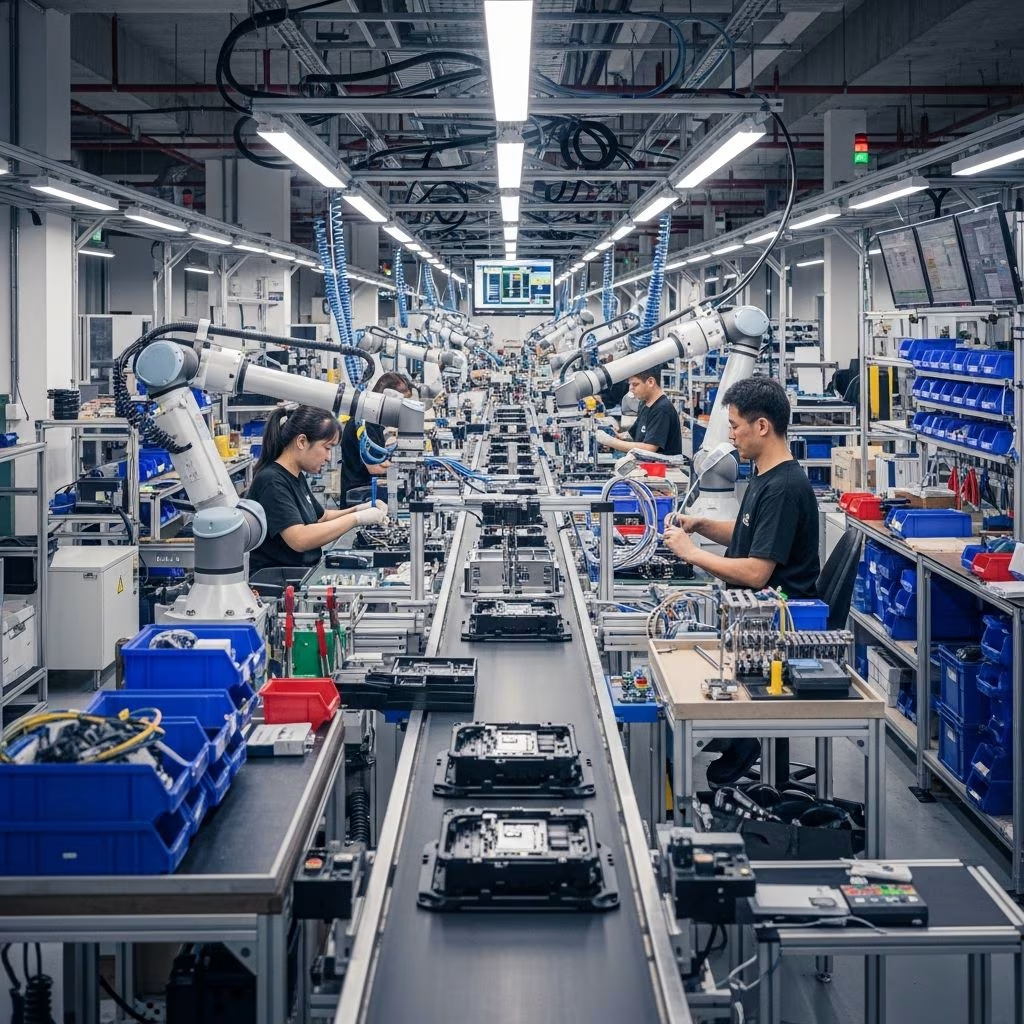
What Is an Assembly Line?
An assembly line is a manufacturing process in which individual parts and components of a product are assembled in a sequential manner on a moving conveyor belt. Also known as progressive assembly, it represents one of the most transformative innovations in industrial history. In an assembly line, the unfinished product moves in a direct line from workstation to workstation, with parts added in sequence until the final product is completed. By mechanically moving parts to workstations and transferring the unfinished product from one workstation to another, a finished product can be assembled faster and with significantly less labor than having workers carry parts to a stationary product.
The assembly line is a form of mass production where components are added in a specific, efficient order to create a finished product at the end of the line. Assembly lines are common methods of assembling complex items such as automobiles and other transportation equipment, household appliances, and electronic goods. The concept has become so integral to modern manufacturing that hardly any consumer goods on the market today are not produced in an assembly line fashion.
How Assembly Lines Work
Assembly lines are designed for the sequential organization of workers, tools or machines, and parts. The fundamental principle is to minimize the motion of workers to the extent possible. All parts or assemblies are handled either by conveyors or motorized vehicles such as forklifts, or gravity, with no manual trucking. Heavy lifting is done by machines such as overhead cranes or forklifts.
Each worker typically performs one simple operation unless job rotation strategies are applied. The assignment of tasks to stations is typically limited by two constraints: first, a precedence graph which indicates what other tasks need to be completed before a particular task can be initiated (for example, not putting in a screw before drilling the hole), and second, a cycle time which restricts the sum of task processing times which can be completed at each workstation before the work-piece is moved to the next station by the conveyor belt.
Major planning problems for operating assembly lines include supply chain integration, inventory control and production scheduling. The efficiency of an assembly line depends on careful coordination between these elements to ensure smooth operations and minimal downtime.
A Practical Example
Consider the assembly of a car: assume that certain steps in the assembly line are to install the engine, install the hood, and install the wheels (in that order, with arbitrary interstitial steps). In traditional production, only one car would be assembled at a time. If engine installation takes 20 minutes, hood installation takes five minutes, and wheels installation takes 10 minutes, then a car can be produced every 35 minutes.
In an assembly line, car assembly is split between several stations, all working simultaneously. When a station is finished with a car, it passes it on to the next. By having three stations, three cars can be operated on at the same time, each at a different stage of assembly. The longest stage on the assembly line determines the throughput, so a car can be produced every 20 minutes, once the first car taking 35 minutes has been produced. This fundamental principle demonstrates how assembly lines dramatically increase production efficiency.
The History of the Assembly Line
The assembly line was first mechanized in the U.S. in 1797 by Eli Whitney, who also patented a type of cotton gin. Whitney began using the assembly line to manufacture muskets that had interchangeable parts. Over a two-year period, Eli’s company built 10,000 muskets rifles for the U.S. government. This early application demonstrated the potential of assembly line manufacturing for producing large quantities of goods efficiently.
However, the modern assembly line was popularized by the Ford Motor Company in the early 20th century. Henry Ford piloted an assembly line which significantly cut the costs of producing cars and helped make them affordable for the general workforce. The moving assembly line was developed for the Ford Model T and began operation on October 7, 1913, at the Highland Park Ford Plant, and continued to evolve after that, using time and motion study.
The assembly line, driven by conveyor belts, reduced production time for a Model T to just 93 minutes by dividing the process into 45 steps. By 1915, the assembly line style of manufacturing allowed the Model T, one of the first mass-produced consumer automobiles, to be sold to the public for $440. Producing cars quicker than paint of the day could dry, it had an immense influence on the world. The invention of the assembly line revolutionized the manufacturing industry, and the industrial revolution would not have come into its current form without this revolutionary invention and the concept of interchangeable parts.
Key Advantages of Assembly Lines
Assembly lines have transformed modern manufacturing by offering numerous significant benefits:
- Increased Production: Assembly lines allow for the production of multiple goods at one time by organizing their assembly by workstation. The assembly line is optimized for speed and efficiency, and most lines can turn out products much faster than traditional methods of manufacturing.
- Reduced Cost: The quicker and easier it is to assemble a product, the cheaper its overall cost becomes. As production volumes increase, the cost per unit decreases, making products more affordable for consumers and boosting overall demand.
- Better Uniformity: The assembly line ensures that products are made to a uniform standard. With each worker performing a specific task, quality control becomes easier. If there are defects, they can be traced back to the exact stage where they occurred.
- Economies of Scale: Assembly lines enable economies of scale from the increased specialisation of the workforce. Because workers do a specific job they need less training to be able to perform a specific task. Economies of scale are also important as they lower per-unit production costs.
- Improved Efficiency: The streamlined nature of the assembly line means that products move along a line with each stage adding to the final product. This organized workflow eliminates wasted motion and time.
- Use of Interchangeable Parts: Products are manufactured on an assembly line using interchangeable parts. This allows for more than one product to be assembled in a facility because it requires fewer specialized pieces. Interchangeable parts are those parts made to specifications that ensure they will be able to fit on any item of the same assembly type. In automobile manufacturing, various engine parts and the chassis of a vehicle are interchangeable to build several models of vehicles on the same platform. This function helps to reduce the overall cost of manufacturing as the only things that may change are the body and other smaller details of the product.
Disadvantages and Challenges of Assembly Lines
Despite their numerous advantages, assembly lines also present several significant challenges and disadvantages that manufacturers must address:
- Bottleneck Issues: A bottleneck in one place could cause the whole process to come to a complete stop, disrupting the entire production schedule.
- Repetitive Work: Work becomes highly repetitive and boring, which can lead to worker fatigue, reduced morale, and potential quality issues over time.
- Quality Control Challenges: Although uniformity is an advantage, it can be hard to identify sources of error and maintain overall quality control when problems do arise.
- Potential Diseconomies of Scale: Assembly lines could lead to diseconomies of scale if not properly managed, where increasing production actually increases per-unit costs.
- Inflexibility: Traditional assembly lines are designed for specific products and can be difficult to adapt to product changes or variations.
- High Initial Investment: Setting up an assembly line requires significant capital investment in machinery, conveyors, and infrastructure.
Modern Assembly Line Methods
Using modern assembly line methods, manufacturing has become a highly refined process. Today, assembly line manufacturing is characterized by concurrent processes that feed into a final assembly stage. These processes require a well-planned flow of materials and the development of advanced materials and a supply infrastructure.
Contemporary assembly lines often incorporate advanced technology, automation, and robotics to further improve efficiency and quality. Computer systems manage inventory, scheduling, and quality control, while robotic arms handle repetitive or dangerous tasks. Lean manufacturing principles and just-in-time inventory management have further optimized modern assembly line operations, reducing waste and improving overall productivity.
Interchangeable Parts: A Cornerstone of Assembly Line Manufacturing
Interchangeable parts are made to specifications that ensure they are nearly identical; the purpose of this is to ensure that they will fit into any product of the same assembly type. This concept was pioneered by Eli Whitney and has become fundamental to assembly line manufacturing.
The use of interchangeable parts allows manufacturers to:
- Reduce design complexity and manufacturing costs
- Enable mass production of multiple product variations on the same line
- Simplify quality control and maintenance processes
- Create standardized products that consumers can rely on for consistency
- Facilitate repairs and replacement of components in finished products
Assembly Line Impact on the Industrial Revolution
The assembly line was one of the key components of the Industrial Revolution. The principles of the assembly line allowed manufacturers to produce greatly increased numbers of products at a lower cost and indirectly made for easier maintenance of products after their assembly. The innovation fundamentally changed the relationship between production capacity and consumer accessibility.
Before the assembly line, manufacturing was primarily a craft-based activity where skilled workers produced goods individually. The assembly line democratized manufacturing by breaking down complex processes into simple, repeatable tasks that required minimal training. This shift made industrial production accessible to a much larger workforce and enabled companies to scale production to unprecedented levels.
Frequently Asked Questions
Q: Who invented the assembly line?
A: Eli Whitney first mechanized the assembly line in 1797 when he began manufacturing muskets with interchangeable parts. However, Henry Ford popularized and refined the modern assembly line in the early 20th century, implementing it at his Ford Motor Company plant in 1913.
Q: What is the main purpose of an assembly line?
A: The main purpose of an assembly line is to increase production efficiency and reduce manufacturing costs by organizing workers, tools, and parts in a sequential manner where each worker performs a specific task as the product moves along a conveyor belt.
Q: How did the assembly line reduce the price of the Ford Model T?
A: The assembly line reduced production time for the Model T to just 93 minutes by dividing the process into 45 steps. This dramatic reduction in production time, combined with economies of scale and the use of interchangeable parts, allowed Ford to reduce the price to $440 by 1915, making automobiles affordable for the average consumer.
Q: What are interchangeable parts, and why are they important?
A: Interchangeable parts are components made to exact specifications that ensure they will fit into any product of the same assembly type. They are important because they enable manufacturers to produce multiple product variations on the same assembly line, reduce costs, simplify quality control, and facilitate repairs and maintenance.
Q: What are some disadvantages of assembly lines?
A: Key disadvantages include bottlenecks that can halt entire production, highly repetitive work that affects worker morale, difficulty identifying quality control issues, potential diseconomies of scale, inflexibility to product changes, and high initial capital investment requirements.
Q: How have modern assembly lines evolved?
A: Modern assembly lines incorporate advanced technology, automation, and robotics to improve efficiency and quality. They often use computer systems for inventory management, scheduling, and quality control, along with lean manufacturing principles and just-in-time inventory management to reduce waste and improve productivity.
References
- Assembly line — Wikipedia. https://en.wikipedia.org/wiki/Assembly_line
- Assembly Line Manufacturing — Fiveable. https://fiveable.me/key-terms/apush/assembly-line-manufacturing
- Assembly line — Economics Help. https://www.economicshelp.org/blog/glossary/assembly-lines/
- Assembly Line Definition, Function & Invention — Study.com. https://study.com/academy/lesson/assembly-lines-history-types-quiz.html
- What Were The Main Advantages Of The Assembly Line? — YouTube. https://www.youtube.com/watch?v=Su016tV7sBY
This article is general information, not personal financial advice. Consider your own situation, or speak with a licensed adviser, before acting on it.


