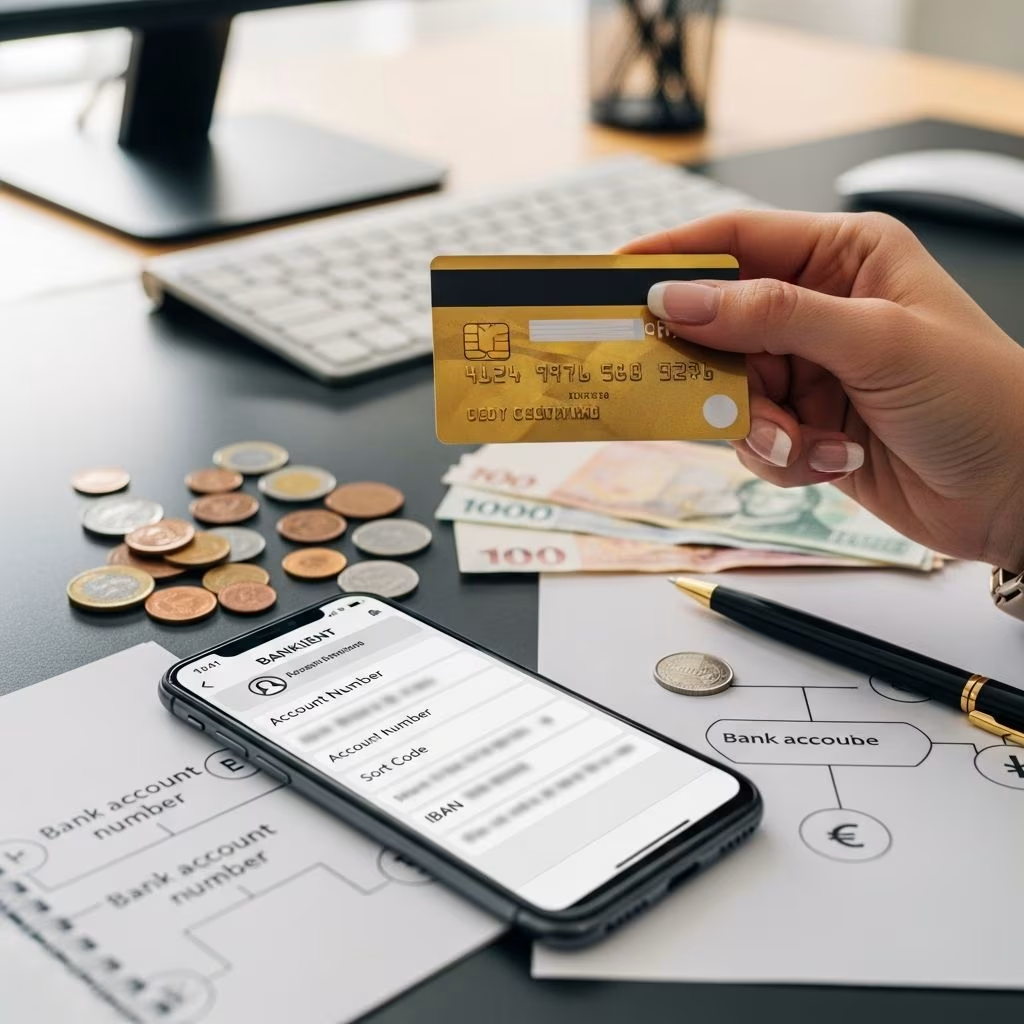
Bank account numbers serve as unique identifiers for individual accounts at financial institutions, typically consisting of 8 to 12 digits that distinguish your specific account from others. These numbers are crucial for processing deposits, withdrawals, transfers, and payments accurately.
The Role of Bank Account Numbers in Modern Banking
In the digital age of finance, a bank account number acts like a personal barcode within a bank’s vast system. When you open a checking, savings, or other deposit account, the institution assigns this exclusive sequence to track all activity tied to it. Unlike generic identifiers, it ensures funds flow precisely to or from your account during transactions such as direct deposits from employers or automated bill payments.
Financial institutions use proprietary methods to generate these numbers, which can vary in length from 5 to 17 digits depending on the bank’s policies. For instance, larger banks might employ longer formats to accommodate millions of customers, while smaller ones use shorter ones. This variability underscores why understanding your own account’s specifics is vital for seamless banking.
Distinguishing Account Numbers from Routing Numbers
A common point of confusion arises between account numbers and routing numbers, but they serve distinct purposes. The routing number, a standard nine-digit code, identifies the bank or credit union itself, including its Federal Reserve district and branch details. It directs transactions to the correct institution, much like a postal code routes mail to a city.
| Feature | Routing Number | Account Number |
|---|---|---|
| Digits | Always 9 digits | 8-12 digits typically (5-17 possible) |
| Identifies | Bank or institution | Specific customer account |
| Usage Example | Direct deposits, wire transfers | Deposits to your personal savings |
| Multiple per Bank? | Yes, by region/service | No, unique per account |
Both are required for most electronic transfers via ACH networks, where the routing number handles institutional routing and the account number pinpoints the endpoint. If you hold multiple accounts at the same bank, each gets a different account number but shares the same routing number for that branch.
Decoding the Structure of a Routing Number
Routing numbers follow a standardized format established by the American Bankers Association (ABA). The first two digits (01-12 or 61-72 for processors) indicate the Federal Reserve district, from Boston (01) to San Francisco (12). Digits 3-4 specify the state or region, while 5-8 provide a unique bank code. The ninth is a check digit, mathematically derived from the prior eight to verify legitimacy and thwart tampering.
This structure ensures no two institutions share the same routing number, enabling precise transaction routing even across vast networks.
Finding Your Account and Routing Numbers
On a Paper Check
Personal checks offer the most visual access to these numbers at the bottom, printed in MICR (Magnetic Ink Character Recognition) font for machine readability. Starting from the left: the nine-digit routing number, followed by the account number (often 10-12 digits), and then the check number.
- Bottom left: Routing number (9 digits).
- Middle: Account number (variable length, right of routing).
- Far right: Check number (matches top right).
Note that some checks print the account number with extra zeros or hyphens; ignore formatting for electronic use.
Online Banking Portals
Log into your bank’s app or website for instant access. Navigate to account details, settings, or ‘Account Information’ sections—routing and account numbers appear alongside balances and recent transactions. Mobile apps often display them under ‘Direct Deposit’ or ‘Share’ options for easy copying.
Bank Statements and Debit Cards
Monthly statements list both numbers near the top or in summary boxes. Debit cards rarely show account numbers directly (for security), but calling customer service or visiting a branch provides them after verification.
Other Reliable Sources
- Voided checks: Use a marked ‘VOID’ check as a reference.
- Customer service: Provide ID for verbal confirmation.
- Setup emails: New account welcome packets include them.
Practical Applications in Everyday Transactions
Account numbers power routine banking: set up payroll direct deposits by sharing both numbers with your employer; link for Venmo or Zelle transfers; authorize utility autopay. For wire transfers, they pair with routing for international or high-value moves.
Businesses rely on them for vendor payments or invoice receipts, ensuring accuracy in high-volume operations. Even tax refunds via IRS direct deposit require these details for swift processing.
Security Best Practices for Protecting Your Numbers
Treating your account number like a Social Security digit is wise—exposure risks unauthorized access. Shred documents showing it, avoid emailing unencrypted copies, and use secure portals for sharing.
- Monitor regularly: Review statements weekly for anomalies.
- Enable alerts: Text notifications for transactions over $50.
- Use strong authentication: Biometrics and two-factor for logins.
- Beware phishing: Never share via unsolicited calls or links.
- Frost if compromised: Contact bank immediately to freeze.
Banks deploy encryption and fraud detection, but vigilance prevents most issues. Report lost checks or stolen info promptly to limit liability.
Common Pitfalls and How to Avoid Them
Mixing up routing and account numbers delays payments—double-check before submitting. Variable lengths confuse; always copy-paste from official sources. International transfers may need IBAN instead, which incorporates both U.S. equivalents.
If switching banks, update all auto-pays promptly to avoid overdrafts. For joint accounts, confirm the primary number with co-holders.
Frequently Asked Questions (FAQs)
What if my account number changes?
Rarely happens unless closing/reopening or errors; banks notify you. Multiple accounts mean multiple numbers.
Can I have the same account number at different banks?
Yes, as numbers are bank-specific, not universal.
Is my debit card number the same as my account number?
No—debit links to account but has its own 16-digit format for POS swipes.
How do I find numbers without checks?
Online banking, statements, or call support.
What happens if I give the wrong account number?
Funds return or delay; banks often reverse errors.
Advanced Considerations for Business and International Banking
Business accounts may include prefixes denoting type (e.g., payroll vs. operating). Internationally, IBAN standardizes with country codes plus domestic details. For U.S. users abroad, confirm SWIFT codes alongside routing for cross-border wires.
Tech integrations like Plaid link accounts securely without manual entry, pulling numbers via API for apps like Robinhood or payroll services.
In summary, mastering account and routing numbers empowers confident financial management. Regularly verify details and prioritize security to safeguard your assets.
References
- Account Number – Overview, How it Works, Protecting — Corporate Finance Institute. 2023-01-15. https://corporatefinanceinstitute.com/resources/wealth-management/account-number/
- What are US bank account numbers? — Stripe. 2024-05-20. https://stripe.com/en-sg/resources/more/what-is-a-bank-account-number-what-it-does-and-how-to-locate-yours
- Account numbers: What they mean and how to find them — Plaid. 2024-08-10. https://plaid.com/resources/banking/account-numbers-explained/
- What is a bank account number? What it does and how to locate yours — Stripe. 2024-05-20. https://stripe.com/resources/more/what-is-a-bank-account-number-what-it-does-and-how-to-locate-yours
- What Is a Bank Account Number? — SoFi. 2024-03-12. https://www.sofi.com/learn/banking/bank-account-number/
- What Is a Bank Account Number and Where Can You Find it? — PNC. 2024-07-05. https://www.pnc.com/insights/personal-finance/spend/what-is-a-bank-account-number.html
This article is general information, not personal financial advice. Consider your own situation, or speak with a licensed adviser, before acting on it.