Bartering, the direct exchange of goods or services without money, offers a timeless way to save cash amid rising costs. In an economy where every dollar counts, learning to barter can unlock value from unused items, surplus skills, and excess inventory. This guide covers everything from basics to advanced strategies, drawing on proven advantages like simplicity and flexibility while addressing challenges such as finding matching needs.
What Is Bartering?
Bartering is a system where participants directly exchange goods or services for other goods or services, bypassing currency entirely. Originating as one of humanity’s earliest trade methods, it thrives today in cash-strapped scenarios, hyperinflation, or when building trust without financial intermediaries. Unlike monetary transactions, bartering relies on mutual value perception—what’s trash to one is treasure to another.
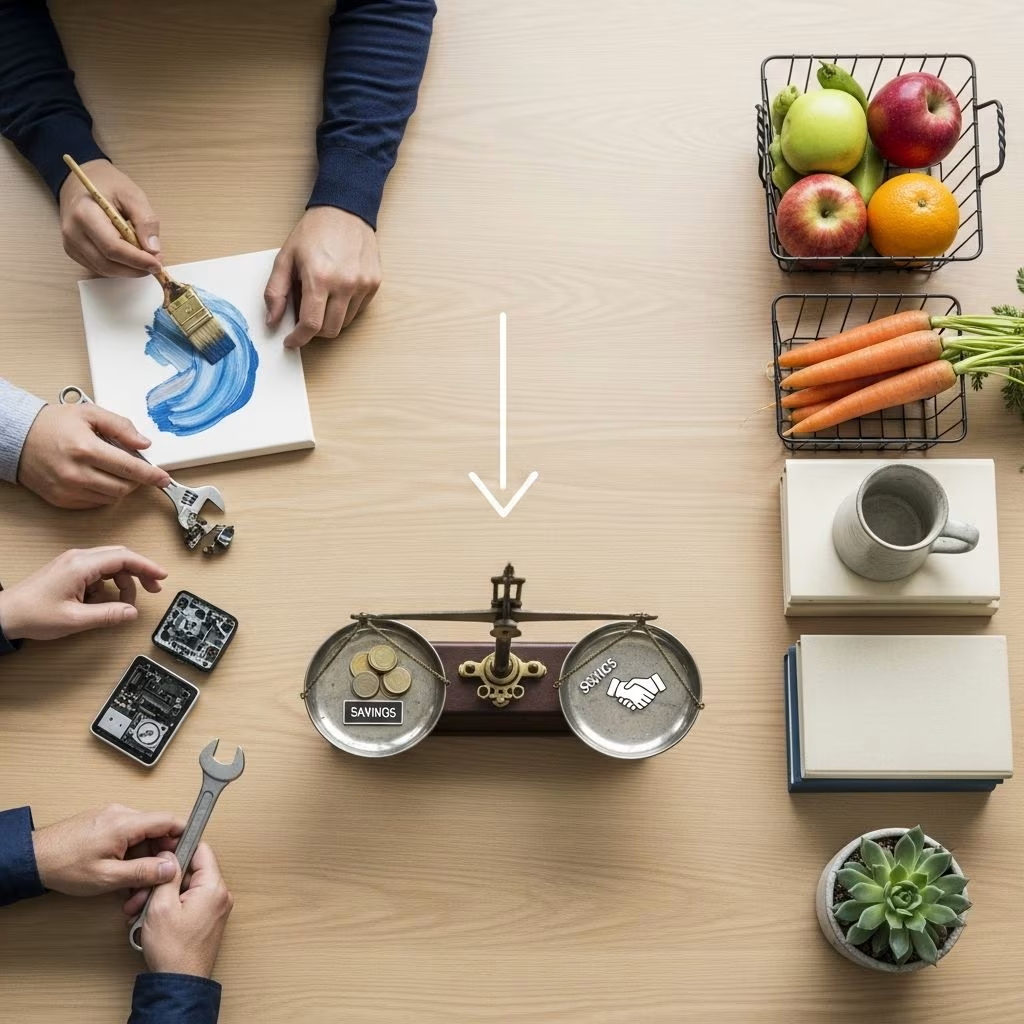
For individuals, this might mean trading a lawnmower for guitar lessons. Businesses use it to offload surplus stock for marketing services. Modern platforms and apps have revived bartering, making the ‘double coincidence of wants’—where both parties desire each other’s offerings—easier to achieve via online networks.
Advantages of Bartering
Bartering shines in its straightforward appeal, especially for those conserving cash. Here are key benefits supported by economic analyses:
- Simplicity: No banks, fees, or currency fluctuations— just direct swaps, avoiding modern finance complexities.
- High Flexibility: Trade unrelated items like a laptop for vacation lodging or services for goods, accommodating diverse needs.
- Cash Savings: Preserve liquidity, crucial for startups or households; trade surplus instead of spending.
- Resource Utilization: Clear excess inventory or underused skills, turning idle assets into value.
- Ideal for Inflation: When money devalues rapidly, bartering maintains purchasing power.
- Builds Relationships: Fosters trust and networks, beneficial for business growth.
Globally, over 450,000 businesses traded $10 billion via barter in 2008, with growth expected annually, per industry reports.
Disadvantages of Bartering
Despite perks, bartering has hurdles that require strategy to overcome. Common challenges include:
- Double Coincidence of Wants: Both parties must want what the other offers; hard without networks.
- Indivisibility: Can’t split items like a cow for small goods without loss.
- No Deferred Payments: Immediate exchanges only—no credit, risking disputes over future quality or value.
- Valuation Disputes: Subjective worth leads to negotiation friction.
- Market Limits: Credits from exchanges may not yield desired items.
These issues make bartering inefficient for complex economies but viable for targeted trades.
How to Find People to Barter With
Success starts with partners. Leverage these channels:
- Online Platforms: Sites like Craigslist, Facebook Marketplace, or dedicated barter apps (e.g., Bunz, Letgo) connect locals globally.
- Social Media Groups: Join ‘Barter & Trade’ Facebook groups or Reddit subs like r/Barter.
- Local Networks: Farmers’ markets, community boards, or neighborhood apps like Nextdoor.
- Business Exchanges: Organized networks like International Reciprocal Trade Association members for B2B.
- Personal Circles: Friends, family, colleagues—start small to build confidence.
Tip: Post specific ‘haves’ and ‘wants’ with photos to attract matches faster.
Barter Examples: Real-Life Success Stories
| What You Have | What You Get | Value Saved |
|---|---|---|
| Unused gym membership | House cleaning service | $200/month |
| Old furniture | Graphic design work | $500 |
| Baking skills | Car repairs | $300 |
| Surplus produce | Tutoring sessions | $150 |
| Marketing expertise | Legal advice | $1,000 |
These examples illustrate everyday swaps. Businesses might trade ad space for inventory, as seen in small firms using barter for 15-20% of transactions.
6 Tips for Successful Bartering
- Know Your Value: Research market prices for fair trades—e.g., if your service is worth $50/hour, seek equivalent.
- Be Specific: Clearly state offers and asks to avoid mismatches.
- Negotiate Politely: Start high, compromise; use ‘win-win’ language.
- Document Agreements: Written notes on details prevent disputes, especially for services.
- Start Small: Build trust with low-stakes trades before big ones.
- Use Escrow for High Value: Third-party holds items until exchange completes.
Bartering Services vs. Goods
Goods: Tangible items like clothes, tools—easy to value but storage/transport issues.
Services: Skills like plumbing, photography—intangible, time-bound; ideal for professionals but quality subjective.
Hybrid swaps (goods for services) maximize utility. Services suit freelancers; goods fit declutterers.
Is Bartering Taxable?
Yes, in the US, barters count as taxable income at fair market value. Report via IRS Form 1099-B if over $600 annually. Track values meticulously; consult a tax pro. This applies to cashless economies too—value drives taxation. Internationally, rules vary; e.g., some countries exempt small personal trades.
Modern Barter Exchanges and Apps
Tech has modernized bartering:
- ITEX/Bartercard: B2B networks with trade credits as currency.
- Apps: TradeMade, SwapSociety for peer-to-peer.
- Cryptocurrency Twists: NFT/barter hybrids emerging.
These mitigate old flaws, boosting volume—expected 15% yearly growth.
Frequently Asked Questions (FAQs)
What is the double coincidence of wants in bartering?
The need for both parties to desire each other’s exact offerings, solvable via exchanges.
Can businesses barter legally?
Yes, common for liquidity; report taxes on value.
How do you value a barter trade?
Use market rates; negotiate based on retail equivalents.
Is bartering better than selling?
For quick needs without cash goals, yes; otherwise, selling yields money.
What if a barter deal goes wrong?
Have backups, document, use platforms with ratings.
Bartering empowers savvy savers. Practice locally, scale digitally, and watch savings grow.
References
- 6 Advantages and Disadvantages of Barter System — Prime Trade NW. 2023. https://primetradenw.com/what-are-the-advantages-and-disadvantages-of-bartering/
- Barter — Wikipedia (citing International Reciprocal Trade Association). 2024-01-10. https://en.wikipedia.org/wiki/Barter
- Barter System: Meaning, Examples, Advantages & Limitations — Equirus Wealth. 2024. https://www.equiruswealth.com/glossary/barter-system
- Bartering – Definition, Uses, Advantages and Disadvantages — Corporate Finance Institute. 2024. https://corporatefinanceinstitute.com/resources/economics/bartering/
- Barter – Meaning, System, Examples, Advantages/Disadvantages — WallStreetMojo. 2023. https://www.wallstreetmojo.com/barter/
- What Is Bartering: With Benefit, Challenges And FAQs — Indeed India. 2024. https://in.indeed.com/career-advice/career-development/what-is-barter
This article is general information, not personal financial advice. Consider your own situation, or speak with a licensed adviser, before acting on it.