

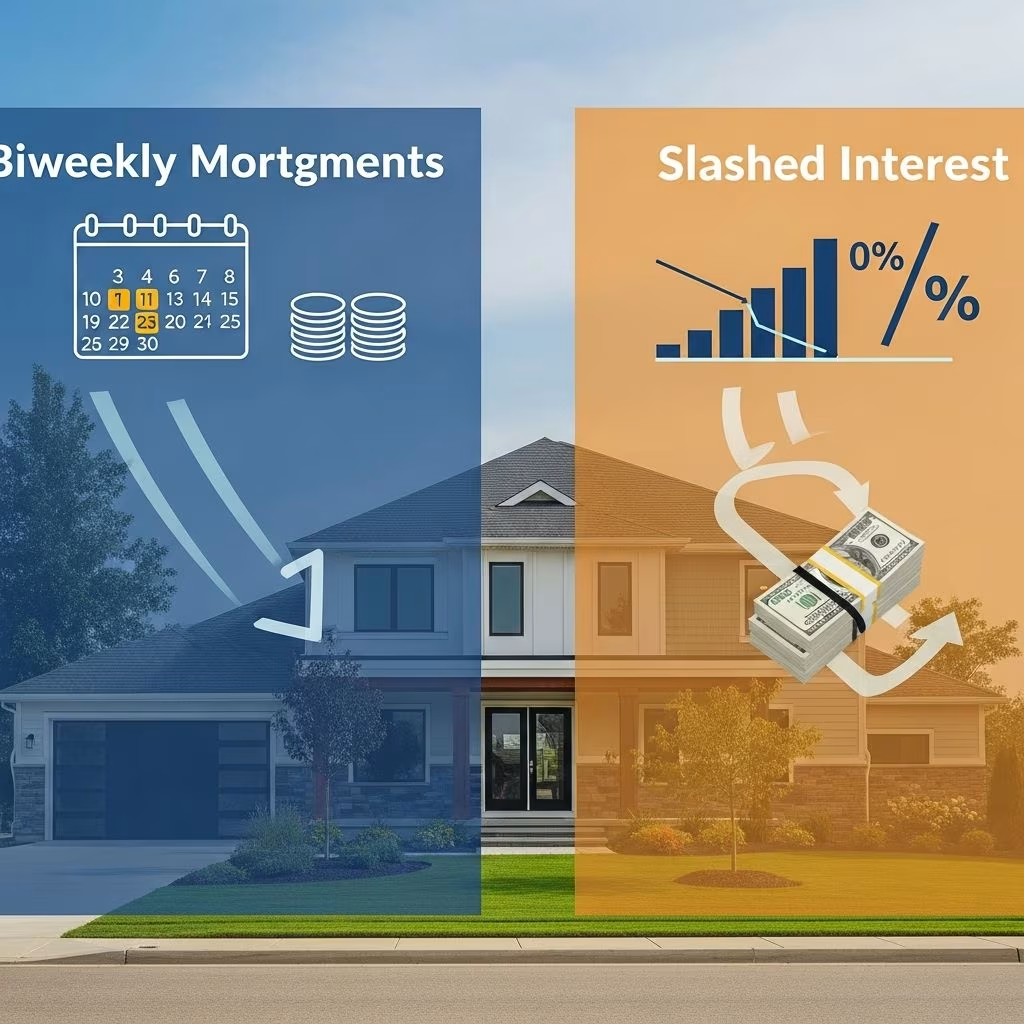
Switching your mortgage payment schedule to biweekly can dramatically reduce the total interest you pay and shorten your loan term without increasing your monthly budget. By making half your monthly payment every two weeks, you effectively make 13 full payments per year instead of 12, applying extra funds to the principal early on.Biweekly payments leverage the calendar’s 52 weeks to create this acceleration naturally.
Understanding Mortgage Payment Schedules
Mortgages offer several payment frequencies, each affecting how quickly you build equity and how much interest accrues. The standard is monthly, but more frequent options like semi-monthly, biweekly, and weekly provide opportunities to pay down the balance faster. Frequent payments mean less time for interest to compound on a higher principal.
Key frequencies include:
- Monthly: One payment per month, totaling 12 annually. Simple but slower principal reduction.
- Semi-monthly: Half monthly payment twice a month, totaling 24 payments yearly. Aligns with some pay cycles but doesn’t add extra principal like biweekly.
- Biweekly: Half monthly payment every two weeks, resulting in 26 payments or 13 full monthly equivalents per year.
- Biweekly Accelerated: Same as biweekly but structured to ensure one extra full payment annually goes directly to principal.
- Weekly/Weekly Accelerated: Even more frequent, ideal for weekly paychecks, further minimizing interest accrual.
Among these, biweekly payments strike a balance of convenience and savings, syncing well with most biweekly payrolls.
How Biweekly Payments Accelerate Your Mortgage Payoff
A biweekly schedule works because there are 52 weeks in a year, making 26 biweekly periods. Paying half your monthly amount each time equals one extra full payment annually. This surplus reduces the principal sooner, lowering future interest calculations since mortgages are amortized with interest front-loaded.
For instance, on a $1,200 monthly payment:
- Monthly: 12 x $1,200 = $14,400/year.
- Biweekly: 26 x $600 = $15,600/year (equivalent to 13 months).
This extra $1,200 goes straight to principal, creating a snowball effect. Over time, it shortens the loan term and cuts total interest.
Real-World Savings: Examples and Comparisons
Consider a $300,000 mortgage at 6% interest over 30 years. Monthly payments are about $1,799. Switching to biweekly ($899.50 every two weeks):
| Payment Type | Monthly Equivalent | Term (Years) | Total Interest Paid | Savings |
|---|---|---|---|---|
| Monthly | $1,799 | 30 | $347,500 | – |
| Biweekly | $899.50 biweekly | 25.5 | $264,000 | $83,500 + 4.5 years |
Data adapted from amortization models; actual savings vary by loan details. On larger loans or higher rates, savings amplify—potentially tens of thousands more.
Another example: $400,000 loan at 5.5%, biweekly accelerated pays off in 21.5 years vs. 30, saving $90,000+ in interest.
Benefits Beyond Interest Savings
- Faster Equity Build: Extra principal payments increase home equity quicker, useful for refinancing or selling.
- Budget Alignment: Matches biweekly paychecks, avoiding cash flow strain.
- Discipline Boost: Forces consistent payments, reducing temptation to spend elsewhere.
- Flexibility: Many lenders allow switching without refinancing fees.
Potential Drawbacks and Considerations
Not all plans are ideal. Confirm your lender applies extra payments to principal, not future installments. Some fees may apply for schedule changes. Biweekly isn’t always “accelerated”—ensure it’s the version adding the 13th payment.
If paid via autopay, align dates carefully to avoid double payments in short months. Budget for the effective higher annual outlay.
Steps to Switch to Biweekly Payments
- Contact Lender: Request a biweekly schedule; provide bank details for autopay.
- Calculate Payments: Divide monthly by 2; use online calculators for projections.
- Set Up Autopay: Ensures consistency and may qualify for discounts.
- Monitor Statements: Verify principal reduction each cycle.
- Adjust as Needed: Recast or refinance if rates drop significantly.
Comparing Payment Frequencies Side-by-Side
| Frequency | Payments/Year | Extra Principal/Year | Typical Savings |
|---|---|---|---|
| Monthly | 12 | None | Baseline |
| Semi-Monthly | 24 | Minimal | Low |
| Biweekly | 26 | 1 month | High |
| Weekly | 52 | ~1 month | High |
| Biweekly Accelerated | 26 | 1+ months | Highest |
Biweekly often wins for most homeowners due to payroll sync and substantial savings.
Frequently Asked Questions (FAQs)
Is biweekly better than monthly mortgage payments?
Yes, for most— it shortens the term and saves interest by adding an extra payment yearly without raising per-paycheck costs.
Can I switch my mortgage to biweekly anytime?
Usually yes, contact your servicer. No refinance needed, but confirm terms.
Does biweekly work with all lenders?
Most do, especially big banks and credit unions. Check your loan docs.
What if I’m paid monthly—should I still go biweekly?
Absolutely; save the ‘extra’ in a separate account if needed, then pay consistently.
How much can I save with biweekly payments?
Depends on loan size/rate: typically 20-30% less interest and 4-8 years shaved off.
Tools and Calculators for Your Situation
Use free biweekly vs. monthly calculators from reputable sites to input your loan details and see personalized projections. Factor in current rates and remaining balance for accuracy.[10]
Pro tip: Run scenarios with slight overpayments to maximize results.
References
- Mortgage Payment Frequency | Monthly vs Weekly vs Biweekly — nesto.ca. 2023. https://www.nesto.ca/mortgage-basics/mortgage-payment-frequency/
- Biweekly vs. Monthly Mortgage Payments: What’s Better — Chase Bank. 2024-02-15. https://www.chase.com/personal/mortgage/education/financing-a-home/monthly-vs-biweekly-mortgage-payments
- Payment Frequency, Explained — True North Mortgage. 2023-11-10. https://www.truenorthmortgage.ca/blog/mortgage-payment-frequency
- Biweekly mortgage payment calculator — Bankrate. 2025-01-20. https://www.bankrate.com/mortgages/bi-weekly-mortgage-calculator/
- Biweekly vs. monthly mortgage payments — Rocket Mortgage. 2024-05-05. https://www.rocketmortgage.com/learn/biweekly-vs-monthly-mortgage-payments
- Compare a Bi-Weekly Mortgage to a Monthly Mortgage — ANB Bank. 2023. https://www.anbbank.com/mortgage-financial-calculators/compare-a-bi-weekly-mortgage-to-a-monthly-mortgage
This article is general information, not personal financial advice. Consider your own situation, or speak with a licensed adviser, before acting on it.


