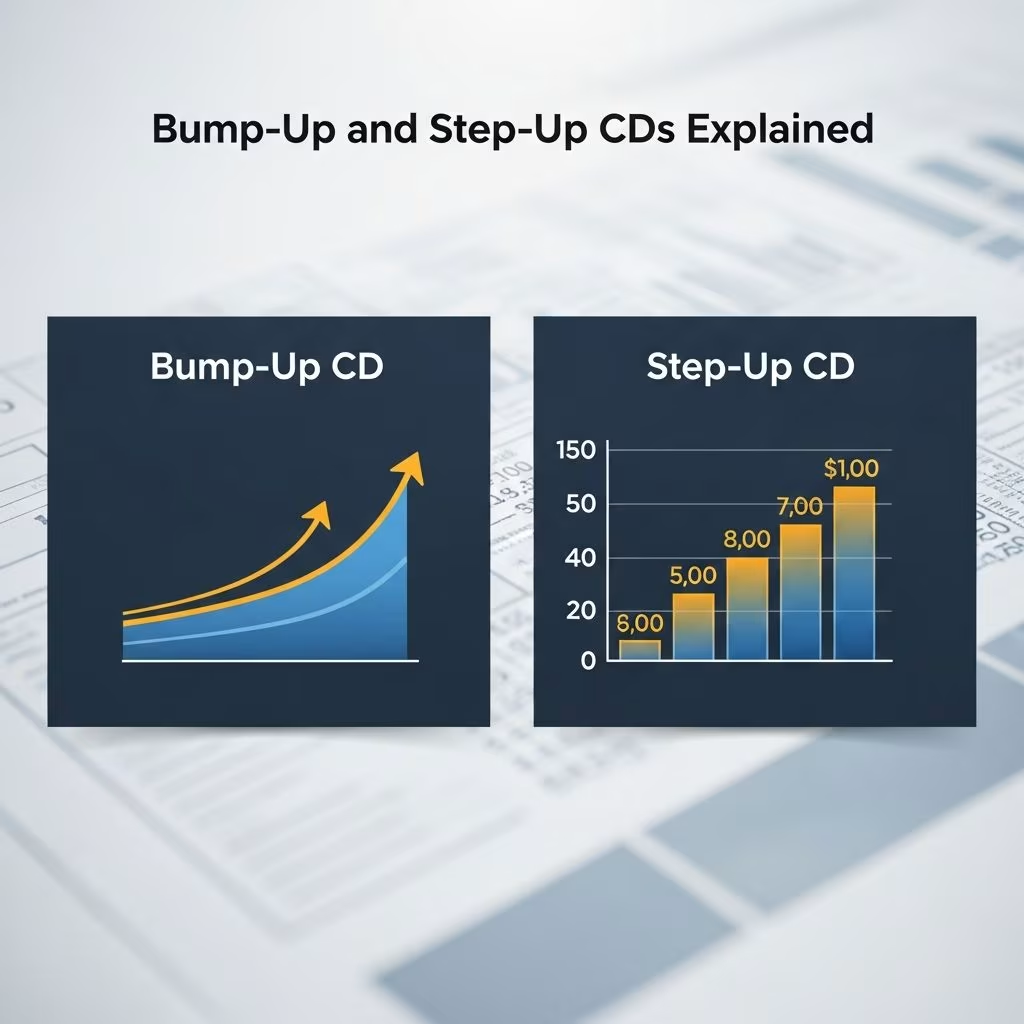
In an era of fluctuating interest rates, traditional certificates of deposit (CDs) can leave savers locked into suboptimal returns if rates climb after opening an account. Bump-up and step-up CDs offer innovative solutions by incorporating mechanisms to capture higher yields without sacrificing the safety of FDIC insurance. These specialized products allow for rate adjustments during the term, providing a hedge against rising rates while maintaining principal protection.
Understanding Certificates of Deposit Fundamentals
Before diving into advanced variants, it’s essential to grasp the basics of CDs. A certificate of deposit is a time-bound savings vehicle issued by banks and credit unions, where you deposit a lump sum for a fixed period in exchange for a guaranteed interest rate. Terms range from a few months to several years, and early withdrawals typically incur penalties. The appeal lies in higher yields compared to regular savings accounts and federal insurance up to $250,000 per depositor per institution.
Standard CDs lock in a single rate from inception to maturity, which works well in falling rate environments but exposes savers to opportunity costs when rates rise. This is where bump-up and step-up CDs shine, introducing flexibility to adapt to market changes.
Demystifying Bump-Up CDs: Flexibility at Your Fingertips
A bump-up CD empowers you to request an interest rate increase—typically once— if the issuing institution raises rates on comparable products during your term. This feature is particularly valuable in ascending rate cycles, allowing you to capture better returns without closing and reopening the account.
These CDs usually start with slightly lower initial annual percentage yields (APYs) than traditional counterparts—often 0.10% to 0.25% less—to compensate for the embedded option. Terms are commonly 2 to 3 years, though longer options exist with potential for multiple bumps.
How Bump-Up CDs Operate in Practice
To initiate, deposit the minimum required amount (often $1,000 or more) and select a term. Monitor the financial institution’s advertised rates for similar bump-up CDs. If they increase, contact the bank to request the bump, which applies prospectively to the remaining balance and term—no retroactive credit for prior periods.
Restrictions vary: most permit one adjustment, but some longer-term products allow more, potentially extending the maturity with each bump. Always review the disclosure for specifics, as the new rate matches the current offering for that CD type, not necessarily the highest market rate.
Real-World Example of a Bump-Up CD
Suppose you open a 24-month bump-up CD with a $10,000 deposit at 4.25% APY. Six months in, rates rise, and the bank now offers 5.00% on new bump-up CDs of the same term. You request the increase, earning 5.00% on the remaining 18 months. Without the bump, you’d miss out on approximately $135 in additional interest (compounded monthly).
| Scenario | Initial 6 Months Interest | Remaining 18 Months Interest | Total Earnings |
|---|---|---|---|
| No Bump (4.25% throughout) | $212 | $642 | $854 |
| With Bump to 5.00% | $212 | $750 | $962 |
This table illustrates the potential gain, assuming monthly compounding.
Step-Up CDs: Automatic Progression for Passive Savers
Unlike their bump-up counterparts, step-up CDs feature predetermined rate increases at fixed intervals, such as every 6 or 12 months, regardless of market conditions. The bank outlines the schedule upfront, with each step boosting the APY automatically—no action required from you.
Initial rates are often the lowest among CD types, reflecting the guaranteed hikes. This predictability appeals to conservative investors who prefer set-it-and-forget-it simplicity over monitoring markets.
Mechanics of Step-Up Rate Schedules
A typical 30-month step-up CD might start at 3.50% for the first year, rise to 4.00% in year two, and end at 4.50% in the final period. The blended APY reflects these tiers, but your effective yield improves over time. Early withdrawal penalties apply as with standard CDs.
Example Step-Up CD Yield Progression
| Period | APY | Months | Cumulative Interest on $10,000 |
|---|---|---|---|
| 0-12 | 3.50% | 12 | $350 |
| 13-24 | 4.00% | 12 | $700 |
| 25-30 | 4.50% | 6 | $1,125 |
Total: About 4.25% blended APY, providing steady growth.
Key Differences: Bump-Up vs. Step-Up CDs Side-by-Side
| Feature | Bump-Up CD | Step-Up CD |
|---|---|---|
| Rate Adjustment | Manual request (1+ times) | Automatic at set intervals |
| Initial APY | Moderate (e.g., 4.25% for 2-yr) | Lower (e.g., 4.00% for 2-yr) |
| Dependency on Market | High—tracks bank rates | Low—predefined schedule |
| Investor Effort | Monitor and act | Passive |
| Best For | Rising rate expectations | Rate uncertainty |
Pros and Cons of These Adjustable CDs
Advantages
- Rate Protection: Safeguard against missing higher yields in rising markets.
- Safety: FDIC-insured up to limits, with fixed principal.
- Flexibility: Better than rigid traditional CDs; laddering enhances liquidity.
- No Downside Risk: Rates don’t decrease automatically.
Potential Drawbacks
- Lower starting rates reduce early earnings.
- Limited bumps may not capture all rises.
- Longer terms tie up funds amid inflation.
- Institution-specific rules add complexity.
Laddering—splitting deposits across staggered maturities—mitigates illiquidity, applicable to both types.
When to Choose Bump-Up or Step-Up CDs
Opt for bump-up CDs if you anticipate sharp rate hikes and are willing to track offerings; they’re ideal for active savers in bullish rate forecasts. Step-up CDs suit passive investors prioritizing guaranteed progression amid volatility. Compare current yields via bank sites or aggregators, considering your timeline, risk tolerance, and liquidity needs.
In 2023-2025 rising rate periods, these products outperformed standards, per industry data, but always verify today’s environment.
Strategies to Maximize Returns
- Ladder multiple CDs with varying terms for regular access.
- Shop institutions: Online banks often lead yields.
- Combine with high-yield savings for short-term needs.
- Reinvest at maturity into new adjustable CDs.
Frequently Asked Questions
What is the minimum deposit for bump-up or step-up CDs?
Typically $1,000-$25,000, varying by bank.
Are they FDIC-insured?
Yes, like standard CDs, up to $250,000.
Can I bump up multiple times?
Usually once; longer terms may allow more.
Do rate bumps apply retroactively?
No, only to future periods.
How do they compare to brokered CDs?
Similar safety, but brokered offer secondary markets for liquidity.
Final Thoughts on Incorporating Adjustable CDs
Bump-up and step-up CDs bridge the gap between fixed-rate security and adaptive earning potential, making them astute choices for diversified savings portfolios. By understanding their mechanics and aligning with market outlooks, savers can enhance yields without undue risk. Consult your financial advisor to integrate them effectively.
References
- What Is a Bump-Up Certificate of Deposit? — SoFi. 2023. https://www.sofi.com/learn/content/what-is-a-bump-up-certificate-of-deposit/
- Bump-Up CDs: What They Are And How They Work — Bankrate. 2024-01-15. https://www.bankrate.com/banking/cds/bump-up-cd/
- What is a Bump Up Certificate of Deposit? — Seattle Bank. 2022-08-04. https://www.seattlebank.com/about/updates/updates-detail.html?title=what-is-a-bump-up-certificate-of-deposit
- What Is a Bump-Up CD? How It Works, Benefits & Examples — Synchrony Bank. 2023. https://www.synchrony.com/blog/bank/how-bump-up-cds-work
- What’s a Bump-Up CD? How It Works and Its Benefits — Gainbridge. 2024. https://gainbridge.com/post/bump-up-cd
This article is general information, not personal financial advice. Consider your own situation, or speak with a licensed adviser, before acting on it.