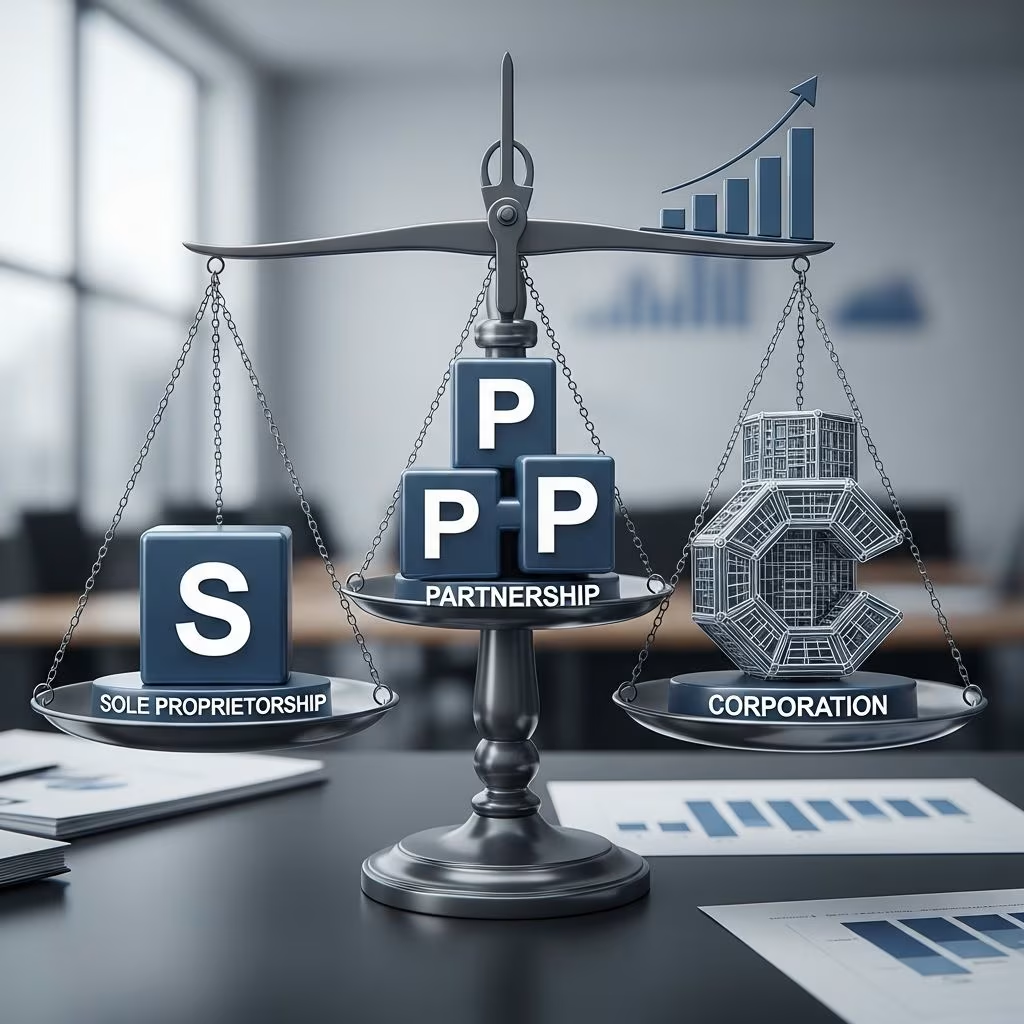
Choosing the right business structure is a foundational decision that influences liability, taxation, management, and long-term viability. Sole proprietorships offer simplicity for solo entrepreneurs, partnerships enable collaborative efforts with shared resources, and corporations provide robust protection for scaling operations. This guide breaks down each option’s core features, advantages, drawbacks, and strategic considerations to help you align your choice with business objectives.
Understanding Sole Proprietorships: The Simplest Entry Point
A sole proprietorship represents the most straightforward way to launch a business, where a single individual owns and operates the enterprise without forming a separate legal entity. The owner handles all aspects of the business personally, blending personal and business finances for tax purposes.
Formation requires minimal effort—often just obtaining local licenses or permits. No state registration or formal agreements are needed, making it ideal for freelancers, consultants, or small retail operations. All profits and losses flow directly to the owner’s personal income tax return via Schedule C, avoiding separate business filings.
Key Advantages of Sole Proprietorships
- Effortless Setup: Launch quickly with low or no startup costs beyond basic permits.
- Full Control: The owner makes all decisions without partner or shareholder input.
- Tax Simplicity: Pass-through taxation means business income is reported on personal returns, potentially qualifying for deductions like home office expenses.
- Fewer Regulations: Minimal compliance compared to structured entities.
Significant Drawbacks and Risks
- Unlimited Liability: Personal assets, including home and savings, are at risk for business debts or lawsuits.
- Funding Challenges: Limited to personal savings or loans; banks hesitate without collateral diversification.
- Impermanence: The business ends with the owner’s death or incapacity.
For low-risk ventures like service-based work, this structure shines due to its agility. However, high-liability industries demand caution.
Partnerships: Collaborating with Shared Ownership
Partnerships involve two or more people pooling resources, skills, and capital to run a business. They function as pass-through entities, with income distributed according to ownership shares and taxed on partners’ personal returns. Partnerships fall into general and limited types, each balancing involvement and protection differently.
General partnerships arise informally, sometimes via verbal agreement, though a written partnership agreement is advisable to outline profit splits, roles, and exit terms. Limited partnerships require state filing and feature general partners (full liability, management) and limited partners (liability capped at investment, passive role).
Benefits That Drive Partnership Formation
- Enhanced Capital Access: Multiple contributors increase borrowing power and investor appeal.
- Diverse Expertise: Combined skills foster innovation and problem-solving.
- Low Barriers: Simpler paperwork than corporations, with pass-through taxes avoiding double taxation.
- Flexibility: Customizable via agreements for management and profit distribution.
Challenges in Partnership Dynamics
- Joint Liability: In general partnerships, each partner is fully responsible for all debts and actions, even those of others.
- Conflict Potential: Disagreements can halt operations without clear dispute resolution.
- Profit Dilution: Earnings split reduces individual take-home compared to solo ventures.
Partnerships suit complementary teams, like a tech-savvy developer and business marketer, but demand strong communication to mitigate interpersonal risks.
Corporations: Building for Scale and Protection
Corporations are distinct legal entities separate from owners (shareholders), capable of owning assets, incurring debts, and entering contracts independently. This separation shields personal assets, making it the go-to for growth-oriented businesses. Subtypes include C Corporations (standard, double-taxed) and S Corporations (pass-through, with restrictions).
Incorporation involves filing articles with the state, drafting bylaws, issuing stock, and ongoing compliance like annual reports. C Corps face corporate-level taxes plus shareholder dividends tax; S Corps pass income through but limit shareholders to 100 U.S. citizens/residents.
Why Corporations Excel in Expansion
- Limited Liability: Shareholders risk only their investment, not personal wealth.
- Perpetual Existence: Survives ownership changes, ideal for long-term planning.
- Capital Raising: Stock issuance attracts investors and enables public offerings.
- Tax Strategies: S Corps offer pass-through benefits; C Corps allow retained earnings at lower rates.
Trade-Offs of Corporate Structure
- Complexity and Costs: High setup fees, legal needs, and annual filings.
- Double Taxation (C Corp): Profits taxed at corporate and personal levels.
- Regulatory Burden: Strict governance via boards and meetings.
Corporations power large enterprises but may overwhelm startups unless scaling is imminent.
Side-by-Side Comparison: Key Metrics at a Glance
| Feature | Sole Proprietorship | Partnership | Corporation |
|---|---|---|---|
| Ownership | One person | 2+ people | Shareholders |
| Liability | Unlimited personal | Unlimited (general); limited for LPs | Limited to investment |
| Taxation | Pass-through (personal) | Pass-through (personal) | Corporate + personal (C); pass-through (S) |
| Setup Ease | Very easy | Easy (general); moderate (limited) | Complex |
| Capital Access | Limited | Moderate | High |
| Continuity | Tied to owner | Tied to partners | Perpetual |
This table highlights how choices shift with business stage: simplicity for startups, collaboration for teams, protection for investors.
Factors to Consider When Selecting Your Structure
Align structure with risk tolerance, growth plans, and partner dynamics. Low-risk, solo operations favor proprietorships. Teams with aligned visions benefit from partnerships. Ambitious ventures eyeing investment need corporations. Consult IRS guidelines and legal experts; state laws vary.
Transitioning structures (e.g., proprietorship to LLC or corp) is possible but involves tax implications and filings. Revisit periodically as business evolves.
Frequently Asked Questions (FAQs)
Can a sole proprietorship convert to a corporation?
Yes, by filing incorporation documents, but expect tax adjustments and asset transfers. Professional advice prevents pitfalls.
Do partnerships require a written agreement?
Not legally for general partnerships, but strongly recommended to define terms and avoid disputes.
What are S Corp eligibility rules?
Up to 100 U.S. shareholders, one stock class, not ineligible entities. File IRS Form 2553.
How does liability differ in limited partnerships?
Limited partners risk only investments; general partners face full exposure.
Are there tax perks for corporations?
C Corps deduct benefits like health insurance; S Corps pass losses to offset personal income.
Strategic Insights for Long-Term Success
Beyond basics, consider credit building: Corporations often secure better terms due to entity status. Experian notes business credit separates from personal, aiding growth. For global ops, corporations ease international compliance. Ultimately, the best structure minimizes risks while maximizing opportunities—review annually.
References
- Sole Proprietorships — Internal Revenue Service. 2024-01-15. https://www.irs.gov/businesses/small-businesses-self-employed/sole-proprietorships
- Partnerships — Internal Revenue Service. 2024-03-10. https://www.irs.gov/businesses/small-businesses-self-employed/partnerships
- Business Structures — U.S. Small Business Administration. 2025-02-20. https://www.sba.gov/business-guide/launch-your-business/choose-business-structure
- Types of Partnerships — UpCounsel Legal Resources. 2024-11-05. https://www.upcounsel.com/difference-between-sole-proprietorship-and-partnership
- Corporations — Experian Business Blog. 2025-01-12. https://www.experian.com/blogs/ask-experian/differences-between-corporation-sole-proprietorship-partnership/
- S Corporations — Internal Revenue Service. 2024-12-01. https://www.irs.gov/businesses/small-businesses-self-employed/s-corporations
This article is general information, not personal financial advice. Consider your own situation, or speak with a licensed adviser, before acting on it.