

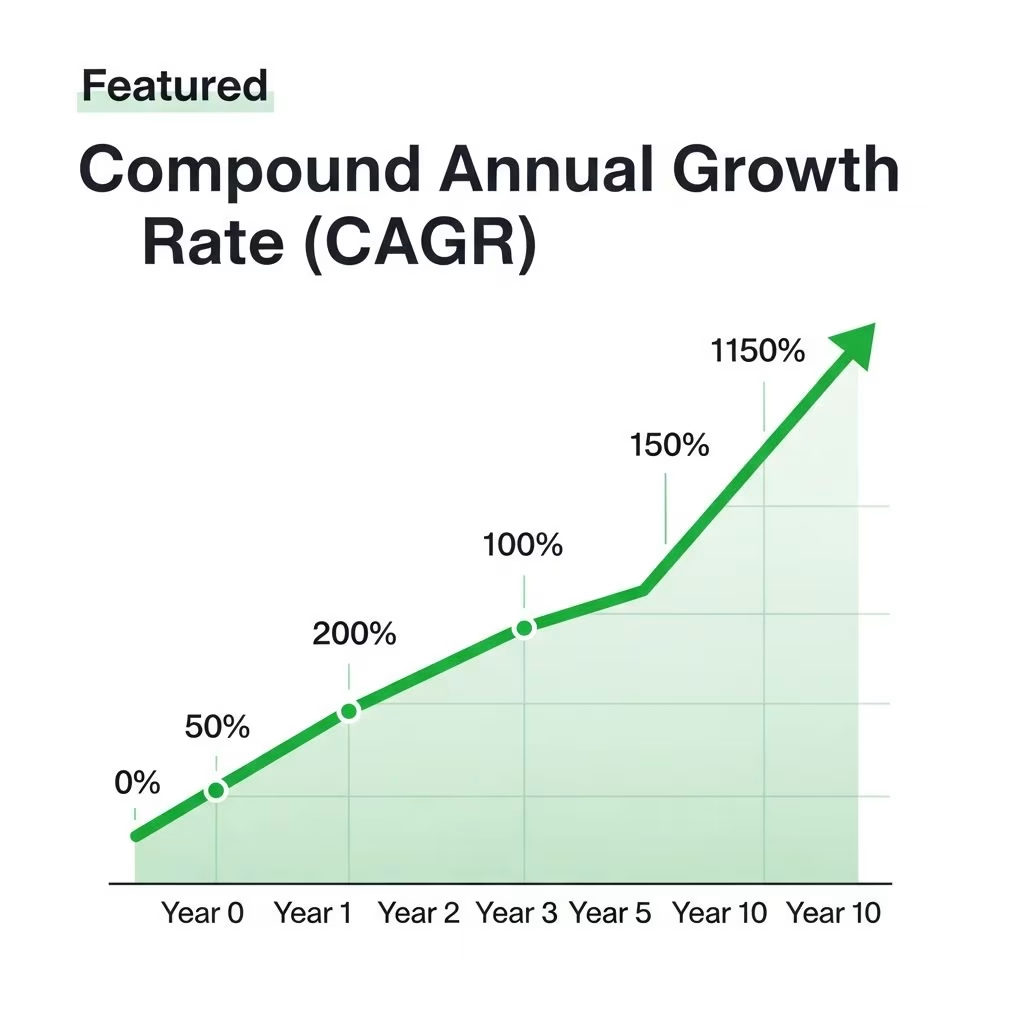
What is CAGR (Compound Annual Growth Rate)?
CAGR, which stands for Compound Annual Growth Rate, is a financial metric that measures the rate at which an investment grows over a specific period, typically multiple years. Unlike simple growth calculations that ignore the compounding effect, CAGR accounts for the reinvestment of profits at the end of each year, providing a more accurate representation of investment performance. It represents the mean annual growth rate of an investment over a specified time period, assuming that profits are reinvested each year.
This metric is particularly useful for investors who want to understand how their investments have performed over time in a way that smooths out volatility and provides a single, standardized rate of growth. Whether you’re evaluating mutual funds, stocks, real estate, or business revenue, CAGR offers a comprehensive view of long-term performance.
Understanding CAGR: The Basics
CAGR eliminates the noise created by periodic fluctuations in returns and provides a smooth growth trajectory. Imagine an investment that grows 50% one year, then declines 20% the next year. The simple average return would be 15%, but CAGR accounts for compounding and provides a more accurate picture of actual growth. This is why CAGR is often preferred by financial analysts and investors when comparing different investment vehicles.
As the famous quote attributed to Albert Einstein suggests, “Compound interest is the eighth wonder of the world. He who understands it, earns it; he who doesn’t, pays it.” CAGR captures this principle by showing how money grows when returns are reinvested over multiple periods.
The CAGR Formula
The formula for calculating CAGR is straightforward and can be expressed as follows:
CAGR = (Ending Value / Beginning Value)^(1/Number of Years) – 1
Where:
- Ending Value: The final value of the investment at the end of the period
- Beginning Value: The initial value of the investment at the start of the period
- Number of Years: The total number of years over which the investment grew
This formula can also be expressed as:
CAGR = (V_final / V_begin)^(1/t) – 1
Where V_final is the final value, V_begin is the beginning value, and t is the time in years. The exponent (1/t) is crucial as it “normalizes” the overall growth into an annual figure, regardless of the length of the investment period.
What Does CAGR Tell You?
CAGR is essentially a number that describes the rate at which an investment would have grown if it had expanded at the same rate every year and profits were reinvested at the end of each year. It smooths out the volatility of returns and provides investors with a clear understanding of how their investment has performed on an annualized basis.
For instance, if you invested $1,000 in a mutual fund and it grew to $2,000 over 10 years, the simple return would be 100%. However, CAGR would reveal that the fund grew at approximately 7.2% annually. This distinction is important because it helps investors understand the actual year-over-year growth rate, which is more meaningful when comparing different investment options or time periods.
CAGR is particularly valuable for:
- Comparing investment performance across different assets and time periods
- Evaluating mutual fund and hedge fund performance
- Assessing business revenue growth and company performance
- Analyzing real estate appreciation over time
- Making informed investment decisions based on historical performance
How to Calculate CAGR: Step-by-Step Example
Let’s work through a practical example to understand CAGR calculation better. Suppose a company’s sales grew as follows:
| Year | Sales (in rupees) |
|---|---|
| Year 1 | 1,000 |
| Year 2 | 1,100 |
| Year 3 | 1,200 |
| Year 4 | 1,350 |
| Year 5 | 1,500 |
| Year 6 | 1,650 |
| Year 7 | 1,750 |
| Year 8 | 1,800 |
Using the CAGR formula:
CAGR = (1,800 / 1,000)^(1/7) – 1
CAGR = (1.8)^(0.142857) – 1
CAGR ≈ 0.0762 or 7.62%
Note that we use 7 years rather than 8 because the first year is the starting point, and we measure growth from Year 1 to Year 8. This means the company’s sales grew at an average annual rate of approximately 7.62% over the 7-year period.
CAGR vs. Other Growth Metrics
While CAGR is a powerful metric, it’s important to understand how it differs from other growth measurements:
| Metric | Description | When to Use |
|---|---|---|
| CAGR | Annualized growth rate accounting for compounding | Long-term investment analysis, historical performance comparison |
| Simple Average Return | Average of all yearly returns without compounding | Quick estimate, individual year analysis |
| Total Return | Overall percentage gain or loss over entire period | Overall profit/loss assessment |
| Absolute Return | Dollar amount gained or lost | Understanding actual cash gains |
Advantages of Using CAGR
CAGR offers several significant advantages to investors and analysts:
- Simplicity: It reduces complex growth patterns into a single, easy-to-understand percentage
- Comparability: Allows fair comparison of investments with different time horizons and starting values
- Accounts for Compounding: Recognizes the power of reinvested returns
- Standardization: Provides a consistent metric across different asset classes
- Decision Making: Helps investors evaluate whether an investment meets their return objectives
Limitations of CAGR
While CAGR is valuable, it has certain limitations that investors should be aware of:
- Ignores Volatility: CAGR doesn’t reflect the year-to-year fluctuations or risk involved in achieving that return
- Past Performance: Historical CAGR doesn’t guarantee future results
- Sensitive to Time Period: Changing the start or end dates can significantly alter the CAGR
- Assumes Reinvestment: CAGR assumes profits are reinvested, which may not always be the case
- Not Suitable for Short Periods: CAGR is most meaningful for investments held over multiple years
Practical Applications of CAGR
Investment Evaluation
Investors use CAGR to evaluate mutual funds, stocks, and bonds. By comparing the CAGR of different funds over the same time period, investors can determine which fund has delivered the best risk-adjusted returns and whether it meets their investment objectives.
Business Analysis
Companies use CAGR to analyze their revenue growth, earnings growth, and market expansion. This helps stakeholders understand business momentum and make strategic decisions about expansion, investment, and resource allocation.
Real Estate Investment
Property investors use CAGR to evaluate property appreciation over time. This helps them understand whether a real estate investment has met their return expectations.
Personal Finance Planning
Individuals can use CAGR to track the performance of their investment portfolios over time, helping them assess whether they’re on track to achieve their financial goals.
Common Misconceptions About CAGR
Misconception 1: CAGR is the same as annual return. Reality: CAGR is an annualized rate that smooths volatility, while annual returns show actual year-to-year performance.
Misconception 2: High CAGR always means a good investment. Reality: High CAGR might come with high volatility and risk, so investors should evaluate risk alongside returns.
Misconception 3: CAGR predicts future performance. Reality: CAGR is historical and doesn’t guarantee future results.
Frequently Asked Questions About CAGR
Q: Is CAGR the same as the annual percentage rate (APR)?
A: No. CAGR is the annualized growth rate of an investment accounting for compounding, while APR is the interest rate charged annually without compounding effects.
Q: Can CAGR be negative?
A: Yes. If an investment’s ending value is less than its beginning value, the CAGR will be negative, indicating a loss over the period.
Q: What is a good CAGR for stocks?
A: Historical market data suggests that the stock market has delivered an average CAGR of approximately 10% annually over the long term, though individual stocks and sectors vary considerably.
Q: Why is the time period important in CAGR calculation?
A: The time period significantly affects the CAGR because the compounding effect changes with different durations. Shorter periods may show higher volatility, while longer periods tend to smooth out market fluctuations.
Q: How do I use CAGR to compare different investments?
A: Calculate the CAGR for each investment over the same time period, then compare the percentages. Higher CAGR indicates better growth, but always consider risk and other factors alongside the return metric.
Q: Does CAGR account for taxes and fees?
A: Standard CAGR calculations don’t account for taxes and fees unless you adjust the ending value to reflect their impact. Some investors calculate after-tax CAGR to get a more accurate picture of net returns.
Conclusion
CAGR is an essential financial metric that provides investors, analysts, and business leaders with a standardized way to measure and compare growth over time. By accounting for compounding and smoothing out volatility, CAGR offers a clearer picture of investment performance than simple return calculations. While it has limitations and shouldn’t be the only metric used in investment decisions, understanding and properly calculating CAGR is fundamental to sound financial analysis. Whether you’re evaluating a mutual fund, analyzing business growth, or tracking your investment portfolio, CAGR remains one of the most valuable tools in your financial toolkit.
References
- Compound Annual Growth Rate (CAGR) — Investopedia. https://www.investopedia.com/terms/c/cagr.asp
- Understanding Investment Performance Metrics — U.S. Securities and Exchange Commission (SEC). https://www.sec.gov
- The Investor’s Guide to Financial Metrics — CFA Institute. https://www.cfainstitute.org
This article is general information, not personal financial advice. Consider your own situation, or speak with a licensed adviser, before acting on it.


