

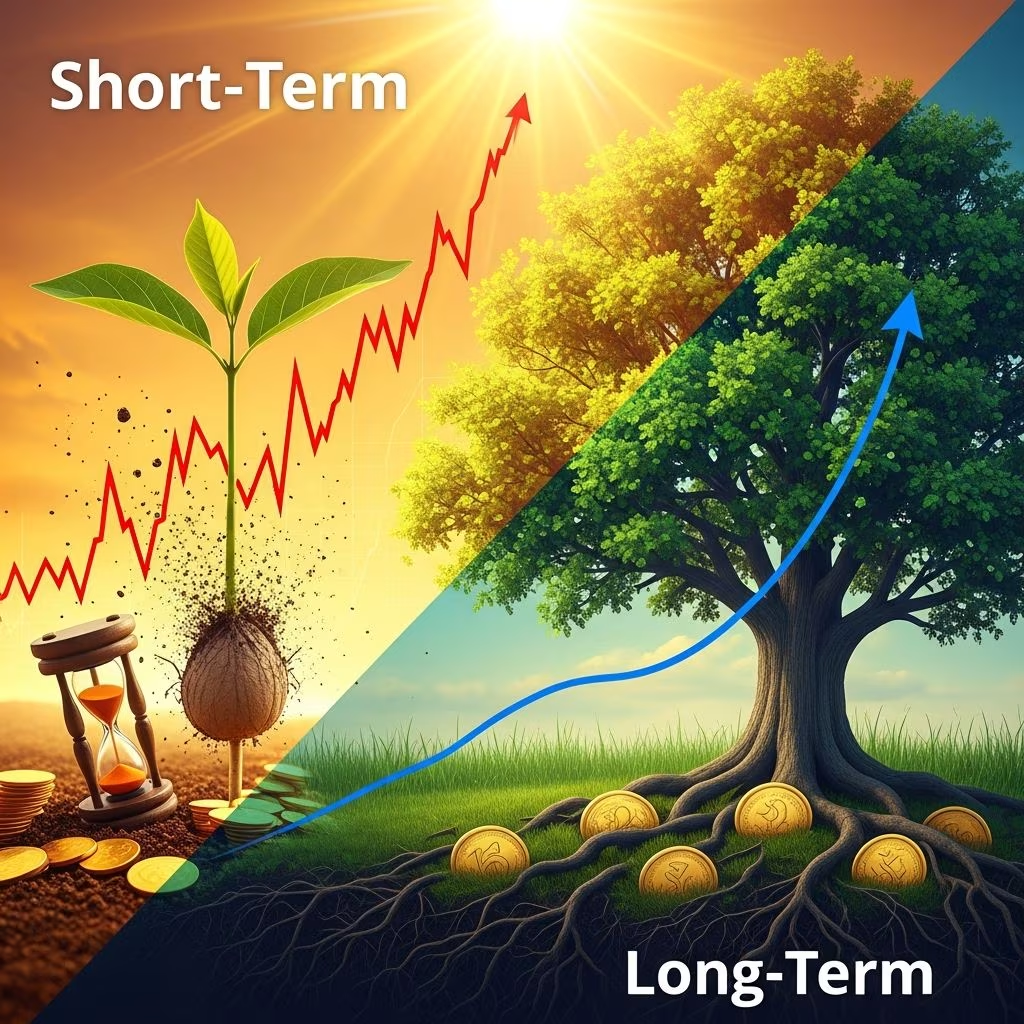
Capital gains taxes apply to profits from selling assets like stocks, bonds, or real estate, with rates depending on holding duration. Short-term gains, from assets held one year or less, face ordinary income tax rates up to 37%, while long-term gains, held over one year, enjoy preferential rates of 0%, 15%, or 20% based on income.
Defining Capital Gains and Holding Periods
A capital gain occurs when an asset’s sale price exceeds its purchase price, known as the basis. The holding period starts the day after acquisition and ends on the sale date. Assets held 12 months or less yield short-term gains taxed as ordinary income; over 12 months qualify as long-term, eligible for lower rates to incentivize sustained investment.
- Short-term: ≤1 year, ordinary rates (10%-37%).
- Long-term: >1 year, 0%/15%/20% rates.
This distinction profoundly impacts net returns, as long-term holding often halves effective tax burdens for many filers.
Tax Rates for Short-Term Capital Gains
Short-term gains integrate into taxable income, applying progressive federal brackets. For 2026, rates span 10% to 37%, mirroring wage taxation without a zero bracket, ensuring even modest earners pay on gains.
| Taxable Income Range (Single) | Rate |
|---|---|
| $0 – $11,925 | 10% |
| $11,926 – $48,475 | 12% |
| $48,476 – $103,350 | 22% |
| $103,351 – $197,300 | 24% |
| $197,301 – $250,525 | 32% |
| $250,526 – $626,350 | 35% |
| $626,351+ | 37% |
Married filing jointly thresholds roughly double. High earners face steep rates; a $50,000 gain for someone in the 37% bracket incurs $18,500 tax.
Preferential Rates for Long-Term Capital Gains
Long-term gains benefit from three tiers: 0% for low incomes, 15% for middle, 20% for high earners, plus potential 3.8% Net Investment Income Tax (NIIT) above income thresholds.
2026 Long-Term Capital Gains Brackets
| Filing Status | 0% Threshold | 15% Threshold | 20% Starts |
|---|---|---|---|
| Single | $0 – $47,025 | $47,026 – $518,900 | $518,901+ |
| Married Joint | $0 – $94,050 | $94,051 – $583,750 | $583,751+ |
| Head of Household | $0 – $63,000 | $63,001 – $551,350 | $551,351+ |
Most taxpayers qualify for 0% or 15%. Example: Married couple with $80,000 income pays 0% on long-term gains up to $94,050 total income.
Real-World Examples: Tax Impact Comparison
Consider a $20,000 gain in 2026.
- Single filer, $100,000 income: Short-term at 24% = $4,800 tax; long-term at 15% = $3,000 (saves $1,800).
- Married joint, $500,000 income: Short-term 32% = $6,400; long-term 15% = $3,000 (saves $3,400).
At $600,000 income, long-term hits 20% ($4,000), still below short-term 35% ($7,000). Savings amplify with larger gains.
Special Cases and Exceptions
Not all long-term gains follow standard rates:
- Collectibles (art, coins): 28% max.
- Qualified small business stock (Section 1202): Up to 28%.
- Unrecaptured Section 1250 real estate depreciation: 25%.
NIIT adds 3.8% for modified AGI over $200,000 single/$250,000 joint on investment income, including gains.
Offsetting Gains with Losses
Capital losses offset gains: short-term losses first against short-term gains, long-term against long-term, then cross. Net losses deduct up to $3,000 annually against ordinary income; excess carries forward.
Strategy: Harvest losses in down years to shelter future gains, prioritizing long-term losses for maximum offset value.
State-Level Taxation
Federal rules dominate, but 41 states tax capital gains as ordinary income, rates 0%-13.3%. Seven states (Alaska, Florida, etc.) have no income tax. Plan sales considering state residency.
Strategies to Minimize Capital Gains Taxes
Optimize via:
- Hold >1 year: Access lower rates.
- Tax-loss harvesting: Sell losers to offset winners.
- 0% bracket planning: Realize gains in low-income years (retirement, etc.).
- Retirement accounts: Tax-deferred growth in 401(k)s/IRAs avoids immediate taxes.
- Opportunity Zones/1031 exchanges: Deferral for real estate.
- Gifting/step-up basis: Transfer to heirs for basis reset at death.
Reporting Capital Gains on Taxes
Form 1099-B from brokers details proceeds/basis. Report on Schedule D (Form 1040), calculating net gains. Short-term on Part I, long-term Part II. Software like TurboTax simplifies.
Frequently Asked Questions (FAQs)
What counts as the holding period?
Day after purchase to sale day. Example: Buy Jan 1, sell Jan 1 next year = exactly 1 year (short-term).
Do cryptocurrencies follow same rules?
Yes, IRS treats crypto as property; gains classified by holding period.
Can I avoid taxes by not selling?
Holding defers taxes, but heirs get step-up basis, often eliminating gains tax.
What’s NIIT?
3.8% on investment income for high earners (AGI >$200K single).
Are rates changing in 2026?
Current brackets inflation-adjusted; monitor TCJA sunset post-2025.
Planning for Future Tax Changes
With potential reforms, review annually. Consult CPAs for personalized advice, especially multi-state or complex portfolios. Long-term holding remains cornerstone for efficiency.
References
- Short-Term vs. Long-Term Capital Gains Tax: What’s the Difference? — Experian. 2025. https://www.experian.com/blogs/ask-experian/short-term-vs-long-term-capital-gains-tax/
- Difference Between Short and Long Term Capital Gain — H&R Block. 2025. https://www.hrblock.com/tax-center/income/investments/is-your-capital-gain-short-or-long-term/
- Differences Between Short Term vs. Long Term Capital Gains — SmartAsset. 2025. https://smartasset.com/financial-advisor/short-term-vs-long-term-capital-gains
- What is the short-term capital gains tax? — Fidelity Investments. 2025. https://www.fidelity.com/learning-center/trading-investing/what-is-short-term-capital-gains-tax
- How are capital gains taxed? — Tax Policy Center. 2025-03-15. https://taxpolicycenter.org/briefing-book/how-are-capital-gains-taxed
- Guide to Short-Term vs. Long-Term Capital Gains Taxes — TurboTax Intuit. 2025. https://turbotax.intuit.com/tax-tips/investments-and-taxes/guide-to-short-term-vs-long-term-capital-gains-taxes-brokerage-accounts-etc/L7KCu9etn
This article is general information, not personal financial advice. Consider your own situation, or speak with a licensed adviser, before acting on it.


