

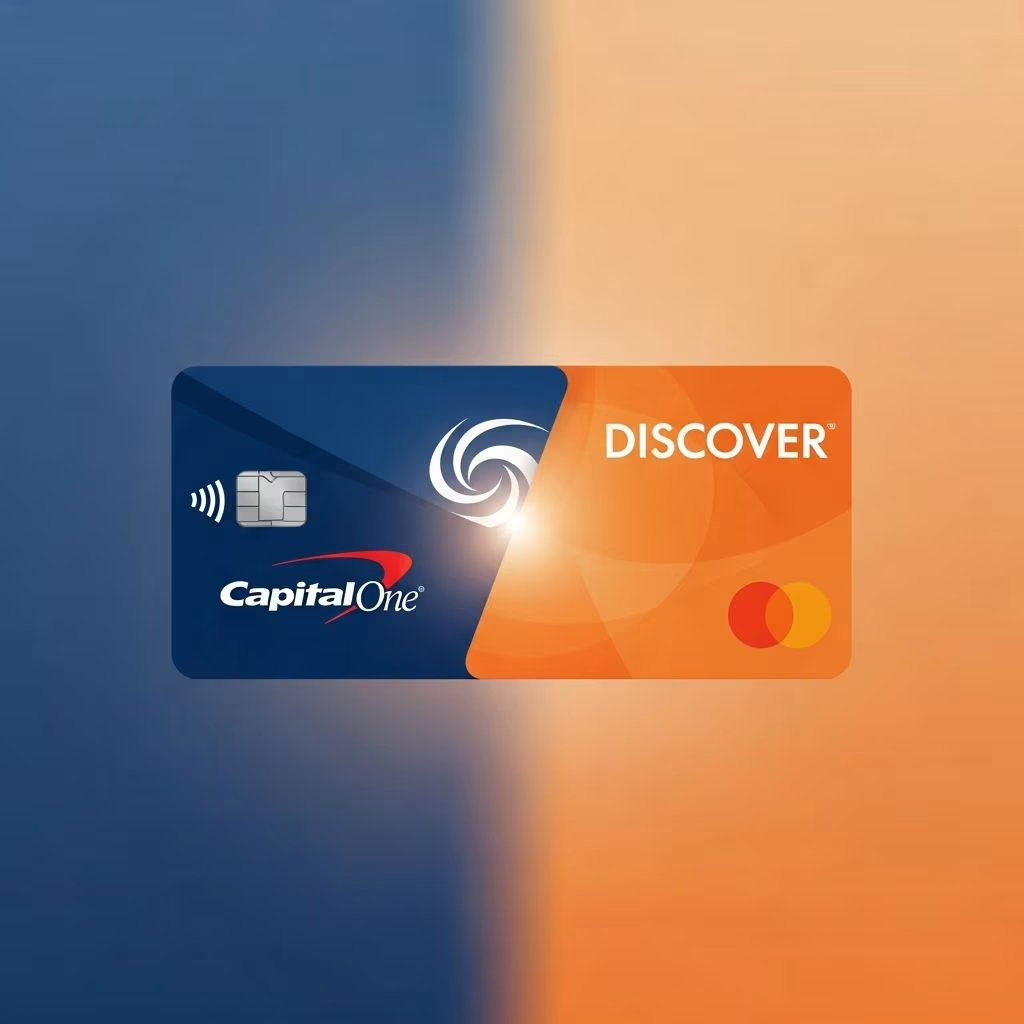
The merger between Capital One Financial Corporation and Discover Financial Services is one of the most significant banking and payments deals in recent U.S. history, combining a major card issuer and retail bank with a global payments network.
This article explains what happened, why it matters, and what you, as a consumer or small business owner, should watch for in the months and years ahead.
Overview of the Capital One–Discover Deal
Capital One agreed to acquire Discover Financial Services in an all-stock transaction valued in the tens of billions of dollars, making it one of the largest U.S. financial services mergers on record.
- Type of transaction: All-stock acquisition of Discover by Capital One
- Industry impact: Creates a banking and payments giant with a large credit card portfolio and a proprietary global card network
- Strategic goal: Build a scaled, technology-driven banking and payments platform able to compete more directly with Visa, Mastercard, American Express, and the largest U.S. banks
Capital One brings strength in consumer and small-business credit cards, deposits, and digital banking, while Discover contributes its card portfolio and a vertically integrated payments network that includes Discover Network, PULSE, and Diners Club International.
Why Capital One Wanted Discover
From Capital One’s perspective, the acquisition is a rare chance to pair its scale in card issuing and digital banking with a full-fledged, owned card network.
- Network ownership: By owning Discover’s global card network, Capital One can route more transactions over rails it controls, potentially lowering network fees and increasing margins over time.
- Competitive positioning: The merged company aims to challenge the dominance of Visa and Mastercard in transaction processing and compete more broadly with the largest U.S. banks.
- Technology and data: Capital One has heavily invested in cloud computing, artificial intelligence, and data analytics, and plans to apply these capabilities to Discover’s network and customer base.
- Customer reach: Discover’s network spans more than 70 million merchant locations in over 200 countries and territories, giving Capital One a broader global acceptance footprint.
Executives at Capital One have described the merger as a unique opportunity to blend two “mission-driven” companies with complementary strengths in digital banking and payments innovation.
Key Facts and Timeline
| Milestone | What Happened |
|---|---|
| Deal announcement | Capital One announced plans to acquire Discover in a large all-stock transaction, subject to shareholder and regulatory approvals. |
| Shareholder approvals | Shareholders of both Capital One and Discover voted to approve the combination after the announcement. |
| Regulatory review | The deal underwent scrutiny by the Federal Reserve and the Office of the Comptroller of the Currency (OCC), as well as state and competition authorities. |
| Key federal approvals | The Federal Reserve and OCC ultimately granted conditional approval, allowing the transaction to close. |
| State approval | The Delaware State Bank Commissioner also approved the acquisition as part of the process. |
| Deal completion | The acquisition formally closed after all required approvals were obtained and closing conditions satisfied. |
Following completion, Capital One expanded its board of directors to include several former Discover directors, signaling a plan to integrate expertise from both organizations.
How Big Is the Combined Company?
The combined Capital One–Discover entity becomes one of the most powerful players in U.S. consumer finance.
- Card issuer scale: The merged company ranks among the very largest credit card issuers in the United States by purchase volume and outstanding balances.
- Bank size: Capital One becomes one of the largest U.S. banks by assets, surpassing several major regional banks.
- Card network presence: Integrating Discover’s network could move it closer to American Express by volume and shift share away from Mastercard, depending on how aggressively Capital One migrates cards onto Discover rails.
| Area | Pre-Merger | Post-Merger Impact |
|---|---|---|
| Card issuing | Capital One and Discover each a top-10 U.S. issuer | Combined entity becomes a top-tier issuer by volume and the largest by some balance measures |
| Payments network | Discover operated its own network; Capital One mainly used Visa/Mastercard | Capital One can route more volume over the Discover network, altering card network competition |
| Banking footprint | Capital One operated as a large national bank; Discover focused on direct banking | Combined bank ranks among the largest in the U.S. by assets |
Regulatory Scrutiny and Conditions
Given the size and implications of the merger, regulators examined the deal closely, particularly its impact on competition and lower-income consumers.
- Federal Reserve and OCC review: The Board of Governors of the Federal Reserve System and the OCC evaluated safety and soundness, competition, consumer compliance, and financial stability implications before granting conditional approval.
- State and legal challenges: State regulators and some state attorneys general examined potential antitrust concerns, and private lawsuits questioned the merger’s effect on competition.
- Subprime credit card concerns: Consumer advocates raised alarms that the combined firm would control a large share of the subprime credit card market, possibly affecting pricing and access for vulnerable borrowers.
- Community commitments: Capital One committed to a multiyear community benefits plan, pledging hundreds of billions of dollars toward lending, investment, and community development if the deal went through.
Regulators ultimately allowed the deal to proceed, but imposed conditions focused on risk management, fair lending, and community impact, in line with their statutory responsibilities under federal banking law.
Impact on Credit Card Networks
One of the most important effects of the merger is on the competition among card networks.
- Shifting volume to Discover: Capital One has indicated that it will move at least some of its card portfolios from Visa and Mastercard onto the Discover network, potentially reducing its reliance on external networks.
- Pressure on Mastercard: Because Capital One historically processed a large share of its volume over Mastercard, any migration could particularly affect Mastercard’s transaction volume.
- Relative position of Visa: Visa may maintain or widen its lead as the largest network if most of Capital One’s conversions come from Mastercard-linked portfolios rather than Visa-linked ones.
- Discover’s new scale: If Capital One eventually routes most of its debit and credit card volume through Discover, the network could climb closer to American Express in the U.S. market by purchase volume.
For merchants, a larger Discover network backed by Capital One’s issuing scale could mean more negotiating leverage and a more complex landscape for interchange and network fees.
What It Means for Existing Customers
For now, most customers will likely see gradual, not immediate, changes. Integration of large financial institutions typically occurs over several years.
Discover Cardholders
- Brand continuity: Capital One has indicated it will continue to issue Discover-branded credit cards alongside its own card products, at least in the near to medium term.
- Rewards and benefits: Existing Discover rewards structures are expected to continue initially, though future card launches may combine Capital One’s and Discover’s strengths.
- Online and mobile banking: Over time, online interfaces and apps may be updated or consolidated, but regulators generally require clear disclosures and transition support.
Capital One Customers
- Network logo on cards: Some Capital One cards that currently run on Visa or Mastercard may be reissued or updated in the future to run on Discover’s network instead.
- New product options: Capital One may introduce new co-branded or network-specific cards that leverage Discover’s global acceptance and Capital One’s technology and rewards platforms.
- Branch and digital access: Capital One’s focus on digital banking and its Capital One Cafés is likely to continue, now paired with a larger customer base.
In both cases, customers can expect substantial notice of any changes to account terms, card networks, or rewards structures, and will typically have an option to close accounts or switch products if they do not wish to accept modified terms.
Community and Consumer Protection Commitments
As part of the merger process, Capital One made significant public commitments to community investment and consumer protection.
- Community Benefits Plan: Capital One announced a multi-year plan, developed alongside community groups, to provide extensive funding for lending, philanthropy, and community development in underserved areas if the deal closed.
- Board expansion: The company expanded its board to add former Discover directors, aiming to incorporate diverse perspectives and expertise from both organizations.
- Settlement of customer disputes: In conjunction with the transaction, Capital One agreed to settlements in certain consumer cases, reflecting ongoing scrutiny around interest rate and fee practices.
Federal regulators, including the Federal Reserve and OCC, evaluate such commitments when weighing whether a merger serves the public interest under the Bank Merger Act and related statutes.
Risks and Concerns Highlighted by Critics
Despite potential benefits, consumer advocates and some policymakers have pointed to several risks.
- Market concentration: Combining two major card issuers raises concerns that the merged firm could exercise greater pricing power in interest rates, annual fees, and penalty charges, particularly in subprime segments.
- Execution risk: Integrating large and complex technology systems, risk frameworks, and cultures can be challenging and may create operational risks or service disruptions if not managed carefully.
- Impact on smaller players: A stronger Capital One–Discover entity may intensify competitive pressure on regional banks, credit unions, and smaller fintech firms, potentially accelerating further consolidation in the sector.
Rating agencies and analysts have generally recognized the strategic logic of the deal while emphasizing the importance of disciplined integration and risk management.
What Consumers Should Do Now
Most cardholders and depositors do not need to take immediate action, but staying informed can help you respond to future changes.
- Monitor official communications: Watch for letters, emails, and secure messages from Capital One or Discover describing any changes to account terms, interest rates, networks, or rewards.
- Review new terms carefully: If your card is moved to a different network or if pricing changes, compare the new terms with alternatives available from other issuers.
- Check automatic payments: If your card number or network changes, verify that recurring payments and digital wallet setups are updated.
- Reassess rewards strategy: As product lineups evolve, you may find better combinations of cards for your spending patterns and travel needs.
Frequently Asked Questions (FAQs)
Q: Will my existing Capital One or Discover card stop working?
A: No immediate disruption is expected. Over time, some cards may be reissued or migrated to different networks, but issuers typically provide advance notice and a transition period so you can continue to use your accounts with minimal interruption.
Q: Could this merger raise my interest rates or fees?
A: The merger itself does not automatically change your pricing, but the combined company may adjust product offerings and pricing over time. Any changes must be disclosed to you under federal consumer protection laws, and you can compare alternatives if you are unhappy with revised terms.
Q: Will Capital One only issue Discover-network cards now?
A: Capital One has strong incentives to route more business over the Discover network it now owns, but it may continue to use Visa and Mastercard for some products, especially where partners, co-brands, or global acceptance strategies call for multiple networks.
Q: Is my money safe in a Capital One or Discover deposit account after the merger?
A: Deposits at Capital One and Discover Bank remain insured by the Federal Deposit Insurance Corporation (FDIC) up to applicable limits, and the merger does not change federal deposit insurance coverage rules.
Q: How will this deal affect competition in the credit card market?
A: The combined firm becomes one of the largest U.S. card issuers and controls its own network, which may increase competitive pressure on some rivals while raising concerns about concentration in certain market segments, especially subprime credit cards.
References
- Discover Completes $50.6 Billion Merger with Capital One — Sullivan & Cromwell LLP. 2025-05-19. https://www.sullcrom.com/About/Rankings/2024/February/Discover-Agrees-to-35-3-Billion-Merger-with-Capital-One
- How Capital One and Discover Forged US$33.5bn Merger — FinTech Magazine. 2024-10-01. https://fintechmagazine.com/articles/how-capital-one-and-discover-forged-us-33-5bn-merger
- $35B Capital One-Discover merger closes — Virginia Business. 2025-05-20. $35B Capital One-Discover merger closes
- Capital One and Discover merger gains approval in jawdropping deal — eMarketer / Insider Intelligence. 2025-05-19. https://www.emarketer.com/content/capital-one-discover-merger-gains-approval
- Capital One Completes Acquisition of Discover Financial Services — FinTech Weekly. 2025-05-21. https://www.fintechweekly.com/magazine/articles/capital-one-acquisition-discover-financial-services
- Capital One’s Discover Acquisition: A Payments Industry Game Changer? — CMSPI. 2024-03-07. https://cmspi.com/capital-ones-discover-acquisition-a-payments-industry-game-changer/
This article is general information, not personal financial advice. Consider your own situation, or speak with a licensed adviser, before acting on it.


