

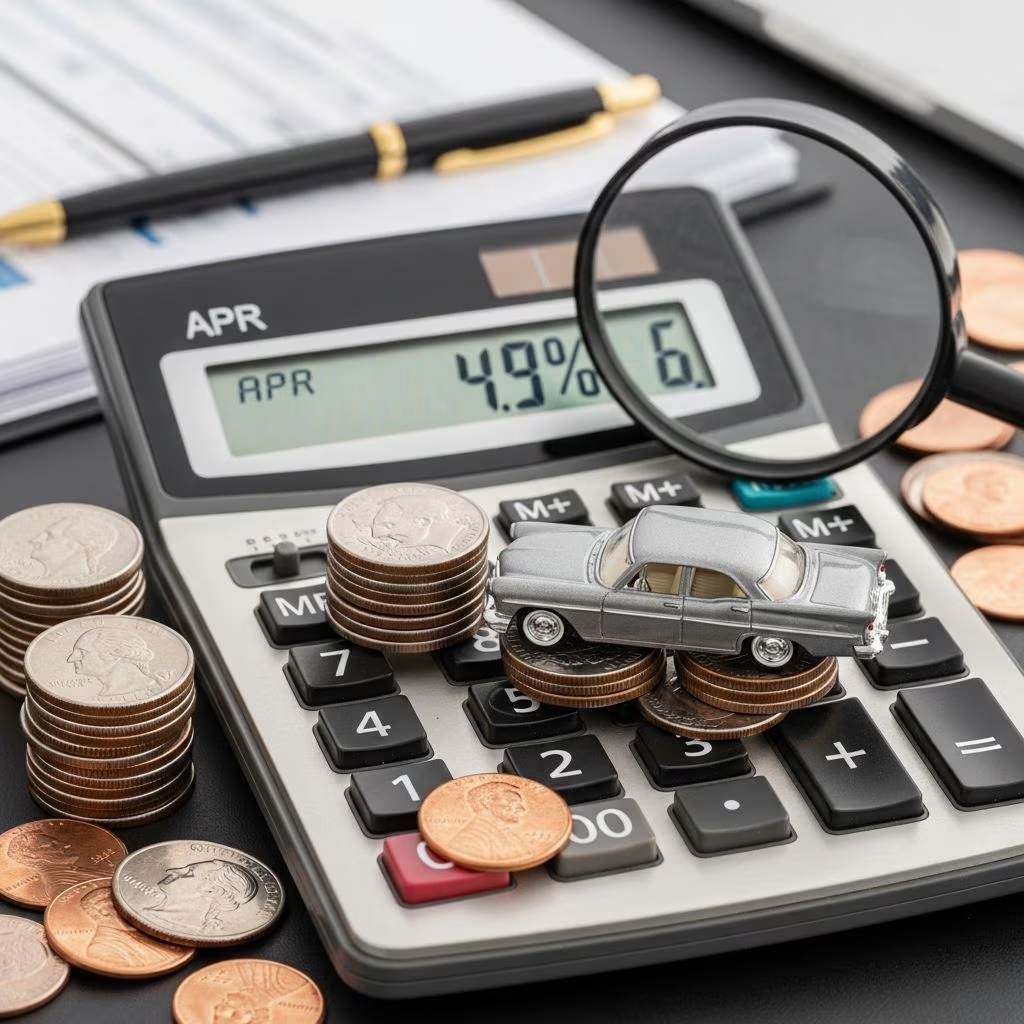
The Annual Percentage Rate (APR) on a car loan represents the true yearly cost of borrowing, encompassing not just the interest charged on the loan principal but also various associated fees. This metric provides a standardized way to evaluate and compare financing options across lenders.
Core Components of Car Loan APR
At its foundation, APR builds on the interest rate—the percentage lenders apply to the borrowed amount—but expands to include additional expenses like origination fees, documentation charges, and prepaid interest. For instance, while a base interest rate might be quoted at 4%, the full APR could rise to 4.5% or higher after factoring in these extras, giving a more accurate picture of total repayment obligations.
Under federal regulations like the Truth in Lending Act, lenders must disclose both the interest rate and APR prominently, ensuring borrowers receive transparent cost information before signing.
Interest Rate vs. APR: Key Distinctions
Many confuse interest rate with APR, but they serve different purposes. The interest rate solely measures the cost of the loaned principal, excluding fees. APR, conversely, aggregates all borrowing costs annualized for apples-to-apples comparisons.
| Aspect | Interest Rate | APR |
|---|---|---|
| Definition | Cost of principal only | Total cost including fees |
| Includes Fees? | No | Yes (origination, docs, etc.) |
| Best For | Basic borrowing cost | Loan comparisons |
| Typical Value | Lower than APR | Higher, more comprehensive |
This table highlights why focusing solely on advertised interest rates can mislead; always prioritize APR for realistic budgeting.
How Lenders Calculate Your Car Loan APR
APR computation integrates the interest rate, upfront fees, loan term length, and repayment structure into a single annual figure. Lenders assess borrower-specific factors: credit history, down payment size, vehicle type (new vs. used), and debt-to-income ratio. A strong credit profile often yields lower rates, while longer terms might elevate APR despite smaller monthly payments.
Online calculators from reputable lenders can estimate personalized APRs by inputting loan amount, term, and estimated credit details, aiding pre-approval planning.
Factors That Drive Car Loan APR Up or Down
- Credit Score: Prime scores (750+) secure rates around 3% for new cars; subprime (below 500) can exceed 15-20%.
- Loan Term: Shorter durations (36-48 months) typically offer lower APRs but higher monthly outlays; extending to 72 months reduces payments yet increases total interest.
- Vehicle Type: New vehicles qualify for better rates than used ones due to lower risk.
- Down Payment: Larger initial payments (20%+) signal lower lender risk, often trimming APR.
- Market Conditions: Fixed APRs lock in rates; variable ones fluctuate with economic shifts, potentially rising.
Average Car Loan APRs by Credit Tier
Benchmarks help gauge expectations. For new cars, excellent credit (750-850) averages 2.96%, good (700-749) at 4.03%, fair (650-699) 6.75%, and poor (450-649) 12.84%. Used car rates trend higher: 3.68%, 5.53%, 10.33%, and 20.43% respectively.
In Q1 2024 data, super-prime borrowers paid 5.38% on new autos and 6% on used, versus 15.62% and 21.57% for deep subprime.
| Credit Tier | New Car APR | Used Car APR |
|---|---|---|
| Excellent (750+) | 2.96% | 3.68% |
| Good (700-749) | 4.03% | 5.53% |
| Fair (650-699) | 6.75% | 10.33% |
| Poor (450-649) | 12.84% | 20.43% |
These figures underscore credit’s pivotal role; improving your score pre-purchase can save thousands.
Real-World Impact: APR’s Effect on Total Costs
A $25,000 loan over 48 months at 3% APR yields lower monthly payments and less interest than at 2% wait—no, lower APR saves money. Precisely: dropping from 3% to 2% APR saves about $11 monthly and more overall. Extending terms from 48 to 60 months at 3% cuts payments by $104 but adds $392 in interest.
For a $30,000 loan with $7,500 annual interest plus $300 fees over 72 months, APR approximates 4.33%. Poor credit at 23.81% APR on similar terms balloons interest to $20,721, versus under $6,000 at prime rates—highlighting potential $15,000+ savings.
Fixed vs. Variable APR: Weighing Stability Against Risk
Fixed APRs maintain consistency, ideal for budgeting amid rate hikes. Variable APRs start lower but adjust with benchmarks like prime rate, risking payment spikes. Most auto loans favor fixed for predictability.
Proven Strategies to Secure Lower Car Loan APR
- Boost Credit Score: Pay down debts, correct errors; aim for 700+.
- Shop Multiple Lenders: Compare banks like PNC (2.79-14.99%), Capital One (3.99-13.98%), PenFed (1.99-18%).
- Increase Down Payment: 10-20% reduces principal and perceived risk.
- Opt for Shorter Terms: Balances affordability with lower total cost.
- Pre-Qualify: Soft inquiries reveal rates without credit dings.
- Buy Newer Vehicles: Lower risk translates to better APRs.
Common Pitfalls in Evaluating Car Loan APR
Avoid zero-percent deals masking fees that inflate effective APR. Ignore unverified online averages without context—your profile dictates terms. Always verify disclosures for included fees.
Frequently Asked Questions (FAQs)
What exactly is included in car loan APR?
APR covers interest plus fees like origination, documentation, and prepaid interest, annualized for comparison.
Why is my APR higher than the interest rate?
Fees add to the base rate, making APR the fuller cost metric.
Does a longer loan term lower APR?
No, it often raises APR slightly while easing monthly payments but hiking total interest.
Can I negotiate car loan APR?
Yes, leverage competing offers and strong credit to bargain.
How does credit score affect APR?
Higher scores unlock sub-4% rates; lower ones push into double digits.
Tools and Resources for APR Optimization
Use lender calculators for simulations. Track averages via reports from Experian or CARFAX for benchmarks. Pre-approvals from credit unions often beat dealer financing.
Understanding APR empowers informed decisions, turning car buying from gamble to calculated investment. Prioritize it over flashy promotions for lasting savings.
References
- Understanding APR vs. interest rate for auto loans — Santander Consumer USA. 2024. https://santanderconsumerusa.com/blog/apr-vs-interest-rate-auto-loan
- What is car finance APR? Annual Percentage Rate explained — Cinch. 2024. https://www.cinch.co.uk/guides/car-finance/what-is-apr-on-car-finance
- What is APR on a Car Loan? — PNC Insights. 2024. https://www.pnc.com/insights/personal-finance/borrow/what-is-apr-on-a-car.html
- APR for a Car Loan | Fees & Averages Explained — Mazda USA. 2024. https://www.mazdausa.com/resource-center/apr-car-loan
- How Do Car Loans Work? — Bank of America. 2024. https://www.bankofamerica.com/auto-loans/how-car-loans-work/
- What Is the Average APR for a Car Loan? — Car and Driver. 2024. https://www.caranddriver.com/auto-loans/a31280000/average-apr-for-car-loan/
This article is general information, not personal financial advice. Consider your own situation, or speak with a licensed adviser, before acting on it.


