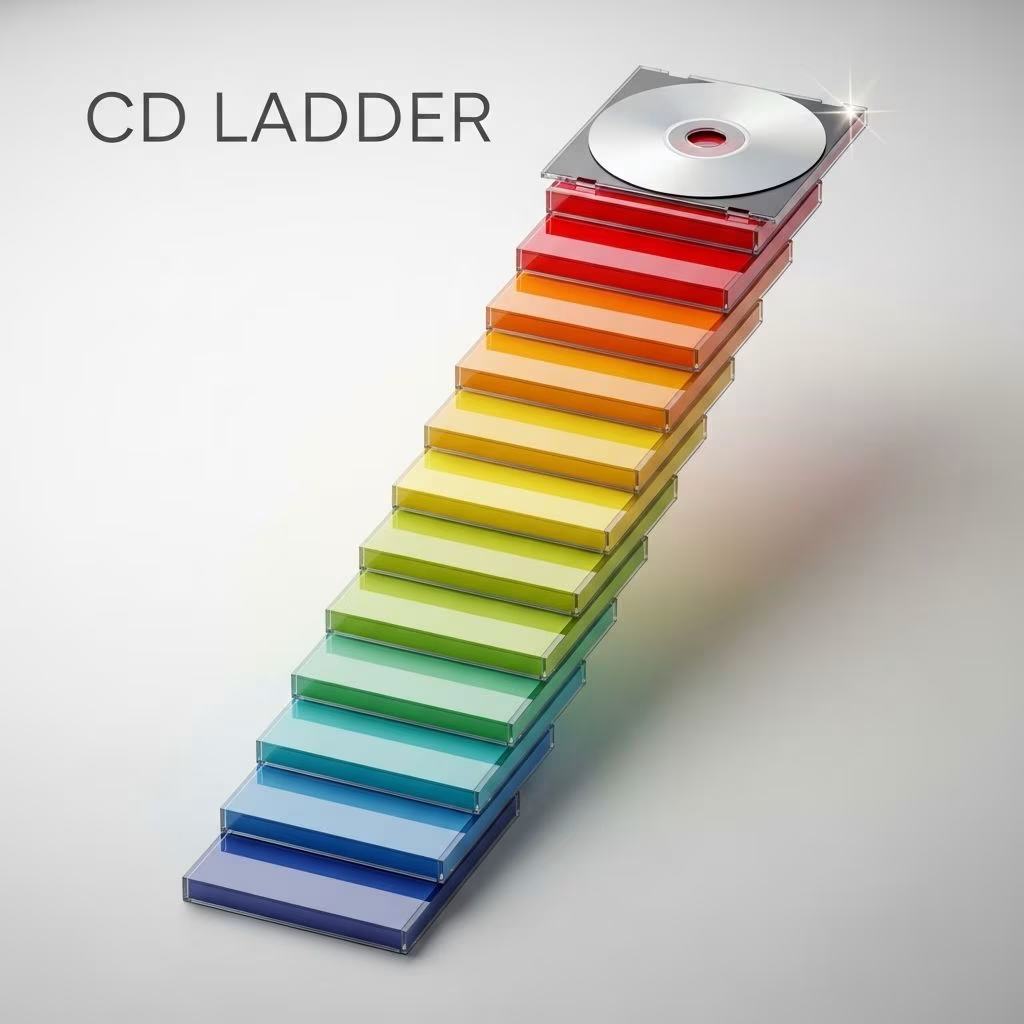
Certificates of deposit (CDs) provide a secure way to grow savings with fixed interest rates, and a CD ladder enhances this by distributing investments across multiple terms for better liquidity and yield potential. This approach allows savers to access portions of their money regularly without sacrificing the benefits of longer-term rates.
Understanding the Fundamentals of CD Laddering
A CD ladder involves dividing a total investment amount into several CDs, each with a different maturity period, creating “rungs” that mature sequentially. This structure ensures that not all funds are locked away simultaneously, offering periodic access while capturing competitive rates across the yield curve.
Unlike a single long-term CD, which might offer higher rates but limits liquidity, laddering mitigates risks from interest rate fluctuations. When rates rise, shorter-term CDs mature sooner, allowing reinvestment at better yields; when rates fall, longer-term CDs retain higher locked-in rates.
Key Benefits Driving the Popularity of CD Ladders
- Higher Potential Yields: Longer-term CDs often pay more than short-term ones or savings accounts, and laddering averages these for improved overall returns.
- Enhanced Liquidity: Staggered maturities mean funds become available at set intervals, ideal for planned expenses or emergencies.
- FDIC Protection: CDs from insured institutions safeguard principal up to $250,000 per depositor per bank, with diversification across issuers extending coverage.
- Rate Risk Mitigation: By spreading terms, investors hedge against changes in interest rates, maintaining a balanced portfolio.
- Steady Cash Flow: Maturing CDs provide regular income streams, supporting financial planning.
Step-by-Step Guide to Constructing Your CD Ladder
Building a ladder starts with assessing your total investable amount, goals, and risk tolerance. Here’s a practical process:
- Determine Investment Size: Choose an amount you can commit without needing immediate access, such as $10,000 or more. Minimums vary by institution, often $1,000 per CD.
- Select Ladder Length: Common options are 1-year (short-term), 3-year, or 5-year ladders, based on your timeline.
- Divide Funds Evenly: Split equally across rungs. For a 5-year ladder with $10,000, allocate $2,000 per CD maturing in 1, 2, 3, 4, and 5 years.
- Shop for Rates: Compare brokered or direct CDs from banks and credit unions for the best yields on each term.
- Purchase CDs: Open accounts with staggered maturities. Use brokerage platforms for one-stop shopping across issuers.
- Plan Reinvestments: Decide on auto-roll into longest-term CDs or cash out as needs arise.
Comparing Ladder Strategies for Different Goals
Different ladder designs suit varying objectives. The table below outlines popular configurations:
| Strategy | Terms (Years) | Ideal For | Pros | Cons |
|---|---|---|---|---|
| Short-Term Ladder | 3 months to 2 years | Near-term goals like down payments | High liquidity, captures rising rates | Lower average yields |
| Standard 5-Year Ladder | 1 to 5 years | Medium-term savings | Balanced yield and access | Funds partially locked longer |
| Long-Term Ladder | 1 to 10 years | Retirement or legacy planning | Highest potential returns | Reduced short-term liquidity |
Short-term ladders prioritize flexibility, while longer ones maximize earnings.
Real-World Example: A $15,000 5-Year Ladder
Suppose current rates are: 1-year at 4.5%, 2-year at 4.7%, 3-year at 4.8%, 4-year at 4.9%, 5-year at 5.0% (hypothetical as of 2026 market conditions). Invest $3,000 in each:
- Year 1: $3,000 1-year CD matures, yielding ~$135 interest; reinvest in new 5-year CD.
- Year 2: Original 2-year CD matures (~$282 interest); roll over.
- And so on, creating continuous renewal.
Over five years, this could generate substantially more than a single savings account, with annual access to 20% of principal.
Navigating Risks and Limitations
While low-risk, CD ladders aren’t flawless. Early withdrawal penalties can erode gains, so avoid them by planning maturities around needs. Inflation may outpace returns if rates are low. Opportunity cost exists versus stocks, but suits conservative savers. Diversify issuers for full FDIC coverage beyond $250,000.
Tools and Platforms to Simplify Setup
Brokerages like Fidelity offer model ladders in $4,000-$5,000 increments with auto-roll options. Vanguard provides educational resources and easy construction. Credit unions like SCCU emphasize reinvestment strategies. Online marketplaces aggregate competitive rates.
Frequently Asked Questions (FAQs)
What is the minimum amount needed for a CD ladder?
Typically $5,000-$10,000 total, depending on rung minimums, but scalable.
Are CD ladders FDIC insured?
Yes, up to $250,000 per depositor per institution; spread across banks for more.
Should I ladder if rates are falling?
Yes, longer rungs lock in current highs.
Can I build a ladder with brokered CDs?
Absolutely, they offer secondary market liquidity but watch for fees.
How often should I reinvest maturing CDs?
Annually or at maturity to maintain the ladder structure.
Advanced Tips for Maximizing Returns
Monitor rate environments: In rising markets, favor shorter rungs; in declining, extend terms. Consider tax-advantaged accounts like IRAs for ladders. Hybrid ladders mix CDs with Treasuries for tax-free options. Review annually, adjusting for life changes.
For 2026, with potential rate normalization post-2025 peaks, laddering preserves gains while positioning for adjustments. Pair with high-yield savings for ultimate liquidity.
References
- What is a CD ladder? – Vanguard — Vanguard. 2023. https://investor.vanguard.com/investor-resources-education/article/cd-ladder
- Model CD Ladders – Fidelity Investments — Fidelity. 2023. https://www.fidelity.com/fixed-income-bonds/cd-ladders
- How CD Laddering Works and Benefits of this Savings Strategy — State Employees’ Credit Union. 2023. https://www.sccu.com/articles/personal-finance/how-cd-laddering-works-saving-benefits
- Why a CD Ladder is a Smart Move for Your Financial Portfolio — Leading Edge Credit Union. 2023. https://leadingedgecu.org/why-a-cd-ladder-is-a-smart-move-for-your-financial-portfolio/
- CD Ladder Explained: 3 Strategies To Increase Your Savings — YouTube (Video). 2023. https://www.youtube.com/watch?v=L48xiw3d6H8
- What Is a CD Ladder? – Citizens Bank — Citizens Bank. 2023. https://www.citizensbank.com/learning/whats-a-cd-ladder.aspx
This article is general information, not personal financial advice. Consider your own situation, or speak with a licensed adviser, before acting on it.