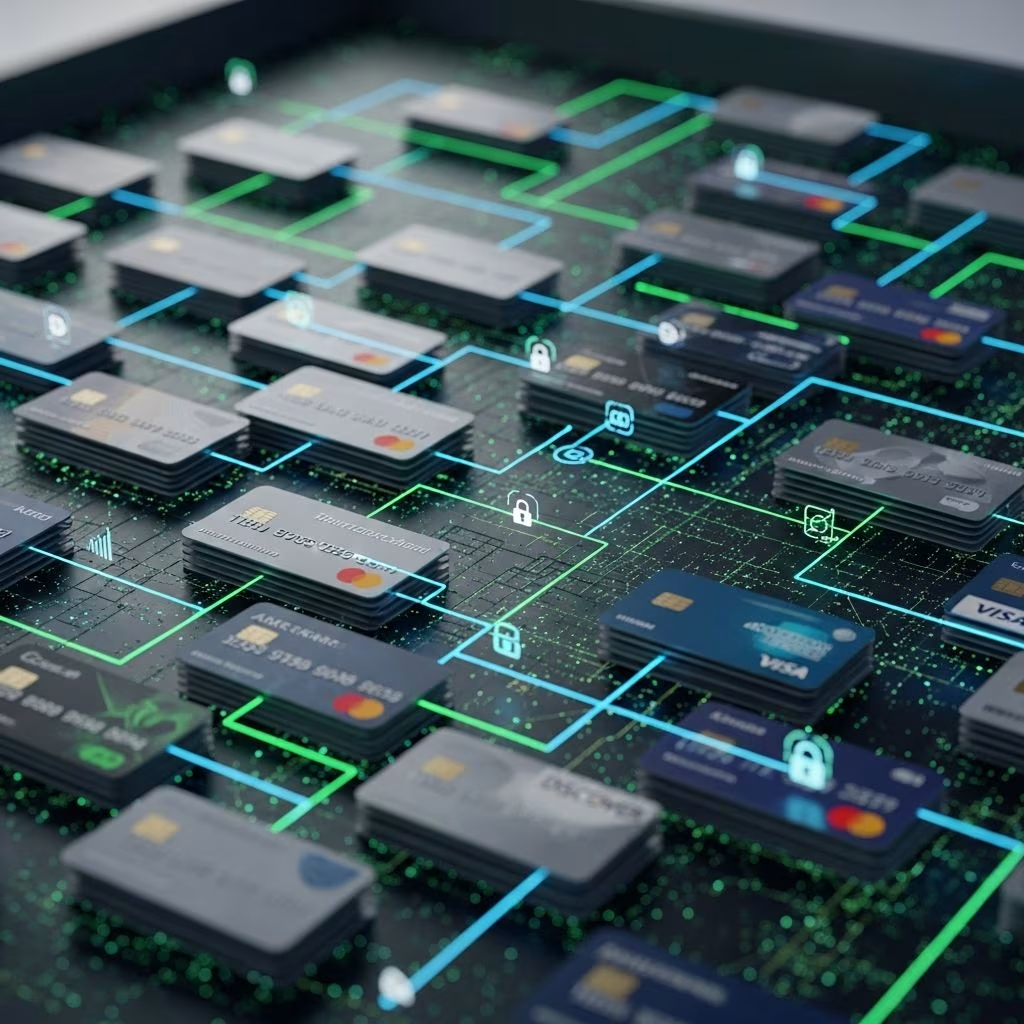
Credit card networks form the invisible backbone of everyday purchases, enabling seamless transactions between consumers, merchants, and banks worldwide. These systems authorize payments, route funds, and enforce security protocols, with major players like Visa, Mastercard, American Express, and Discover dominating the landscape.
The Fundamental Role of Payment Networks
At their core, credit card networks act as intermediaries in the payment ecosystem. They connect the cardholder’s issuing bank with the merchant’s acquiring bank, ensuring that funds move efficiently while verifying transaction legitimacy. Unlike issuers, which determine interest rates and rewards, networks focus on infrastructure, rules, and fee structures.
For consumers, the network logo on a card signals where it can be used. Businesses rely on these networks for broad acceptance, as not all merchants support every system. Globally, these networks process trillions in volume annually, underscoring their economic significance.
Distinguishing Open and Closed Network Models
Credit card networks fall into two primary categories: open and closed, differentiated by their issuing structures and operational models.
Open Networks: Collaborative Ecosystems
Open networks, often termed four-party systems, partner with numerous financial institutions to issue cards. This model fosters widespread availability, as banks like Chase or Wells Fargo can brand their products with the network’s logo.
- Visa: The largest by transaction volume, accepted in over 200 countries with billions of cards in circulation.
- Mastercard: Similar global reach, emphasizing innovation in contactless and digital payments.
These networks do not issue cards themselves but provide the rails for processing, leading to higher acceptance rates internationally.
Closed Networks: Integrated Operations
Closed networks, or three-party systems, handle issuing, acquiring, and processing internally, streamlining operations but limiting partnerships.
- American Express: Issues its own cards, known for premium rewards and higher merchant fees, with strong presence in North America.
- Discover: Operates similarly, offering cashback perks; occasionally partners with select issuers like Credit One.
Store cards, such as those from retailers, often mimic closed models with restricted use. Closed systems may yield higher per-transaction spends but face narrower acceptance.
| Feature | Open Networks (e.g., Visa, Mastercard) | Closed Networks (e.g., Amex, Discover) |
|---|---|---|
| Issuing Model | Multiple banks issue cards | Network issues cards directly |
| Parties Involved | Four: Cardholder, Issuer, Acquirer, Merchant | Three: Cardholder, Network, Merchant |
| Global Acceptance | Very high | Moderate, stronger domestically |
| Merchant Fees | Typically lower | Often higher |
Step-by-Step: How Transactions Flow Through Networks
A typical credit card purchase involves several stages, orchestrated by the network.
- Initiation: Customer presents card via swipe, chip, tap, or online entry at the merchant’s terminal.
- Authorization Request: Merchant’s processor sends details to the network, which queries the issuer for approval based on funds, limits, and fraud checks.
- Approval/Decline: Issuer responds via network; if approved, a hold is placed on funds.
- Settlement: Network batches transactions, transferring funds from issuer to acquirer, minus fees, usually within 1-3 days.
Processing methods influence fees: contactless (NFC) or EMV chips often cost less than magstripe or card-not-present (CNP) transactions.
Fees and Economics: Who Pays What?
Networks set interchange fees—percentages paid by merchants to cover processing, typically 1.5%-3.5% per transaction. These fund rewards programs indirectly, as issuers pass savings to consumers.
- Open networks: Fees shared among issuer, network, and acquirer.
- Closed networks: Retain more, enabling richer rewards but higher merchant costs.
Merchants choose supported networks via processors like Stripe, balancing acceptance with expenses.
Security Protocols in Modern Networks
Networks enforce PCI DSS standards, tokenization, and real-time fraud detection to safeguard data. EMV chips reduce counterfeiting, while 3D Secure adds online authentication layers.
Tokenization replaces card numbers with unique identifiers, minimizing breach risks during CNP transactions. Global adoption has curbed fraud significantly.
Regional Players and Emerging Trends
Beyond the U.S. “big four,” networks like UnionPay (China-dominant) and JCB (Japan-focused) hold sway regionally. Trends include digital wallets (Apple Pay routes via networks), buy-now-pay-later integrations, and blockchain pilots for faster settlements.
Consumer Impacts: Choosing the Right Network
Network choice affects usability: Visa/Mastercard excel for travel; Amex for premium perks. Credit scores remain issuer-driven, but network acceptance influences spending freedom.
- Check logos at merchants or apps for compatibility.
- Opt for cards with versatile networks for maximum utility.
Business Perspectives: Optimizing Network Use
Merchants weigh fees against customer preferences. Supporting all majors boosts sales; tools like Stripe enable this seamlessly. Analytics from networks help detect patterns and reduce chargebacks.
Frequently Asked Questions
What determines my card’s network?
Your issuing bank selects it based on partnerships; check the card’s logos.
Do networks affect my APR or rewards?
No, those are issuer decisions.
Why do some stores reject certain networks?
High fees or low volume; closed networks often face this.
Are debit cards part of these networks?
Yes, many use the same infrastructure for credit/debit.
How do international transactions work?
Open networks convert currencies dynamically via set rates.
Future Horizons for Card Networks
Expect deeper AI fraud prevention, central bank digital currency interoperability, and expanded contactless adoption. Competition drives lower fees and innovation, benefiting all parties.
References
- Credit card networks explained — Stripe. 2023. https://stripe.com/resources/more/how-do-credit-card-networks-work
- Card Networks: An Explainer — Nuvei. 2023. https://www.nuvei.com/posts/card-networks-an-explainer
- What Is a Credit Card Network? — Experian. 2023-10-01. https://www.experian.com/blogs/ask-experian/what-is-credit-card-network/
- Mastering card networks: Everything you need to know — Primer.io. 2023. https://primer.io/blog/what-are-card-networks-and-how-do-they-work
- Understanding Card Processing Networks for Beginners — Spreedly. 2023. https://www.spreedly.com/blog/card-processing-network
- How do credit card networks work? Here’s what you need to know — Airwallex. 2023. https://www.airwallex.com/us/blog/credit-card-networks
This article is general information, not personal financial advice. Consider your own situation, or speak with a licensed adviser, before acting on it.