

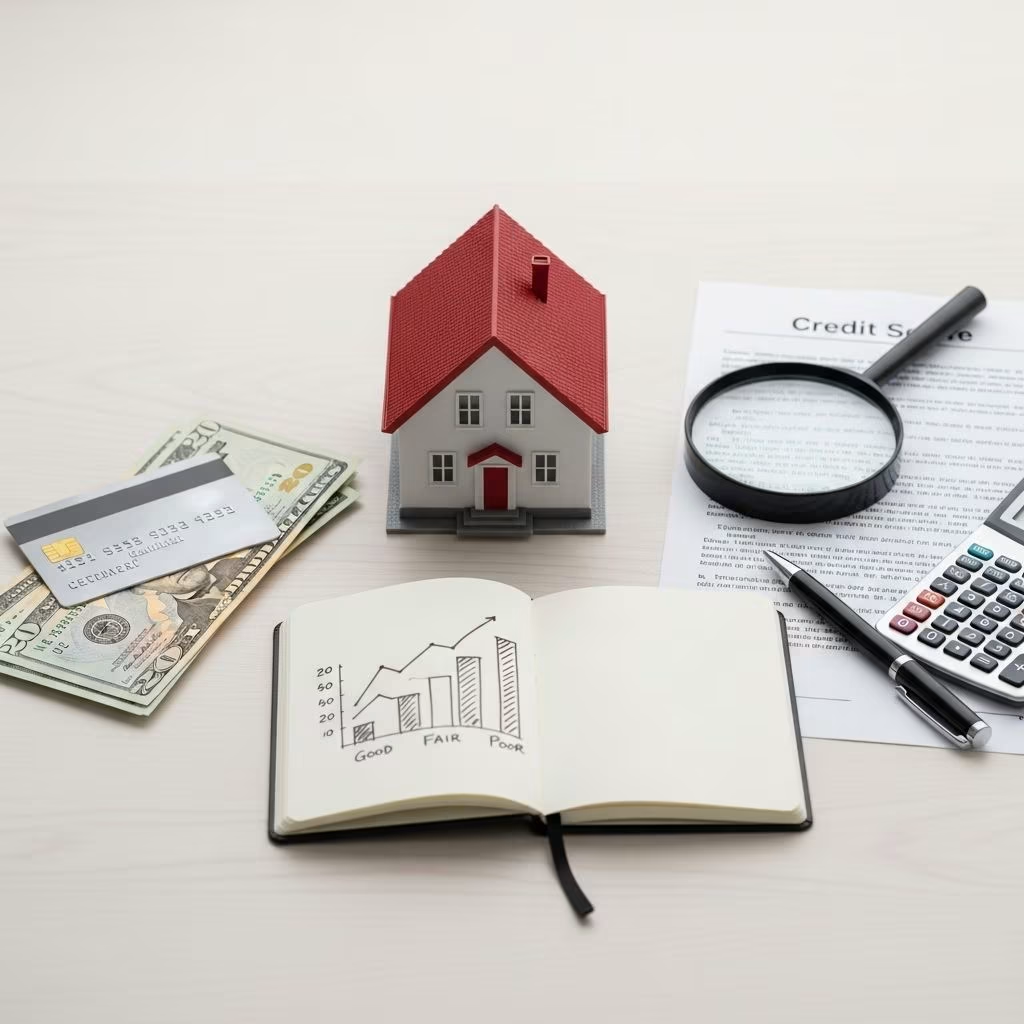
Purchasing a home represents one of the largest financial commitments most people undertake, and your credit score plays a pivotal role in determining eligibility for a mortgage. Lenders use this three-digit number, typically ranging from 300 to 850, to assess your likelihood of repaying the loan. While requirements differ by loan type, a score of at least 620 opens doors to most conventional options, with government-backed programs offering flexibility for lower scores.
Understanding Credit Scores in Mortgage Lending
Credit scores are calculated by major bureaus like Experian, Equifax, and TransUnion using models such as FICO or VantageScore. For mortgages, lenders often pull tri-merge reports from all three bureaus and use the middle or lower-middle score for underwriting. Factors influencing your score include payment history (35%), amounts owed (30%), length of credit history (15%), new credit (10%), and credit mix (10%).
Aim for scores above 740 for the best interest rates and terms, as higher scores signal lower risk. Recent changes, such as Fannie Mae and Freddie Mac eliminating strict minimums for conforming conventional loans as of November 2025, mean approval hinges more on overall credit risk, though lenders frequently set their own floors around 620.
Minimum Credit Scores by Mortgage Type
Different loan programs cater to varied borrower profiles. Here’s a breakdown of typical minimums:
| Loan Type | Minimum Credit Score | Key Notes |
|---|---|---|
| Conventional | 620 | Conforms to Fannie Mae/Freddie Mac standards; jumbo loans often 700+. |
| FHA | 580 (3.5% down) 500 (10% down) | Government-insured; ideal for first-time buyers. |
| VA | 620 (lender typical) | No VA-set minimum; for veterans and eligible spouses. |
| USDA | 580 (lender typical) | For rural properties; no official minimum. |
| Jumbo | 700 | For loans exceeding conforming limits. |
These thresholds can vary by lender. For instance, some require 660+ for conventional loans under manual underwriting.
Factors Beyond Credit Score That Lenders Evaluate
While credit score is crucial, it’s part of a holistic review. Debt-to-income (DTI) ratio should ideally stay below 43%, with back-end DTI under 36% for best rates. Down payment size matters: 20% avoids private mortgage insurance (PMI). Employment stability, cash reserves, and property type also factor in. First-time buyers may receive leniency on credit history length.
- DTI Ratio: Total monthly debts divided by income; max 45-50% for some programs.
- Reserves: Lenders like 2-6 months of payments in savings post-closing.
- Loan-to-Value (LTV): Lower LTV (higher down payment) reduces risk.
Improving Your Credit Score Before Applying
Building credit takes time but yields significant rewards. Start 6-12 months ahead:
- Check Reports: Get free weekly reports from AnnualCreditReport.com; dispute errors promptly.
- Pay Down Debt: Reduce utilization below 30%; pay cards in full monthly.
- On-Time Payments: Set autopay; even one late payment drops scores 100+ points.
- Avoid New Credit: Inquiries can ding scores 5-10 points each.
- Build History: Use secured cards or credit-builder loans if thin file.
Recent positive changes appear faster on VantageScore (30 days) vs. FICO (up to 2 months). Tools like Experian Boost add utility/telecom payments to your file.
Options for Buyers with Lower Credit Scores
If your score falls below 620, government programs provide pathways:
- FHA Loans: Accessible with 500+, though PMI is lifelong unless refinanced.
- VA/USDA: No set mins, but lender overlays apply; zero-down possible.
- Non-QM Loans: For self-employed or unique situations, but higher rates.
- Co-Signers: Boosts via higher-score partner, but shared liability.
Manual underwriting for HomeReady/HomePossible allows flexibility with 25%+ down.
Impact of Credit Score on Mortgage Terms
Higher scores unlock better deals. On a $300,000 30-year loan:
| FICO Score | Rate (approx.) | Monthly Payment | Total Interest Saved |
|---|---|---|---|
| 760+ | 6.0% | $1,799 | Baseline |
| 700-759 | 6.25% | $1,845 | $16,800 less savings |
| 680-699 | 6.5% | $1,896 | $29,400 less savings |
| 620-639 | 7.0% | $1,996 | $57,600 less savings |
Over 30 years, a 140-point score gap could cost $57,000+ extra. Shop multiple lenders for personalized quotes.
First-Time Buyer Considerations
First-timers often qualify via FHA or state programs with scores as low as 580. Programs like Fannie Mae’s HomeReady require 620 but offer 3% down. Build credit early; average first-time buyer score is 700+ for optimal terms. Pre-approval strengthens offers.
Common Myths About Credit Scores and Mortgages
- Myth: Higher home price needs higher score. Fact: Thresholds are uniform; affordability factors in.
- Myth: No score means no loan. Fact: New rules allow non-traditional credit evaluation.
- Myth: Renters can’t build scores. Fact: Services now report rent payments.
Frequently Asked Questions
Can I buy a house with a 580 credit score?
Yes, via FHA with 3.5% down or 10% for 500+. Co-borrowers help for conventional.
What’s the average credit score for homebuyers?
Around 745 in recent years, per industry data.
How long after bankruptcy can I get a mortgage?
2-4 years for FHA/VA; 4-7 for conventional.
Does checking my score hurt it?
Soft pulls don’t; hard pulls do temporarily.
Can I improve my score in 30 days?
Yes, by paying down debt and disputing errors.
Steps to Take Before Mortgage Shopping
1. Pull and review credit reports.
2. Calculate DTI and budget.
3. Save for down payment/closing costs (2-5%).
4. Get pre-approved.
5. Compare lenders and rates.
Strong credit positions you for success in competitive markets. Consult a loan officer for tailored advice.
References
- What Credit Score Do I Need to Buy a House? — Experian. 2025. https://www.experian.com/blogs/ask-experian/what-credit-score-do-i-need-to-buy-a-house/
- What Credit Score Is Needed To Buy a House? — Freedom Mortgage. 2025. https://www.freedommortgage.com/learning-center/articles/credit-score-buy-house
- What credit score do you need to buy a house? — Ally Bank. 2025. https://www.ally.com/stories/home/what-credit-score-do-i-need-to-buy-a-house/
- What credit score do you need to buy a house? — Rocket Mortgage. 2025-11-16. https://www.rocketmortgage.com/learn/what-credit-score-is-needed-to-buy-a-house
- Minimum Mortgage Requirements for 2026 — LendingTree. 2026. https://www.lendingtree.com/home/mortgage/minimum-mortgage-requirements/
- What’s the Minimum Credit Score to Buy a Home? — Chase. 2025. https://www.chase.com/personal/mortgage/education/buying-a-home/what-credit-score-is-needed-to-buy-a-house
This article is general information, not personal financial advice. Consider your own situation, or speak with a licensed adviser, before acting on it.


